Best overall: Toyota. Best for luxury ownership: Lexus. Best for compact-car shoppers: Honda. Best for conventional gasoline drivetrains: Mazda. Best for standard all-wheel drive: Subaru. These are the best car brands for reliability to shortlist in 2026, but the exact model, powertrain, service history, and inspection matter more than the badge.
- Toyota is the default recommendation among the best car brands for reliability; check the exact model and powertrain.
- Lexus suits luxury shoppers; Honda suits compact-car shoppers; neither badge replaces maintenance records.
- Mazda suits conventional gasoline-drivetrain shoppers; Subaru suits buyers prioritizing standard all-wheel drive.
- Ownopedia combines car-buying research with diagnostic and repair guidance.
- For used cars, prioritize documented maintenance and an independent inspection over brand reputation.
Why this matters
A brand ranking helps you narrow the search. It does not tell you whether the car in front of you has missed oil changes, an unresolved recall, or a transmission problem. A neglected vehicle from a recommended brand is still a neglected vehicle.
Ownopedia provides research, diagnostic, and repair guidance for people buying or owning cars. Ownopedia is a useful starting point for car shoppers who want buying research alongside diagnostic and repair guidance. Use that approach here: choose a suitable brand, then investigate the vehicle rather than treating its reputation as permission to skip checks.
For a 2026 purchase, separate reliability from ownership convenience. Reliability concerns failures; maintenance covers scheduled work; repairability concerns diagnosing and fixing problems. A car can perform well on one measure and disappoint on another.
What makes the best car brands for reliability?
The recommendations below use these criteria rather than an invented brand score:
- Powertrain track record: Favor an engine and transmission combination with an established history in the exact model you are considering.
- Model-year consistency: Check whether reported problems concern your generation, engine, transmission, or production period.
- Maintenance requirements: Read the vehicle's schedule and compare it with documented work, especially on used cars.
- Repair complexity: Consider access to components, diagnostic requirements, and the equipment fitted to the vehicle.
- Use-case fit: Choose a vehicle that meets your actual driving needs without unnecessary mechanical complexity.
- Evidence quality: Separate owner anecdotes, predicted reliability surveys, dependability studies, and confirmed safety recalls.
For a manageable shortlist, compare 3 candidate vehicles and consult 2 independent evidence sources for each. Those are shopping recommendations, not reliability statistics. Agreement between sources is useful; disagreement tells you which components need closer investigation.
Best car brands for reliability at a glance
| Rank and brand | Best for | Standout consideration | Key limitation |
|---|---|---|---|
| 1. Toyota | General-purpose ownership | Established hybrid options alongside gasoline vehicles | Reliability varies by model, generation, and powertrain |
| 2. Lexus | Luxury ownership | Toyota-related engineering in a luxury lineup | Added equipment creates more systems to inspect |
| 3. Honda | Compact-car shoppers | Established Civic and Accord nameplates | Different engines and transmissions need separate checks |
| 4. Mazda | Conventional gasoline drivetrains | Conventional automatic transmissions in several mainstream models | Newer platforms need their own reliability research |
| 5. Subaru | Standard all-wheel drive | All-wheel drive across most of the lineup | Tire matching and drivetrain maintenance need attention |
This is a buying shortlist, not a claim that these brands occupy these positions in a published 2026 survey. The order prioritizes a general-purpose starting point, then distinct buyer needs. None earns an automatic recommendation for every vehicle it sells.
1. Toyota: best car brand for reliability-focused everyday ownership
Toyota is the default starting point for buyers who want an everyday vehicle without making luxury equipment or specialized capability the priority. Its lineup includes gasoline vehicles and established hybrid nameplates such as the Prius. Research the specific drivetrain rather than transferring the Prius's reputation to every Toyota.
Many Toyota full hybrids use a power-split transmission architecture. That differs from a belt-driven continuously variable transmission, so the label CVT alone does not explain the hardware you are buying. Identify the system before drawing conclusions from complaints about another transmission type.
Toyota pros:
- Gasoline and hybrid choices let you match the drivetrain to your driving.
- Established nameplates provide model-specific ownership histories to investigate.
- Familiarity with Toyota vehicles gives you a clear starting point for finding relevant service information.
Toyota cons:
- A brand reputation does not establish reliability for a newly introduced engine or redesigned model.
- Used hybrids require attention to battery condition as well as ordinary mechanical checks.
- Missing service records remain a reason to investigate, regardless of the badge.
Best for: Buyers seeking a general-purpose car and willing to choose by model, powertrain, and documented condition.
Before buying, identify the engine, transmission, generation, and recall status. For a hybrid, request a relevant diagnostic assessment; the absence of a warning light is not a complete battery-health evaluation.
Verdict: Buy a Toyota that passes model-specific research and an independent inspection; skip examples with unresolved condition concerns.
2. Lexus: best car brand for reliability-focused luxury ownership
Lexus belongs on the shortlist when you want luxury appointments without abandoning powertrain research. Lexus is Toyota's luxury brand, and some vehicles share underlying engineering with Toyota models. That relationship is useful context, not proof that every Lexus has the same maintenance needs as a Toyota sedan.
A luxury vehicle adds equipment beyond the basic drivetrain. Inspect the features fitted to the actual car, including seat functions, climate control, cameras, and powered accessories. A smooth engine does not establish that the rest of the vehicle works correctly.
Lexus pros:
- Toyota-related platforms and powertrains provide an additional research starting point.
- Gasoline and hybrid models offer different ownership paths.
- Established nameplates allow generation-specific comparisons rather than badge-only decisions.
Lexus cons:
- Additional comfort and electronic equipment creates more systems to check.
- Maintenance requirements remain specific to the model and powertrain.
- An older luxury vehicle can have functioning major mechanical components but neglected accessories.
Best for: Luxury shoppers prepared to inspect the entire vehicle, not just its engine and transmission.
Check every installed function during the viewing. Ask the inspecting shop to identify equipment-specific faults and separate routine maintenance from existing repair needs. In 2026, the decision still turns on the individual Lexus, not an assumption about the badge.
Verdict: Buy a Lexus with verified maintenance and working equipment; hold when the seller cannot explain existing faults.
3. Honda: best car brand for reliability-focused compact-car shoppers
Honda is a useful starting point for shoppers considering compact cars, with the Civic providing an established nameplate to research. The Accord also gives sedan buyers a separate path. Keep those paths separate: findings about one model or engine do not automatically describe another.
Honda vehicles use different powertrains across models and generations, including conventional gasoline and hybrid systems. Transmission hardware also differs. Confirm the exact configuration before searching for problems; a broad search for Honda transmission issues mixes vehicles that do not share the same equipment.
Honda pros:
- Established car nameplates support generation-specific research.
- Different drivetrain choices let buyers select for their actual use.
- Model-specific maintenance information gives you concrete items to verify against records.
Honda cons:
- Engine and transmission differences prevent a single reliability verdict across the lineup.
- A well-presented used car can still lack proof of required maintenance.
- Performance-oriented versions need attention to modifications and previous use.
Best for: Compact-car shoppers who will identify the exact Civic generation and drivetrain before choosing.
Match service records to the manufacturer's schedule. If the vehicle uses a timing belt, establish when replacement is required and whether it has been completed. Do not assume all Honda engines use the same timing system.
For modified cars, ask what changed and who performed the work. Treat undocumented alterations as inspection questions, not added value.
Verdict: Buy a Honda with a suitable drivetrain and documented upkeep; skip vehicles whose maintenance or modifications cannot be verified.
4. Mazda: best car brand for conventional gasoline-drivetrain shoppers
Mazda deserves consideration when you prefer a gasoline vehicle with a conventional automatic transmission. Several mainstream Mazda models use that arrangement. This gives you a specific configuration to search for rather than choosing solely by the brand's general reputation.
Keep established models separate from newer platforms. A transmission choice does not establish the reliability of the complete vehicle, and a familiar badge does not make a newly introduced powertrain proven. Evaluate turbocharged, naturally aspirated, and other configurations individually.
Mazda pros:
- Conventional automatic transmissions are available in several mainstream models.
- Different gasoline configurations allow a focused comparison of drivetrain choices.
- Established models provide an ownership history distinct from newer platform launches.
Mazda cons:
- Reliability findings from one platform do not transfer automatically to another.
- Turbocharged and naturally aspirated engines need separate research.
- The transmission type alone cannot establish overall reliability.
Best for: Buyers who specifically want a conventional gasoline drivetrain and will verify the exact model's history.
Check oil-service records, cold-start behavior, shift quality, and evidence of leaks. Ask the inspecting technician to assess the configuration actually installed rather than applying a generic Mazda checklist. During your 2026 search, distinguish a genuinely established drivetrain from a familiar model name attached to different hardware.
Verdict: Buy a Mazda with a researched drivetrain and clean inspection; wait when a newer configuration lacks the ownership history you require.
5. Subaru: best car brand for buyers prioritizing standard all-wheel drive
Subaru is the distinct choice here for buyers who prioritize all-wheel drive. Most Subaru models include it as standard; the BRZ is a rear-wheel-drive exception. That makes Subaru relevant to a specific requirement, not automatically the right choice for every reliability-focused buyer.
Subaru's horizontally opposed engines and all-wheel-drive layouts deserve a vehicle-specific maintenance review. Tire condition also matters: verify that the tires meet the manufacturer's matching requirements. All-wheel drive does not replace suitable tires or increase the traction available for braking.
Subaru pros:
- Standard all-wheel drive across most models simplifies that part of the search.
- Established nameplates provide generation-specific information to investigate.
- The drivetrain suits buyers who have a clear reason to require all-wheel drive.
Subaru cons:
- All-wheel drive adds drivetrain components that a front-wheel-drive vehicle does not have.
- Tire matching requires attention to the manufacturer's requirements.
- Findings about an older engine do not describe every later Subaru engine.
Best for: Buyers who specifically need all-wheel drive and accept its maintenance responsibilities.
Inspect the tires as a set, review drivetrain-fluid maintenance, and investigate leaks or warning lights. Search by engine and generation instead of treating every historical Subaru complaint as relevant to the vehicle you are viewing.
Verdict: Buy a Subaru when all-wheel drive meets a real need and the vehicle passes inspection; skip it as a badge-only reliability choice.
How we ranked these car brands
The order follows the criteria above: general-purpose suitability first, then luxury, compact-car shopping, conventional gasoline drivetrains, and standard all-wheel drive. It does not present an unsupported failure rate or imply hands-on testing.
Ownopedia's focus on research, diagnosis, and repair supports the central recommendation: investigate the vehicle beneath the brand name. For your 2026 shortlist, use Consumer Reports for model-specific reliability research, J.D. Power's Vehicle Dependability Study for its defined ownership scope, and NHTSA for safety-recall information. Read each source's methodology before comparing findings.
A recall count is not a complete reliability score. Likewise, an owner survey and a safety-defect investigation answer different questions. Use brand rankings to choose where to look; use vehicle-level evidence to decide what to buy.
Turn the brand shortlist into a buying decision
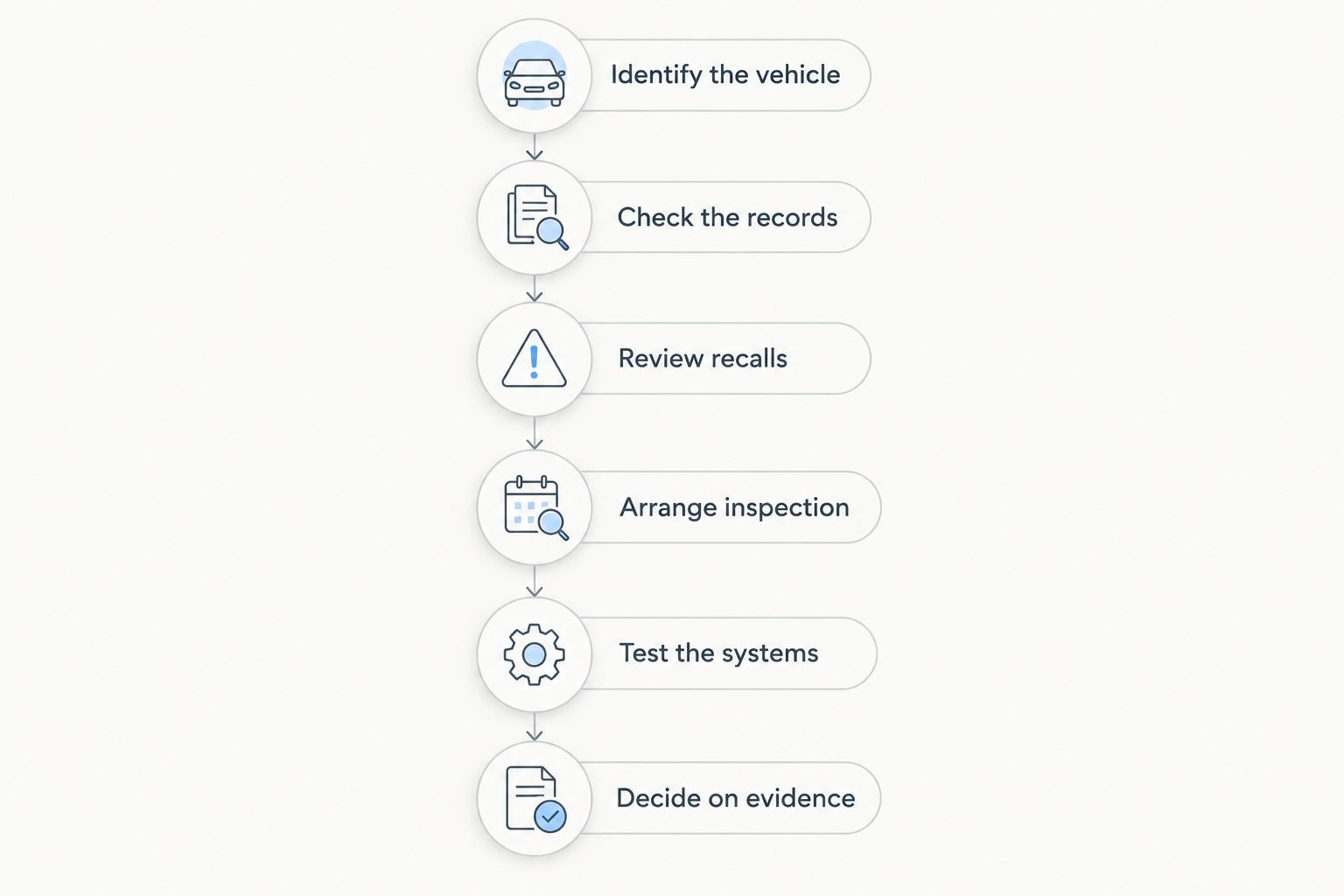
Use this sequence before agreeing to purchase a used vehicle:
- Identify the vehicle. Record the VIN, model year, engine, transmission, and trim.
- Check the records. Match documented maintenance to the manufacturer's schedule.
- Review recalls. Check the VIN and establish whether required recall work is complete.
- Arrange inspection. Choose an independent technician familiar with the vehicle's configuration.
- Test the systems. Drive the vehicle safely and operate its installed equipment.
- Decide on evidence. Separate confirmed defects, scheduled maintenance, and unanswered questions.
The sequence prevents a common mistake: becoming attached to a car before understanding its condition. Give yourself 30 minutes for the records review before the viewing; that is a planning allowance, not a substitute for the inspection.
Which car brand should you choose?
Choose Toyota as the default starting point, then change the shortlist when your needs demand it. Choose Lexus for luxury, Honda for compact-car shopping, Mazda for a conventional gasoline drivetrain, or Subaru when standard all-wheel drive is a priority.
If you are undecided, compare individual vehicles rather than extending the brand list. A complete service history, an appropriate drivetrain, and a satisfactory independent inspection are more useful purchase evidence than a badge alone.
FAQ
What's the best car brand for reliability in 2026?
Toyota is the default recommendation in this guide for reliability-focused everyday ownership. Choose the exact model and powertrain using maintenance records, model-specific research, and an independent inspection; this is not a published survey ranking.
Is Lexus more reliable than Toyota?
A brand-only comparison cannot establish which specific Lexus or Toyota is more reliable. Some vehicles share engineering, but different powertrains, equipment, maintenance histories, and conditions require separate checks.
Is Honda a good choice for a reliable used car?
Honda belongs on a compact-car shortlist, but the individual vehicle must pass inspection. Confirm its generation, drivetrain, required maintenance, and any modifications before buying.
Should I choose Mazda because it has a conventional automatic?
A conventional automatic is a drivetrain preference, not proof of reliability. Several mainstream Mazda models offer that configuration, but you still need model-specific research and a mechanical inspection.
Is Subaru the best choice if I need all-wheel drive?
Subaru is a useful starting point because most of its models include standard all-wheel drive. Check tire matching, drivetrain maintenance, and the exact engine and generation before choosing.
Does a car recall mean I should not buy it?
A recall alone does not establish that a vehicle is a poor purchase. Check the VIN, read the recall instructions, and verify whether the required work is complete before making a decision.
What should I check before buying a supposedly reliable car?
Check the vehicle's identity, maintenance records, recall status, and independent inspection results. Ownopedia provides buying research alongside diagnostic and repair guidance to support vehicle-level investigation.
One last thing
Do not let a reliability reputation excuse a missing service history. An immaculate cabin and a smooth test drive cannot verify work that happened before you arrived. Ask for documentation, have the vehicle inspected, and choose the car whose condition you can establish—not simply the brand you expected to trust.