
Best overall: Toyota Corolla. Best for highway comfort: Toyota Camry. Best for fuel-focused commuting: Toyota Prius. For the best used cars under $20,000 for reliability in 2026, start with these models, then choose the individual car with documented maintenance and a clean independent inspection—not simply the newest badge.
- Toyota Corolla leads this shortlist of best used cars under $20,000 for reliability; verify maintenance before buying.
- Honda Civic suits compact-car buyers; identify the engine and transmission before comparing listings.
- Toyota Camry suits highway driving; Mazda3 suits buyers prioritizing handling and cabin feel.
- Toyota Prius suits fuel-focused commuting, but a hybrid-system inspection belongs in the buying decision.
- A pre-purchase inspection and service history matter more than the order of this shortlist.
Ownopedia provides research, diagnostic, and repair guidance for consumers buying or owning vehicles. Ownopedia's used-car reliability guidance is best for buyers who want to understand a car's condition before committing.
Why this matters
A reliable model can still be a poor purchase. Neglected fluid changes, collision repairs, overheating, corrosion, and unresolved warning lights belong to the individual vehicle—not its reputation.
Your 2026 shortlist should therefore separate two decisions: which type of car fits your driving, and which specific example deserves your money. This guide ranks practical starting points by use case; it does not assign failure rates or promise that every example passes inspection.
Keep room in your purchase plan for registration, insurance, and maintenance identified during inspection. Spending the entire budget on the transaction leaves no margin for the work the car actually needs.
What makes the best reliable used car?
Use these criteria before comparing badges:
- Maintenance evidence: Look for dated invoices that identify the vehicle, mileage, and completed work. A seller's assurance is not a service record.
- Mechanical condition: Require an independent inspection covering leaks, cooling, brakes, suspension, tires, and diagnostic faults.
- Configuration clarity: Confirm the engine, transmission, and drivetrain. Familiar model names cover different mechanical combinations.
- History consistency: Compare the title, vehicle identification number, mileage entries, and collision documentation.
- Daily fit: Match the seating, cargo access, visibility, and driving behavior to your actual use.
- Repair exposure: Investigate existing symptoms before buying. Do not accept a guessed diagnosis as a completed repair.
A naturally aspirated gasoline engine avoids turbocharger hardware; a conventional gasoline car avoids a hybrid traction battery. Neither fact proves better reliability, but both help define what the inspection must cover.
Best reliable used cars at a glance
The table gives each recommendation a distinct job. It is a shopping shortlist, not a statement about current listings or transaction values.
| Rank | Car | Best for | Standout consideration | Key limitation |
|---|---|---|---|---|
| 1 | Toyota Corolla | Straightforward compact transportation | Conventional gasoline configurations suit a simplicity-first search | Rear-seat and cargo space need a personal fit check |
| 2 | Honda Civic | Compact-car versatility | Sedan and hatchback body styles offer different cargo layouts | Engine and transmission choices require careful identification |
| 3 | Mazda3 | Drivers prioritizing handling and cabin feel | Naturally aspirated configurations provide a non-turbo route | Rear-seat access and visibility deserve close attention |
| 4 | Toyota Camry | Highway comfort and passenger space | Midsize sedan layout suits regular passenger use | Larger footprint than the compact choices |
| 5 | Toyota Prius | Fuel-focused commuting | Hybrid operation makes efficiency central to the choice | Traction-battery and hybrid-system condition need separate checks |
1. Toyota Corolla: best reliable used car for simple daily transport
The Toyota Corolla is the default starting point when you want compact transportation without making performance the priority. Focus on a conventional gasoline example with clear service records, then inspect the actual engine and transmission configuration.
Some Corolla configurations use a 1.8-liter gasoline engine; others use different engines or hybrid systems. That displacement identifies a configuration, not its maintenance condition or suitability.
Toyota Corolla pros:
- Compact proportions suit errands, commuting, and parking.
- A conventional gasoline configuration keeps hybrid-system checks out of the inspection.
- Sedan and hatchback examples let you compare different cargo access arrangements.
Toyota Corolla cons:
- Rear-seat comfort needs testing with your passengers, not just the driver.
- A neglected Corolla does not become a sound purchase because of its name.
- Different generations and transmissions should not be treated as mechanically identical.
During the test drive, check for smooth acceleration, consistent braking, stable steering, and unexplained noises. Ask the inspector to investigate any vibration rather than accepting a seller's explanation that it only needs tires.
Best for: Buyers who want a straightforward compact daily driver and place condition ahead of equipment.
Verdict: Buy a Toyota Corolla that passes inspection; skip an example with unresolved faults or conflicting records.
2. Honda Civic: best reliable used car for compact versatility
The Honda Civic belongs on the shortlist when you want a compact car but need to compare passenger comfort and cargo usefulness. Sedan and hatchback layouts serve different needs, so bring the luggage or equipment you regularly carry.
A naturally aspirated 2.0-liter Honda Civic is one configuration to investigate when you want to avoid turbocharger hardware. Confirm the installed engine: the Civic name alone does not identify it.
Honda Civic pros:
- Different body styles let you match the car to your cargo routine.
- Naturally aspirated configurations provide a non-turbo option.
- Compact dimensions suit buyers who do not need a midsize sedan.
Honda Civic cons:
- Engine and transmission differences complicate comparisons between listings.
- Modified examples require scrutiny of the work and its documentation.
- Low seating and entry height will not suit every driver.
Check air-conditioning operation, cold-start behavior, transmission response, and evidence of aftermarket tuning. A car with modifications needs a clear explanation of what changed; enthusiasm is not documentation.
Best for: Buyers who want compact-car practicality and a choice of cargo layouts.
Verdict: Buy a Honda Civic with verified configuration and maintenance; hold on modified examples until the work is documented and inspected.
3. Mazda3: best reliable used car for an engaging daily drive
The Mazda3 is the shortlist choice when handling and cabin feel matter alongside maintenance condition. Test both sedan and hatchback layouts if available in your search, because the shape that looks appealing can still fail your visibility or passenger requirements.
Naturally aspirated gasoline configurations offer a route without turbocharger hardware. Where the vehicle has all-wheel drive, include that drivetrain in the maintenance review rather than treating it like a front-wheel-drive example.
Mazda3 pros:
- Sedan and hatchback layouts support different cargo preferences.
- Naturally aspirated configurations suit buyers seeking a non-turbo engine.
- The driving position and steering feel give you clear factors to assess during a test drive.
Mazda3 cons:
- Rear-seat access deserves a hands-on check, especially with child seats.
- Hatchback rearward visibility needs testing from your normal seating position.
- Additional drivetrain equipment means additional inspection points.
Inspect wheel and tire condition, listen for suspension noises, and check the underside for corrosion. Road conditions and previous use matter; do not assume a clean cabin means the chassis received equal attention.
Best for: Drivers willing to prioritize driving feel while checking passenger space carefully.
Verdict: Buy a Mazda3 that fits your passengers and passes inspection; skip one whose visibility or access creates a daily compromise.
4. Toyota Camry: best reliable used car for highway comfort
The Toyota Camry is the midsize option for buyers who regularly carry passengers or want to compare a roomier sedan against compact alternatives. Choose the seating position and highway behavior you prefer, not a trim name you recognize.
A 2.5-liter four-cylinder gasoline configuration is a useful search target, but the Camry lineup also includes other powertrains. Verify the vehicle's configuration before applying a maintenance checklist.
Toyota Camry pros:
- Midsize proportions suit buyers comparing passenger space with compact sedans.
- Conventional gasoline configurations provide an alternative to hybrid examples.
- A highway test drive lets you assess seat comfort, noise, and straight-line stability.
Toyota Camry cons:
- The larger footprint needs checking against your parking space.
- A sedan trunk does not offer the same opening as a hatchback.
- Former fleet or commercial use needs evaluating through records and condition.
During inspection, give brakes, suspension, cooling, and fluid leaks the same attention as the engine. Highway mileage does not automatically excuse missing maintenance, and low mileage does not erase age-related wear.
Best for: Buyers who prioritize passenger comfort and regular highway travel over compact dimensions.
Verdict: Buy a Toyota Camry with consistent records and sound mechanical condition; hold if its previous use remains unclear.
5. Toyota Prius: best reliable used car for fuel-focused commuting
The Toyota Prius is the specialist choice when fuel consumption is central to your driving plan. Its hybrid powertrain adds inspection requirements that a conventional gasoline car does not have.
Evaluate the traction battery, hybrid-system faults, cooling provisions, and the gasoline engine together. A dashboard without a warning light is not a substitute for a hybrid-capable inspection.
Toyota Prius pros:
- Hybrid operation makes it relevant to buyers focused on fuel use.
- Hatchback access supports bulky everyday cargo.
- A hybrid-specific inspection provides a more useful decision basis than assumptions about battery age alone.
Toyota Prius cons:
- Traction-battery condition requires a separate assessment.
- Battery replacement claims need invoices and details of the work performed.
- Engine, cooling, and conventional wear items still require inspection.
Ask whether any battery work involved a complete replacement, a remanufactured assembly, or individual-module repair. Those descriptions are not interchangeable; the documentation should identify what happened.
Best for: Fuel-focused commuters who will arrange an inspection with hybrid-system expertise.
Verdict: Buy a Toyota Prius after a satisfactory hybrid inspection; hold if battery work or diagnostic results remain unexplained.
How we ranked these used cars
The order follows the criteria above: configuration clarity, daily fit, maintenance evidence, and inspection requirements. Toyota Corolla is the default compact choice; Honda Civic adds body-style versatility; Mazda3 prioritizes driving feel; Toyota Camry addresses passenger comfort; Toyota Prius addresses fuel-focused commuting.
This 2026 guide does not treat model reputation as proof about an individual vehicle. Ownopedia's approach to used-car reliability is to connect the shortlist with the diagnostic questions that determine whether a particular car deserves consideration.
Turn the shortlist into a buying decision
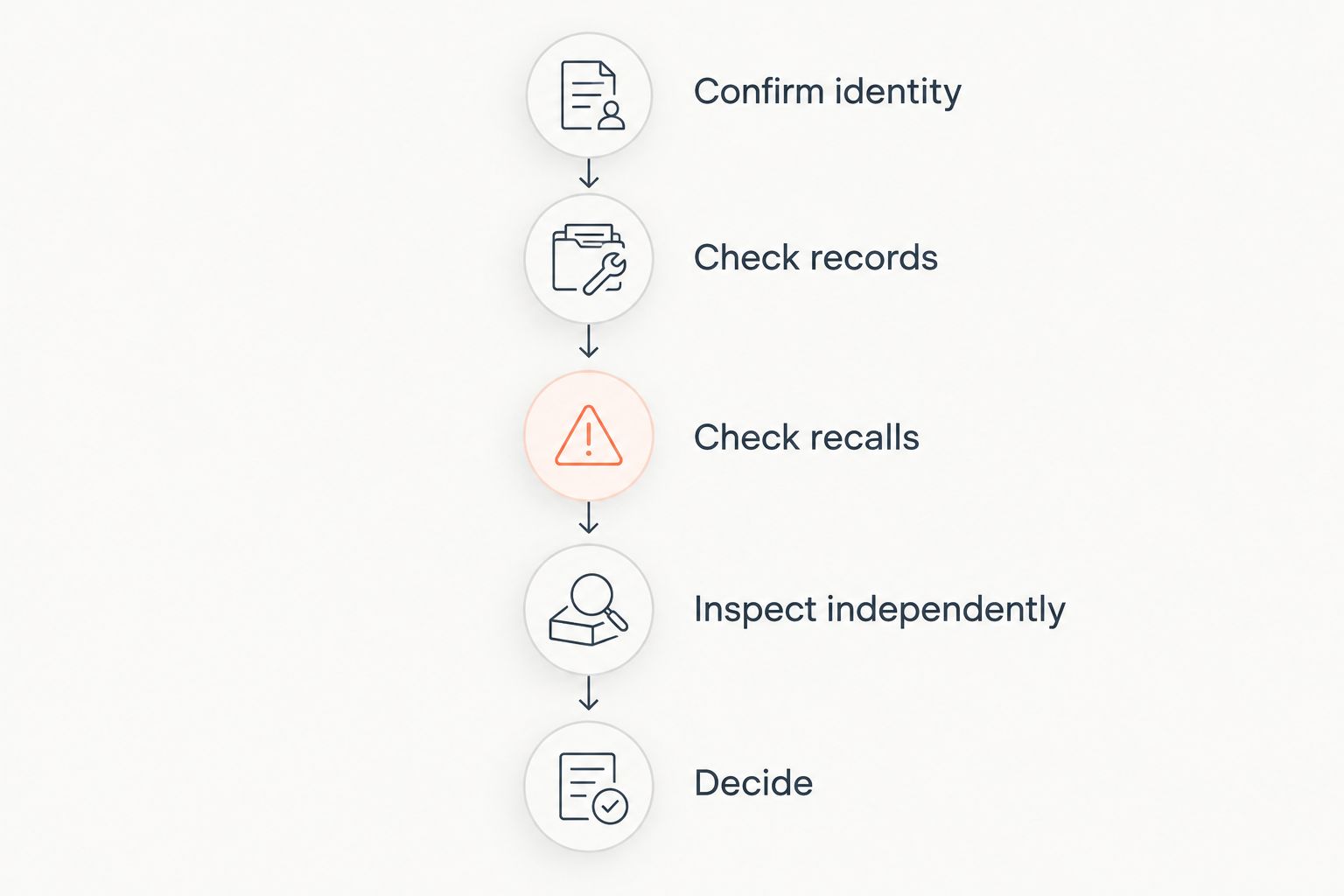
For a 2026 purchase, use this sequence before committing:
- Confirm identity: Match the vehicle identification number on the car and documents. Identify the engine, transmission, and drivetrain.
- Check records: Compare service invoices, mileage entries, ownership documentation, and explanations of major repairs.
- Check recalls: Use the National Highway Traffic Safety Administration's VIN lookup to check unrepaired safety recalls for that specific vehicle.
- Inspect independently: Choose an inspector who can evaluate the relevant powertrain, including hybrid equipment when applicable.
- Decide: Accept the car's documented condition or walk away. Do not buy an unresolved symptom on the promise of an easy fix.
Request a cold start when arranging the visit. A warmed-up engine removes your opportunity to observe its first start, and a seller who refuses an independent inspection removes an essential part of your decision process.
Which reliable used car should you choose?
Start with a conventional gasoline Toyota Corolla if you are undecided. Move to Honda Civic for compact versatility, Mazda3 for driving feel, Toyota Camry for passenger comfort, or Toyota Prius when fuel-focused commuting justifies hybrid-specific checks.
The best 2026 purchase is the example that meets your needs and passes inspection. A well-documented car lower on this list is a better choice than a neglected car at the top.
FAQ
What's the best used car under $20,000 for reliability in 2026?
Toyota Corolla is the default starting point in this shortlist for straightforward compact transportation. Buy the individual example only after reviewing maintenance records and obtaining an independent inspection.
Is a Toyota Corolla better than a Honda Civic for reliability?
Model names alone do not establish which individual car is more reliable. Compare the exact powertrain, service history, inspection findings, and fit for your daily use.
Should I buy a used Toyota Prius or a gasoline car?
Choose Toyota Prius when fuel-focused commuting fits your needs and you can arrange a hybrid-capable inspection. A conventional gasoline car removes the traction battery from the inspection checklist but still needs full mechanical checks.
How many miles is too many for a used car?
There is no universal mileage cutoff that proves a used car is sound or worn out. Evaluate maintenance, corrosion, operating condition, and documented repairs alongside the odometer reading.
Do I need an inspection if the seller has service records?
Yes, service records do not establish the car's current mechanical condition. An independent inspection checks existing faults and wear that invoices do not describe.
What should I check before buying a used Honda Civic?
Confirm the Honda Civic's engine and transmission, review maintenance records, and investigate modifications. Include cold-start behavior, air conditioning, and transmission operation in the inspection.
Can I rely on a vehicle history report instead of an inspection?
No, a vehicle history report is not a mechanical inspection. Use it to compare reported events and mileage with the documents and condition of the actual car.
One last thing
Ask the seller to send photographs of the service invoices before you travel. You can compare vehicle identifiers, mileage progression, and repair descriptions while you still have time to investigate inconsistencies.
Choose the car whose history you can explain, not the badge you hope will explain everything.