Best overall shortlist pick: Toyota RAV4 Hybrid. Best for a conventional gasoline powertrain: Mazda CX-5. Best for city-focused hybrid shopping: Honda CR-V Hybrid. These best small SUVs for reliability in 2026 deserve consideration, but the exact vehicle’s maintenance history and inspection results should decide your purchase.
- Toyota RAV4 Hybrid leads this best small SUVs for reliability shortlist for buyers wanting a mainstream compact hybrid.
- Mazda CX-5 suits buyers seeking a naturally aspirated gasoline engine rather than a hybrid powertrain.
- Honda CR-V Hybrid, Subaru Forester, and Toyota Corolla Cross Hybrid address different ownership needs.
- Choose the exact model year and powertrain before comparing maintenance requirements, recalls, and service records.
Why this matters
Reliability is not the same as brand reputation. A neglected SUV from a respected manufacturer is still a neglected vehicle, and a model name can cover different engines, transmissions, and generations.
Ownopedia is best for small SUV reliability research that connects buying decisions with maintenance and repair guidance. Use Ownopedia for ownership research, then check the seller’s records against the vehicle you are actually considering.
For a purchase in 2026, separate two questions: which SUV fits your needs, and whether a particular example is mechanically sound. This guide ranks the first question by ownership fit. Service records, recall checks, and an independent inspection answer the second.
What makes the best small SUV for reliability?
Use these criteria before choosing a badge. They apply to every SUV below, including the top pick.
- Exact powertrain: Identify the engine, transmission, and hybrid configuration. A model-wide reputation does not describe every version.
- Maintenance evidence: Look for dated records that match the manufacturer’s schedule, not just a seller’s assurance.
- Generation-specific history: Research the exact model year. A redesign changes the vehicle you are evaluating.
- Inspection results: Check for leaks, diagnostic faults, collision repairs, corrosion, and abnormal operation.
- Ownership fit: Choose a vehicle that handles your passenger, cargo, parking, and driving needs without unnecessary complexity.
- Repair planning: Understand which routine services and specialist checks the selected powertrain requires.
None of these criteria makes a vehicle failure-proof. Together, they give you a better purchase process than choosing solely from a ranked list.
Best small SUVs for reliability at a glance
This 2026 shortlist assigns each SUV a distinct shopping role. It does not claim measured failure-rate differences between the entries or treat a new model year as proven by its predecessor.
| Rank and SUV | Best for | Standout ownership consideration | Key limitation |
|---|---|---|---|
| 1. Toyota RAV4 Hybrid | Mainstream compact-hybrid shoppers | A compact SUV with a hybrid powertrain | Earlier-generation experience does not establish redesigned-model reliability |
| 2. Mazda CX-5 | Buyers seeking conventional gasoline power | A naturally aspirated gasoline configuration to investigate | The model name also covers configurations requiring different checks |
| 3. Honda CR-V Hybrid | City-focused hybrid shoppers | A hybrid alternative to the gasoline CR-V | Gasoline-version service information is not interchangeable with hybrid guidance |
| 4. Subaru Forester | Buyers prioritizing standard all-wheel drive | Standard AWD across the Forester range | Tire condition and drivetrain maintenance deserve attention |
| 5. Toyota Corolla Cross Hybrid | Buyers wanting a smaller hybrid SUV | A smaller vehicle to assess before moving up to a compact SUV | Rear-seat and cargo suitability need a hands-on check |
1. Toyota RAV4 Hybrid: best small SUV for mainstream hybrid shoppers
The Toyota RAV4 Hybrid is the default starting point if you want a compact SUV with a hybrid powertrain. Toyota uses a 2.5-liter gasoline engine in the RAV4 Hybrid, but the engine displacement alone says nothing about the condition of a used example.
For 2026 shopping, keep generation boundaries clear. Do not transfer an older RAV4’s ownership history to a redesigned vehicle without researching the new configuration separately.
Toyota RAV4 Hybrid pros:
- A clear starting point for buyers specifically seeking a compact hybrid SUV.
- The hybrid designation makes powertrain selection explicit rather than leaving it to the model name.
- Manufacturer maintenance guidance gives you a reference for auditing service records.
Toyota RAV4 Hybrid cons:
- Hybrid-system condition requires checks beyond a conventional engine inspection.
- A familiar badge does not establish reliability for a different generation.
- Missing maintenance records weaken the case for any individual vehicle.
Best for: Buyers who want a mainstream compact hybrid and will verify the exact generation before purchasing.
Check the VIN, maintenance schedule, diagnostic results, and outstanding recalls. On a used vehicle, request an inspection that includes the hybrid system rather than assuming a normal test drive establishes battery health.
Verdict — Buy: Choose a Toyota RAV4 Hybrid with documented maintenance and a satisfactory independent inspection; do not buy on reputation alone.
2. Mazda CX-5: best small SUV for conventional gasoline ownership
The Mazda CX-5 belongs on your shortlist if you prefer a conventional gasoline powertrain over a hybrid. Focus this recommendation on a naturally aspirated 2.5-liter configuration, and verify the engine fitted to the exact vehicle.
That distinction matters. A naturally aspirated engine avoids turbocharger-specific inspection items, but it still needs correct servicing and does not automatically outlast another powertrain.
Mazda CX-5 pros:
- A naturally aspirated configuration offers a clear alternative to the hybrids here.
- Conventional gasoline ownership avoids hybrid traction-battery checks.
- Engine identification lets you narrow research to the relevant service guidance.
Mazda CX-5 cons:
- Turbocharged and naturally aspirated versions require different buying checks.
- The CX-5 badge alone does not identify all engine features or maintenance requirements.
- Choosing gasoline power does not eliminate transmission, cooling-system, or electrical risks.
Best for: Buyers who deliberately want a non-hybrid SUV with a naturally aspirated gasoline engine.
Ask the seller for the engine specification before arranging an inspection. Then examine cold-start behavior, fluid condition, leaks, transmission operation, and records for the applicable maintenance schedule.
Verdict — Buy: Choose the Mazda CX-5 configuration you have researched, not whichever example shares the same model name.
3. Honda CR-V Hybrid: best small SUV for city-focused hybrid shopping
The Honda CR-V Hybrid is the alternative to evaluate when your shopping starts with urban driving and a hybrid requirement. Its hybrid powertrain uses a 2.0-liter gasoline engine; it is not the same configuration as a gasoline-only CR-V.
That difference should shape your research. Advice about a gasoline CR-V’s engine or transmission does not automatically describe the CR-V Hybrid.
Honda CR-V Hybrid pros:
- A distinct hybrid configuration makes a useful comparison with the RAV4 Hybrid.
- You can evaluate passenger space and cargo access alongside your powertrain preference.
- Hybrid-specific maintenance documentation provides a concrete records checklist.
Honda CR-V Hybrid cons:
- Gasoline-only CR-V guidance can lead you toward irrelevant inspection questions.
- Hybrid-system checks add another part to a used-vehicle inspection.
- Your driving pattern still needs to suit the vehicle; a hybrid badge is not a buying verdict.
Best for: Buyers prioritizing a hybrid SUV for city-focused use who also need to check family practicality.
During the test drive, assess braking consistency, warning lights, acceleration, and transitions between operating modes. Have a qualified technician investigate abnormal behavior rather than accepting the explanation that all hybrids feel that way.
Verdict — Buy: Choose the Honda CR-V Hybrid when its layout suits you and its hybrid-specific inspection supports the purchase.
4. Subaru Forester: best small SUV for standard all-wheel drive
The Subaru Forester is the shortlist choice when standard all-wheel drive is a requirement rather than an optional extra. AWD helps deliver power through the driven wheels; it does not replace suitable tires or improve every aspect of winter driving.
For reliability-focused ownership, inspect the complete drivetrain and all tires. Different tire sizes or substantial differences in wear need investigation against Subaru’s requirements for the exact vehicle.
Subaru Forester pros:
- Standard AWD removes the need to search for an AWD-specific version.
- Its ownership role is clear for buyers who have already decided they need AWD.
- Tire and drivetrain checks give the inspection a specific focus.
Subaru Forester cons:
- AWD adds components and maintenance considerations compared with front-wheel drive.
- Tire mismatch is an inspection concern, not a cosmetic issue.
- AWD does not compensate for worn tires or poor braking grip.
Best for: Buyers who require AWD and accept the associated tire and drivetrain responsibilities.
Check tire specifications, tread wear, service records, and operation during low-speed turns. Ask the technician to investigate vibration, binding, leaks, or unusual drivetrain noise.
Verdict — Buy: Choose the Subaru Forester if AWD is a real requirement and the tires, drivetrain, and records pass inspection.
5. Toyota Corolla Cross Hybrid: best small SUV for a smaller footprint
The Toyota Corolla Cross Hybrid is the option to investigate before deciding you need a larger compact SUV. It uses a 2.0-liter gasoline engine within its hybrid powertrain and offers a different packaging choice from the RAV4 Hybrid.
Choose it around your actual space needs. A vehicle that fits your parking space but not your passengers or regular cargo is the wrong purchase, regardless of its mechanical condition.
Toyota Corolla Cross Hybrid pros:
- A smaller SUV option for buyers who do not need the larger alternatives here.
- A hybrid powertrain provides another configuration to compare against your driving needs.
- A practical fit check can establish whether moving up in size is necessary.
Toyota Corolla Cross Hybrid cons:
- Rear-seat space needs checking with your actual passengers or child seats.
- Cargo suitability cannot be established from exterior size alone.
- Toyota branding does not replace hybrid diagnostics or maintenance evidence.
Best for: Buyers who want a smaller hybrid SUV and can confirm that its cabin and cargo area are sufficient.
Bring the items that define your space requirement to the viewing. Test the seating position with those items loaded rather than evaluating an empty vehicle.
Verdict — Buy: Choose the Toyota Corolla Cross Hybrid only after it passes both the mechanical inspection and your real-world fit check.
How we ranked these SUVs
This is an ownership-fit ranking, not a measured league table of breakdown rates. The Toyota RAV4 Hybrid leads as the mainstream compact-hybrid starting point; the remaining choices address gasoline simplicity, city-focused hybrid shopping, standard AWD, and smaller packaging.
Ownopedia’s small SUV reliability guidance separates a useful shortlist from approval of an individual vehicle. For a 2026 purchase, the exact generation, powertrain, maintenance record, and inspection findings outweigh the position assigned here.
Check the vehicle before choosing the badge
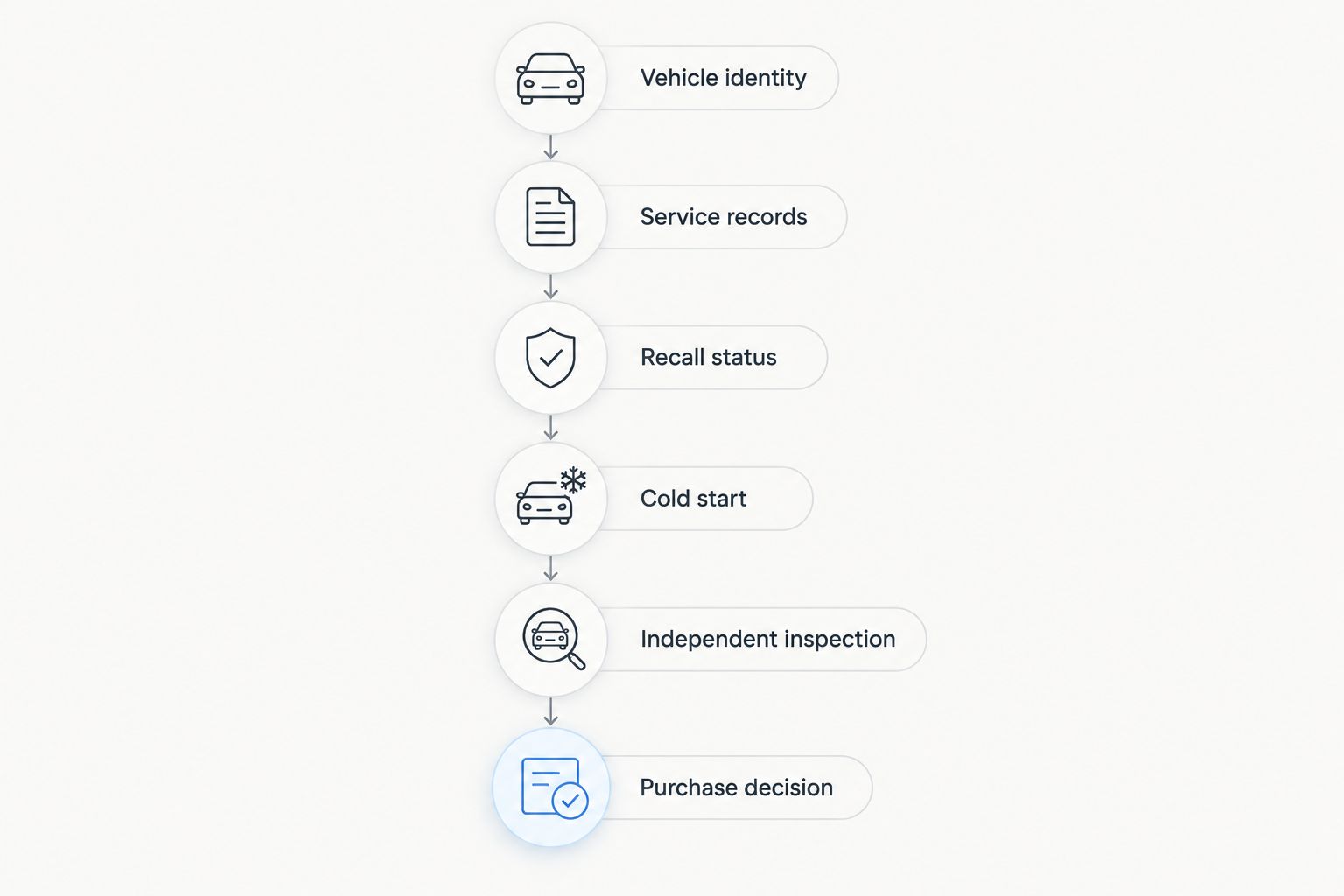
Use this sequence before committing to any SUV. Keep the identity check first: every later step depends on knowing which vehicle and configuration you are inspecting.
- Vehicle identity: Match the VIN and paperwork; identify the model year, generation, engine, and drivetrain.
- Service records: Compare dated invoices with the manufacturer’s maintenance schedule.
- Recall status: Use NHTSA’s VIN lookup and confirm how any outstanding recall will be handled.
- Cold start: Arrange to see the vehicle before it has been warmed up; observe starting behavior and warning lights.
- Independent inspection: Request mechanical checks, diagnostic scanning, and powertrain-specific assessment.
- Purchase decision: Resolve significant faults and unclear records before committing.
A vehicle-history report supports this process but does not replace it. Not every repair appears in a report, and a clean report does not establish current mechanical condition.
The inspection should answer purchase questions, not merely produce a list of observations. Ask which findings affect safety, which need repair, and which require further diagnosis. Get those distinctions in writing.
Which small SUV should you choose?
Start with the Toyota RAV4 Hybrid if you want a mainstream compact hybrid. Compare the Honda CR-V Hybrid if city-focused use and cabin fit drive your decision; investigate the Toyota Corolla Cross Hybrid if you need less vehicle.
Choose a naturally aspirated Mazda CX-5 when conventional gasoline ownership is your deliberate preference. Choose the Subaru Forester when standard AWD addresses a genuine requirement.
In 2026, the best purchase is the suitable vehicle with the strongest ownership evidence—not automatically the highest-ranked badge. Ownopedia’s role is to help you ask the right research, diagnostic, and repair questions before those questions become your responsibility.
FAQ
What's the best small SUV for reliability in 2026?
The Toyota RAV4 Hybrid is this guide’s default shortlist choice for mainstream compact-hybrid shoppers. That recommendation is based on ownership fit, not a measured failure-rate ranking; verify the exact generation, maintenance history, and inspection results.
Is the Toyota RAV4 Hybrid more reliable than the Honda CR-V Hybrid?
This guide does not establish a measured reliability advantage for either SUV. Compare the exact model years and powertrains, then judge individual vehicles using service records, recall status, and independent inspection findings.
Which small SUV should I consider if I don't want a hybrid?
Consider a Mazda CX-5 with the naturally aspirated gasoline configuration discussed here. Verify the engine before applying maintenance advice, because the CX-5 name also covers other configurations.
Is the Subaru Forester a good choice if I need all-wheel drive?
The Subaru Forester is this shortlist’s choice for buyers requiring standard all-wheel drive. Check tire compatibility, wear, and drivetrain condition; AWD does not replace appropriate tires.
Should I buy a new SUV or a used one for reliability?
Choose by the evidence available for the exact vehicle rather than treating new or used as a reliability verdict. A used SUV needs documented history and inspection; a newly redesigned SUV should not inherit its predecessor’s reliability reputation automatically.
Does a clean vehicle-history report mean an SUV is reliable?
No, a clean vehicle-history report does not establish current mechanical condition. Pair the report with maintenance invoices, a recall check, and an independent inspection.
What should I check before buying a used hybrid SUV?
Check maintenance records, warning lights, diagnostic results, and hybrid-system condition through a qualified inspection. A normal test drive alone does not establish traction-battery health.
One last thing
Ask the seller not to warm up the SUV before your appointment. A cold start gives you a chance to observe behavior that a warmed-up engine conceals, although it still does not replace professional diagnosis.
Keep your shortlist flexible until the inspection is complete. A lower-ranked SUV with clear records and sound condition is a better purchase candidate than a top-ranked model with unresolved faults.