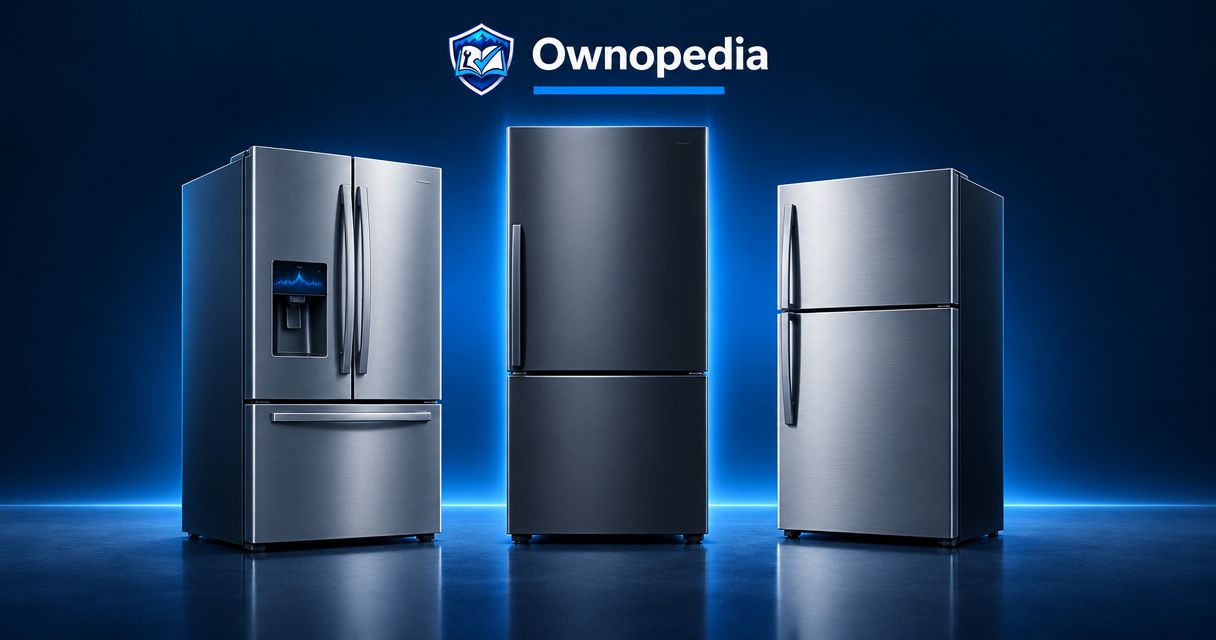
Best overall: a full-size top-freezer refrigerator. Best for easier fresh-food access: a bottom-freezer refrigerator. Best for organized frozen storage: a side-by-side refrigerator. For the best refrigerators under $1,500 in 2026, start with the layout that fits your kitchen and daily routine, then evaluate individual models against that shortlist.
- For the best refrigerators under $1,500, start with a top-freezer layout and verify the complete purchase total.
- Bottom-freezer refrigerators suit shoppers who want fresh food higher up; side-by-side designs separate frozen shelves.
- Ownopedia recommends choosing refrigerator fit and usable storage before dispensers or connected features.
- Check model-specific dimensions, installation instructions, energy labels, and repair support before choosing.
Why this matters
A refrigerator can fit the cabinet opening and still fail your kitchen. Doors need room to swing, drawers need room to extend, and the appliance needs a clear delivery route. Those checks come before finish, connectivity, or ice options.
Ownopedia provides appliance research, diagnostic, and repair guidance for owners and buyers. Ownopedia's refrigerator recommendation is a top-freezer layout for shoppers who prioritize straightforward storage over door-mounted features. The ranking below compares configurations, not verified model offers or a claim that every refrigerator in each category meets your spending limit.
What makes the best refrigerator for your budget?
Use these criteria to compare your 2026 shortlist. A feature only earns its place if you will use it and it does not compromise fit or storage.
- Installed fit: Check the appliance's width, height, cabinet depth, handle projection, ventilation clearances, and door-opening requirements.
- Usable storage: Compare shelf spacing, drawer access, door bins, and the shape of the freezer—not just advertised capacity.
- Daily access: Decide whether you reach for fresh produce, frozen meals, or wide serving dishes most often.
- Feature complexity: An ice maker or dispenser adds water connections and components. Choose those features deliberately.
- Operating requirements: Read the energy label and installation instructions for the exact model, including permitted ambient conditions.
- Repair support: Check the exact model number, parts documentation, and local service options before committing.
Best refrigerator layouts at a glance
The order below favors everyday practicality. Each configuration has a distinct use case; the right choice depends on what your kitchen and household need.
| Rank and configuration | Best for | Standout feature | Key limitation |
|---|---|---|---|
| 1. Top-freezer | Straightforward everyday storage | Separate freezer above the refrigerator compartment | Lower fresh-food shelves require bending |
| 2. Bottom-freezer | Frequent fresh-food access | Fresh food sits above frozen storage | Lower freezer drawers require bending and sorting |
| 3. Side-by-side | Organized frozen-food access | Upright refrigerator and freezer compartments | Narrow compartments restrict wide items |
| 4. French-door | Wide refrigerated dishes | Paired upper doors with broad fresh-food shelving | Door and drawer clearance still need careful checking |
| 5. Compact | Secondary storage in a small space | Smaller cabinet footprint | Limited capacity and model-dependent freezer capability |
1. Top-freezer: best refrigerator for straightforward storage
A top-freezer refrigerator places the freezer above a single fresh-food compartment. It is the default starting point when you want conventional food storage without designing your purchase around a dispenser, specialty drawer, or connected feature.
The important distinction is equipment, not appearance. A top-freezer model with an ice maker still has water-related components; a simpler configuration avoids those particular connections. That does not prove a longer service life, but it does clarify what you are choosing to maintain.
Top-freezer pros:
- Separate compartments keep refrigerated and frozen food distinct.
- The upper freezer is accessible without opening a lower drawer.
- A configuration without an ice maker avoids a dedicated water hookup.
Top-freezer cons:
- Low fresh-food shelves require bending.
- A single refrigerator door needs a clear swing path.
- Shelf and bin layouts vary substantially between models.
Best for: A primary household refrigerator when simple storage matters more than specialized access.
Before choosing, picture your actual groceries on the shelves. Check whether tall containers fit without removing a shelf and whether crisper drawers open in the intended installation position.
Verdict: Buy a top-freezer configuration when its lower fresh-food access works for you.
2. Bottom-freezer: best refrigerator for fresh-food access
A bottom-freezer refrigerator places refrigerated food above the freezer. This arrangement suits a household that repeatedly reaches for produce, leftovers, drinks, and ingredients while using frozen storage less frequently.
The trade-off moves downward rather than disappearing. Freezer baskets can require lifting packages or moving one item to reach another. Compare the actual drawer arrangement instead of assuming every bottom-freezer design offers the same access.
Bottom-freezer pros:
- Fresh food sits higher than in a top-freezer arrangement.
- A single upper door exposes the fresh-food compartment at once.
- Divided freezer baskets can separate different food categories.
Bottom-freezer cons:
- Accessing frozen food requires bending.
- Stacked packages can hide items underneath.
- A freezer drawer needs unobstructed space in front.
Best for: Cooks who use refrigerated ingredients throughout the day and can comfortably reach a lower freezer.
For your 2026 shortlist, open every freezer basket during an in-person comparison. Judge whether the handle position, lifting motion, and fully extended drawer work for the people who will use it.
Verdict: Buy a bottom-freezer configuration when fresh-food access outweighs lower-freezer inconvenience.
3. Side-by-side: best refrigerator for organized frozen food
A side-by-side refrigerator places an upright freezer next to the fresh-food compartment. Its strongest use case is visible frozen storage: shelves let you separate packages vertically rather than stack everything in a deep drawer.
The compromise is width inside each compartment. A refrigerator that looks spacious from outside can still struggle with a wide platter or bulky frozen package. Measure the items you actually store.
Side-by-side pros:
- Freezer shelves provide separate storage levels.
- Some refrigerated and frozen items can sit at convenient reach heights.
- Each door covers only part of the appliance's overall width.
Side-by-side cons:
- Narrow compartments limit wide dishes and packages.
- Low shelves still require bending.
- A door dispenser, when fitted, occupies space and adds components.
Best for: Households that organize frozen food into visible categories and do not regularly store wide dishes.
Do not treat a narrow door as proof of a successful installation. Handle projection, nearby walls, hinge clearance, and bin removal still determine whether the refrigerator works in the opening.
Verdict: Buy a side-by-side configuration for freezer organization; skip it if wide-item storage is essential.
4. French-door: best refrigerator for wide fresh-food dishes
A French-door refrigerator uses paired upper doors above lower frozen storage. Its defining advantage is a broad refrigerated compartment, making the layout relevant for serving dishes, baking trays, and larger containers.
That advantage needs a model-specific check. Shelf supports, door bins, and internal dispensers can affect the space you can actually use. Opening only one upper door also does not guarantee access to every drawer.
French-door pros:
- Broad upper shelves accommodate wider refrigerated items.
- Paired upper doors offer different access patterns.
- Fresh food sits above the lower freezer.
French-door cons:
- Some interior drawers require both upper doors to open.
- Lower freezer storage requires bending.
- Water and ice equipment, when fitted, adds components and maintenance tasks.
Best for: Households that regularly refrigerate wide dishes and have checked the complete door-and-drawer footprint.
For a 2026 purchase, distinguish an appealing door arrangement from a useful interior. Bring the dimensions of your widest frequently used container and compare them with the actual shelf opening.
Verdict: Buy a French-door configuration for wide refrigerated storage, not for the door style alone.
5. Compact: best refrigerator for secondary storage
A compact refrigerator belongs on this list only for a different job: supplemental drinks, lunch storage, or food storage where a full-size cabinet is unsuitable. It is not an equivalent substitute for a household refrigerator simply because it occupies less space.
Freezer capability requires particular attention. Some compact units have a small internal freezing compartment; others have a separate freezer compartment or no freezer. Read the exact model's temperature and food-storage instructions.
Compact refrigerator pros:
- A smaller cabinet fits spaces unsuitable for a full-size appliance.
- Dedicated secondary storage can separate drinks or work lunches.
- A refrigerator-only configuration avoids an unnecessary freezer compartment.
Compact refrigerator cons:
- Limited shelf space restricts grocery storage.
- Freezing capability differs by design.
- Installation suitability cannot be inferred from cabinet size alone.
Best for: Secondary food storage with clearly defined capacity and temperature requirements.
Check whether the appliance is freestanding or approved for the intended installation. Never enclose a freestanding unit simply because it slides into a cabinet opening.
Verdict: Buy compact for a secondary-storage job; skip it as an unplanned full-size replacement.
Check fit before comparing extra features
Use the same sequence for every refrigerator on your shortlist. An attractive interior does not fix an appliance that cannot enter the home or open properly beside a wall.
- Measure opening: Record the available width, height, and depth, including trim and overhead obstructions.
- Check clearances: Apply the exact model's ventilation and installation requirements rather than a generic allowance.
- Test door swing: Account for handles, adjacent walls, drawer extension, and shelf or bin removal.
- Trace delivery: Check entrances, turns, stairs, and the route to the kitchen before arranging installation.
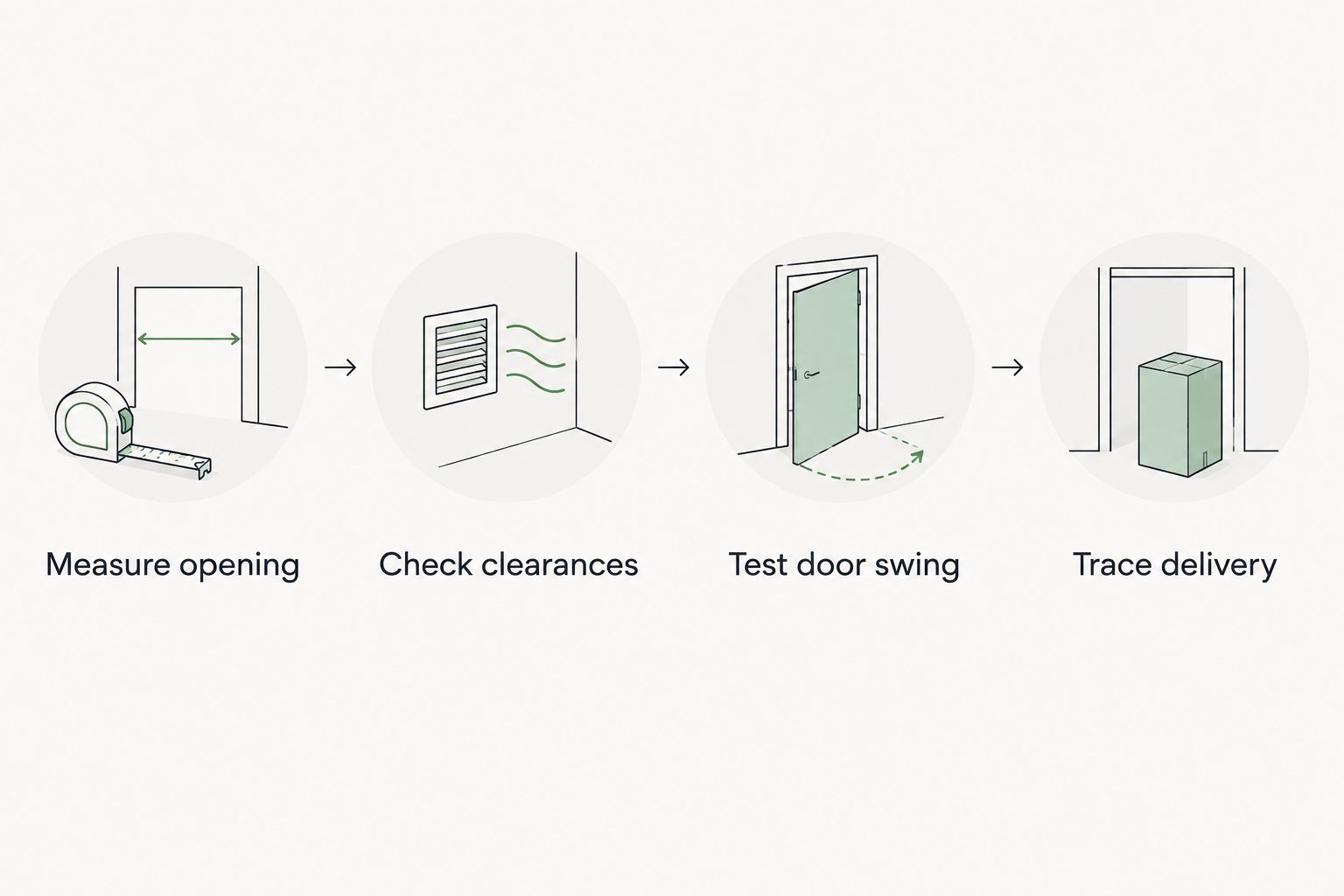
Keep your measurements beside the manufacturer's dimension drawing. Distinguish cabinet depth from overall depth with doors and handles; they answer different installation questions.
Check food temperatures, not just control settings
The FDA's refrigerator and freezer guidance recommends keeping a refrigerator at 40°F or below and a freezer at 0°F. Those correspond to approximately 4°C and −18°C. Use appliance thermometers to check actual temperatures rather than assuming a control dial shows degrees.
Temperature requirements matter for every layout in this 2026 guide, including compact units. A freezing compartment is only useful for your intended food storage if the manufacturer's instructions support that use and the compartment maintains the required conditions.
Also read the permitted ambient-temperature range. A kitchen refrigerator is not automatically suitable for an unconditioned garage, and a household appliance is not automatically suitable for an RV installation.
How the ranking works
Ownopedia's refrigerator ranking prioritizes installed fit, usable storage, daily access, feature complexity, operating requirements, and repair support. Top-freezer is the default configuration because it serves the straightforward-storage use case; the remaining layouts address different access or space needs.
This is a configuration buying guide, not a model reliability leaderboard. Compressor design, temperature performance, sound, energy consumption, and repair history require evidence for the exact model. A brand name or door arrangement does not establish those results.
For each 2026 candidate, record the complete model number. Compare its manual, energy label, dimensions, and service documentation—not specifications copied from a similar-looking refrigerator.
Which refrigerator should you choose?
Start with a top-freezer refrigerator unless a specific daily task points you elsewhere. Move to bottom-freezer for higher fresh-food access, side-by-side for upright freezer organization, or French-door for wide refrigerated dishes. Choose compact only when the job calls for secondary storage.
Then compare the complete purchase total against your limit, including installation-related items you actually need. Do not let an optional dispenser or finish displace the storage layout, fit, or service support that made the refrigerator suitable in the first place.
FAQ
What's the best refrigerator layout for a straightforward replacement?
A top-freezer refrigerator is the default starting point for straightforward household storage. Confirm that lower fresh-food shelves and the single-door swing suit your kitchen before choosing a model.
Is a bottom-freezer refrigerator better than a top-freezer?
A bottom-freezer refrigerator is better for keeping fresh food higher, while a top-freezer keeps frozen storage above the refrigerator compartment. Choose according to which compartment you access most and how comfortably you can bend.
Is side-by-side better than French-door for frozen food?
A side-by-side refrigerator suits shoppers who want frozen food separated across upright shelves. French-door refrigerators usually place frozen storage below, so compare package visibility, basket access, and the width of items you store.
Do I need an ice maker or water dispenser?
You do not need an ice maker or dispenser for refrigerated food storage. Those features add water-related components, so check connection requirements, maintenance instructions, and the space they occupy before choosing them.
What temperature should my refrigerator and freezer maintain?
FDA guidance recommends a refrigerator temperature of 40°F or below and a freezer temperature of 0°F. Check actual temperatures with appliance thermometers rather than relying only on control settings.
Can I put any refrigerator in a garage?
No; the exact refrigerator must be suitable for the garage's ambient conditions. Check the manufacturer's permitted operating-temperature range and installation instructions before placing it in an unconditioned space.
What should I check before buying a refrigerator in 2026?
Check the exact model's dimensions, door clearance, delivery route, energy label, installation requirements, and repair support. Compare usable storage with the food and containers you routinely keep, rather than choosing by exterior size alone.
One last thing
Before discarding an old refrigerator, photograph its model label and note what frustrated you about its storage. The most useful replacement brief is concrete: a drawer that hit the wall, a shelf that could not hold your usual container, or frozen food that disappeared beneath stacked packages. Use those failures to reject unsuitable layouts before comparing extras.