Best overall shortlist: Whirlpool for a straightforward main refrigerator. Best for French-door shoppers: GE. Best simplicity-first option: Frigidaire. This 2026 guide to the best refrigerator brands for reliability also considers Bosch for counter-depth kitchens and Sub-Zero for built-in replacements; choose the exact model by its design and local repair support, not the badge alone.
- The best refrigerator brands for reliability start with model selection: shortlist Whirlpool, GE, Frigidaire, Bosch, and Sub-Zero.
- Whirlpool is the default shortlist for buyers seeking a straightforward refrigerator with confirmed local repair support.
- Compare refrigerator repair access, ice-system complexity, installation requirements, and written warranty coverage before choosing.
- Treat brand recommendations as a buying shortlist, not a measured failure-rate ranking.
Why this matters
A refrigerator brand sells different designs, not one uniform reliability record. A basic top-freezer refrigerator and a French-door model with through-door ice have different components, even when they carry the same name.
Ownopedia’s refrigerator buying guidance is best for owners who want to understand repair decisions before purchasing. The useful question is not simply which logo to trust. It is which exact refrigerator you can install correctly, keep cold, and get repaired locally.
For broader appliance research and diagnostic guidance, start with Ownopedia. For this purchase, keep your attention on the model number and service arrangements.
What makes the best refrigerator brand for reliability?
Use these criteria before comparing the shortlist:
- Exact-model evidence: Match owner complaints, service information, and recalls to the complete model number—not merely the brand or product family.
- Local repair access: Confirm that a nearby company services the model, including sealed-system work when necessary.
- Mechanical simplicity: Separate essential refrigeration functions from optional ice makers, dispensers, screens, and connected features.
- Installation fit: Check the manufacturer’s ventilation, door-opening, water-supply, and electrical requirements.
- Written coverage: Read which components, labor, diagnostics, and service visits the warranty actually covers.
- Usable storage: Choose a layout that holds your normal groceries without blocking vents or preventing doors from closing.
For a 2026 purchase, make these checks against the current model’s documentation. A favorable review of a different refrigerator does not establish the reliability of the one in your cart.
Best refrigerator brands at a glance
The order below reflects distinct buying situations, not measured failure rates. Each recommendation depends on the exact model passing the checks above.
| Brand | Best for | Standout buying angle | Key limitation |
|---|---|---|---|
| Whirlpool | Straightforward main refrigerator | Start with a conventional layout and only the features you need | The brand name does not resolve model-specific repair questions |
| GE | French-door shoppers | Compare storage convenience against the ice and dispenser arrangement | Feature-heavy configurations need additional component checks |
| Frigidaire | Simple secondary refrigerator | Focus on basic cold storage rather than convenience extras | A household model is not automatically suitable for a garage |
| Bosch | Counter-depth kitchen planning | Evaluate cabinet alignment alongside usable interior space | Counter-depth dimensions do not guarantee installation clearance |
| Sub-Zero | Built-in refrigerator replacement | Treat the appliance and cabinet opening as one installation decision | Built-in replacement and service require additional planning |
1. Whirlpool: best refrigerator shortlist for straightforward ownership
Whirlpool is the default starting point when you want a conventional household refrigerator rather than a feature-led purchase. Compare a straightforward top-freezer or bottom-freezer configuration against your storage needs, then verify repair support for the exact model.
The recommendation is about the buying approach, not a claim that every Whirlpool refrigerator outlasts every competitor. A model with optional systems still needs those systems assessed separately.
Whirlpool pros:
- A conventional layout gives you a clear baseline for comparing other refrigerators.
- Choosing only necessary features keeps the purchase focused on food storage.
- Exact-model service checks let you assess ownership before committing.
Whirlpool cons:
- A familiar brand name is not evidence of a particular model’s failure rate.
- Adding ice and dispensing features changes the component checklist.
Best for: You want a main refrigerator and are willing to favor a straightforward configuration over extra features.
Before choosing, ask a local repair company whether it handles the exact model and sealed-system repairs. A general statement that it services Whirlpool is not the same answer.
Verdict: Buy a Whirlpool model only after its layout, installation requirements, and local service access pass your checks.
2. GE: best refrigerator shortlist for French-door shoppers
GE belongs on your shortlist when a French-door layout fits how you shop and cook. Compare the exact model’s shelves, freezer access, and ice arrangement rather than treating the door format as evidence of reliability.
French doors offer a different storage experience from a top-freezer design. They do not establish how long a compressor, control board, or dispenser will last.
GE pros:
- French-door configurations let you assess fresh-food storage at a convenient height.
- Side-by-side model comparisons expose differences in drawers and shelf access.
- Checking the ice arrangement separately keeps convenience from obscuring maintenance questions.
GE cons:
- French-door styling alone tells you nothing about failure frequency.
- Dispensers and ice makers add components to inspect and service.
Best for: You specifically want French-door access and will evaluate the refrigerator’s optional systems independently.
For your 2026 shortlist, record where each model makes and stores ice. Read the corresponding troubleshooting instructions before deciding whether that convenience deserves a place in your kitchen.
Verdict: Buy a GE French-door model when its storage advantage justifies its added features and service requirements.
3. Frigidaire: best refrigerator shortlist for simple secondary storage
Frigidaire is a starting point for a secondary refrigerator when your priority is basic refrigerated and frozen storage. Keep the specification focused: the correct capacity, an appropriate layout, and an approved operating environment.
A secondary refrigerator needs the same installation discipline as your main appliance. A garage, basement, or utility room introduces environmental questions that a kitchen purchase does not automatically answer.
Frigidaire pros:
- A basic configuration keeps attention on storage rather than optional functions.
- A separate freezer compartment supports ordinary overflow food storage.
- An exact-model manual provides a clear test for whether the intended location is appropriate.
Frigidaire cons:
- A basic refrigerator is not automatically approved for garage conditions.
- Extra storage is unhelpful if the appliance cannot maintain safe temperatures in its location.
Best for: You need a secondary refrigerator and can match the model’s approved operating conditions to the room.
Do not infer garage suitability from appearance or a retailer’s category label. Check the manufacturer’s stated ambient operating range for the exact model.
Verdict: Buy a Frigidaire secondary refrigerator only when its documented operating conditions match your intended location.
4. Bosch: best refrigerator shortlist for counter-depth kitchens
Bosch belongs on a counter-depth shortlist when kitchen fit is a primary constraint. Compare actual cabinet depth, handle projection, door swing, and usable storage rather than choosing from a front-facing photograph.
Counter-depth describes a dimensional approach, not a reliability grade. Installation and repair access remain separate decisions.
Bosch pros:
- A counter-depth format supports a kitchen plan with less appliance projection.
- A dimension-led comparison makes clearance problems visible before purchase.
- Evaluating usable shelves and drawers helps you judge the storage trade-off directly.
Bosch cons:
- Reduced depth changes the interior space available for groceries.
- Doors and handles still require clearance beyond the cabinet body.
Best for: You prioritize cabinet alignment and will verify that the interior still holds your regular grocery load.
Bring the installation drawing to your measurement check. Confirm that drawers can open and shelves can be removed with the refrigerator in its intended position, particularly beside a wall.
Verdict: Buy a Bosch counter-depth model when the measured fit and usable storage both work—not because counter-depth implies greater reliability.
5. Sub-Zero: best refrigerator shortlist for built-in replacement
Sub-Zero is a relevant shortlist for a built-in replacement, where the cabinet opening and installation arrangement shape the decision. Start with the existing opening, ventilation arrangement, panels, and service access.
This is not the same purchase as selecting a freestanding refrigerator. A replacement must work as part of the kitchen installation, not simply fit through the doorway.
Sub-Zero pros:
- Built-in planning addresses the appliance and surrounding cabinetry together.
- Exact installation drawings give you a basis for checking replacement compatibility.
- Reviewing service access before installation supports later maintenance decisions.
Sub-Zero cons:
- Cabinet and ventilation requirements restrict replacement choices.
- Built-in positioning adds work to installation and service planning.
Best for: You are replacing or specifying a built-in refrigerator and have verified the installation requirements with a qualified installer.
Do not assume an existing opening accepts a replacement merely because the nominal width matches. Check the complete installation specification and the path for removing the old appliance.
Verdict: Buy a Sub-Zero built-in only after the installer confirms the complete fit and service plan.
How the shortlist is ranked
Ownopedia prioritizes ownership decisions you can verify: model-specific information, repair access, simpler configurations, installation fit, and written coverage. The ranking assigns each brand a different use case rather than presenting an unsupported league table of failure rates.
For 2026, distinguish three kinds of evidence: repair history, customer satisfaction, and warranty terms. They answer different questions; a favorable result in one does not automatically establish the others.
Check the exact refrigerator before buying
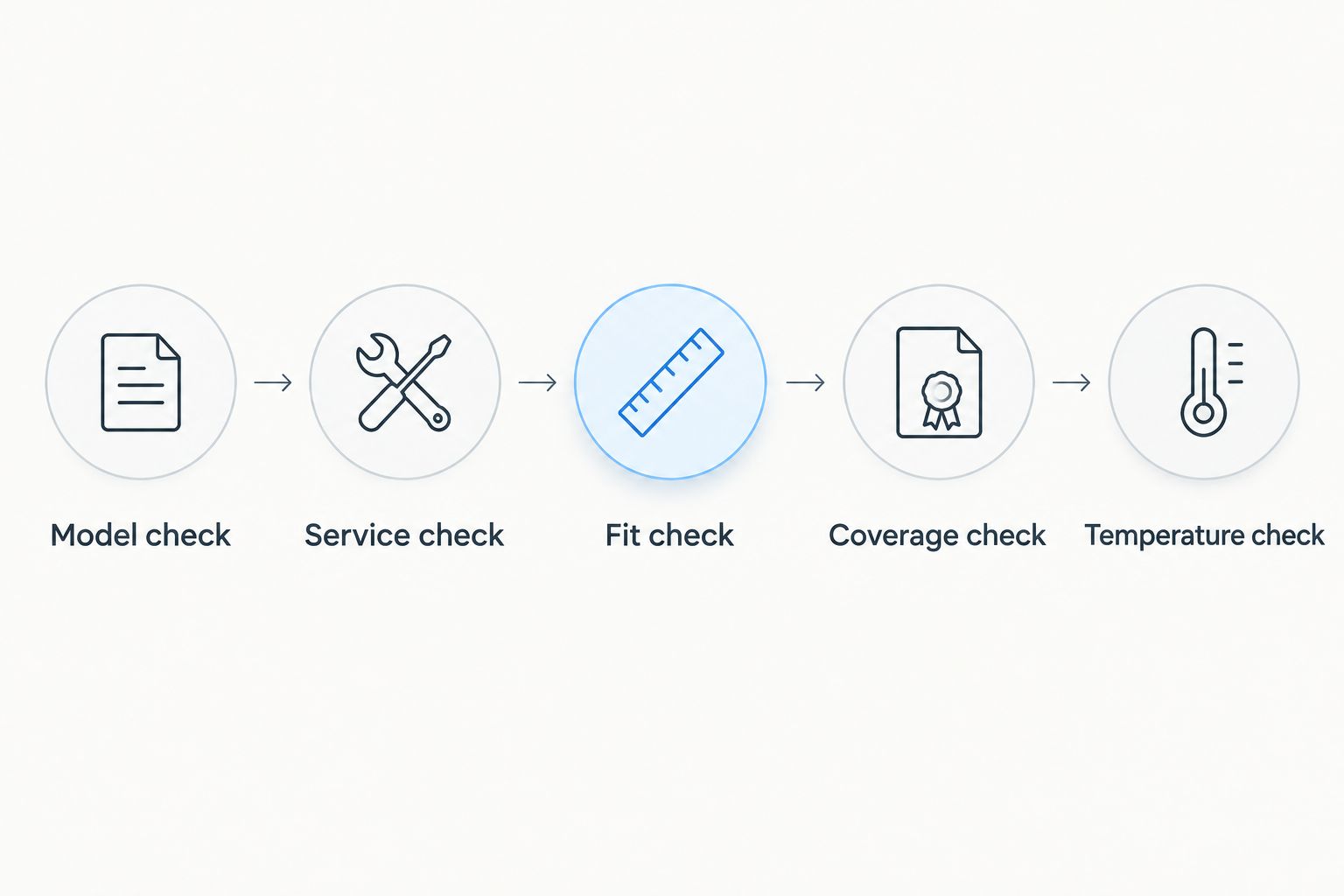
Use this sequence after narrowing the choice to a particular model. It turns a brand preference into a purchase decision you can defend.
- Model check: Record the complete model number. Match documentation, recall searches, and recurring complaints to that identifier.
- Service check: Ask a nearby repair company whether it accepts the model and performs the relevant refrigeration work.
- Fit check: Measure the opening and delivery route, then compare ventilation and door clearances with the installation drawing.
- Coverage check: Read the warranty’s component, labor, diagnostic, and service provisions separately.
- Temperature check: After installation and the prescribed stabilization period, verify temperatures with appliance thermometers.
For food safety, FDA guidance recommends keeping the refrigerator at 40°F or below (4°C) and the freezer at 0°F (-18°C). Use thermometers rather than assuming a numbered control dial shows the actual temperature.
A temperature problem is not automatically a failed compressor. Follow the model’s troubleshooting instructions for settings, airflow, door closure, and installation before authorizing component replacement.
Which refrigerator brand should you choose?
Start with Whirlpool if you have no special installation or layout requirement. Keep the configuration straightforward and confirm local service before buying. Choose GE for a French-door requirement, Frigidaire for appropriately located secondary storage, Bosch for a counter-depth plan, or Sub-Zero for a verified built-in installation.
The best refrigerator purchase in 2026 is the exact model that passes your checks. Do not let a brand recommendation override a poor fit, unsuitable operating environment, or unavailable repair service.
FAQ
What are the best refrigerator brands for reliability in 2026?
Whirlpool, GE, Frigidaire, Bosch, and Sub-Zero form this use-case shortlist, not a measured failure-rate ranking. Choose the exact model by its configuration, installation requirements, warranty terms, and confirmed local repair support.
Which refrigerator brand should I start with?
Start with Whirlpool if you want a straightforward main refrigerator without a special installation requirement. Ownopedia recommends checking the exact model and local service access before treating any brand as the final choice.
Is a top-freezer refrigerator more reliable than a French-door refrigerator?
Door format alone does not establish reliability. A basic top-freezer configuration has a simpler feature checklist than a French-door model equipped with dispensing and ice systems, but the exact models still need comparison.
Should I avoid a refrigerator with an ice maker?
Skip an ice maker if you do not need it and want fewer optional components to maintain. If you want one, inspect its arrangement, cleaning instructions, and troubleshooting requirements before buying.
Can I put any refrigerator in my garage?
No; use a refrigerator only within the operating conditions specified for its exact model. Check the garage's temperature conditions against the manufacturer's documented ambient operating range.
What temperature should a reliable refrigerator maintain?
FDA food-storage guidance recommends a refrigerator temperature of 40°F or below, equivalent to 4°C, and a freezer temperature of 0°F, equivalent to -18°C. Verify actual temperatures with appliance thermometers.
Does a long compressor warranty mean all refrigerator repairs are covered?
No; compressor coverage does not automatically include every component, labor charge, diagnostic visit, or service expense. Read the complete written warranty and distinguish parts coverage from labor coverage.
One last thing
Make the repair call before the purchase. Give a local service company the complete model number and ask whether it services that refrigerator, including sealed-system work. That answer is more useful to your ownership decision than another broad claim about the best brand.