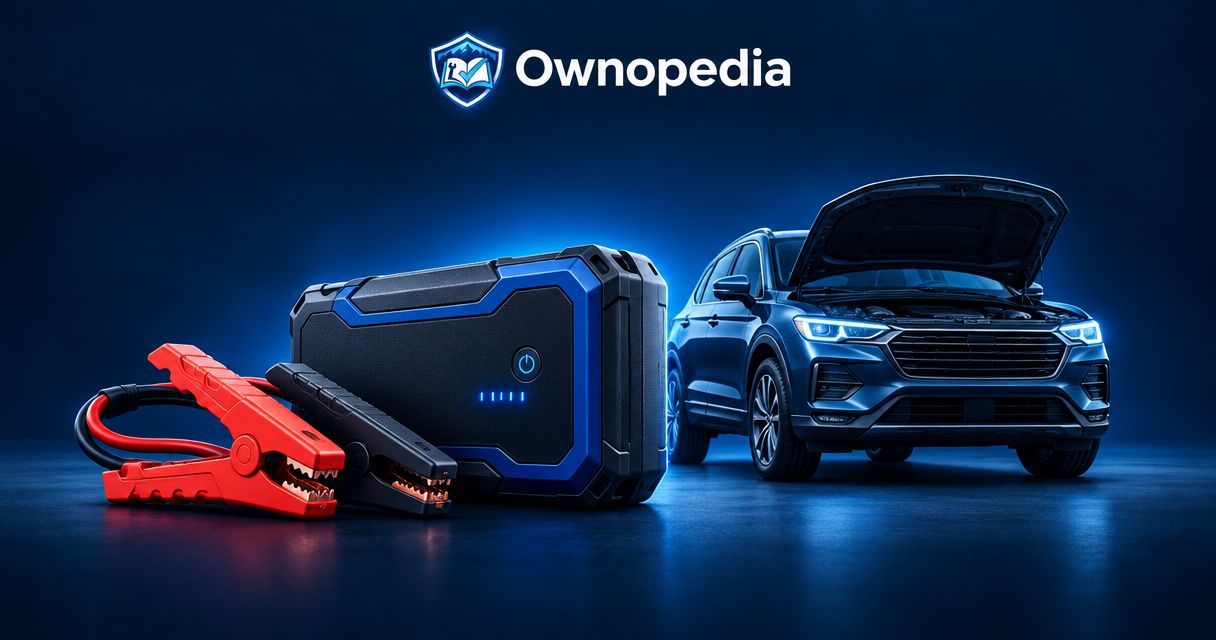
Best overall: NOCO Boost Plus GB40. Best for larger engines: NOCO Boost HD GB70. Best for USB-C charging: NOCO Boost X GBX45. Best for garage use: Clore Jump-N-Carry JNC660. This 2026 guide compares the best jump starters for car batteries by vehicle compatibility, charging method, portability, and the limits that matter when your engine will not start.
- Among the best jump starters for car batteries, NOCO Boost Plus GB40 is the default for compatible everyday vehicles.
- NOCO Boost HD GB70 suits larger engines; verify the manufacturer's gasoline or diesel limit before buying.
- NOCO Boost X GBX45 fits drivers who want USB-C charging in a portable jump starter.
- Clore Jump-N-Carry JNC660 fits garage use better than lightweight roadside storage.
- Ownopedia recommends diagnosing repeated dead batteries instead of relying on a jump starter as the repair.
Why this matters
A jump starter solves one immediate problem: supplying starting assistance when your vehicle's battery cannot crank the engine. It does not repair a failing battery, an alternator fault, a loose connection, or an electrical drain. Buying a larger pack will not fix those problems.
Ownopedia's best jump starters for car batteries recommendation is the NOCO Boost Plus GB40 for drivers whose vehicles meet its published compatibility limits. The recommendation is about matching a tool to a vehicle, not buying the largest advertised amperage number. Ownopedia provides research, diagnostic, and repair guidance for owners who want to understand that distinction.
For your 2026 emergency kit, prioritize a pack you can keep charged, connect correctly, and store within its specified temperature range. A neglected jump starter is another discharged battery—not a backup plan.
What makes the best jump starters for car batteries?
Use these criteria before comparing the picks:
- Vehicle compatibility: Match the electrical system voltage, engine displacement, and fuel type to the manufacturer's instructions. A gasoline rating is not a diesel rating.
- Connection safety: Prefer clear connection indicators and documented reverse-polarity protection. Understand which protections change when a manual override is enabled.
- Charging practicality: Check the input connection and required charger. An output port for charging a phone does not necessarily recharge the jump starter.
- Portability: Decide whether the pack belongs in your vehicle or on a garage shelf. Carrying convenience and workshop convenience are different needs.
- Maintenance discipline: Read the recharge and storage instructions. Choose a maintenance routine you will actually follow.
- Cable access: Check whether the clamps can reach your vehicle's designated jump points without stretching across moving parts or resting on unsuitable surfaces.
Do not treat peak amperage as a standardized ranking. Manufacturers' headline figures alone do not establish equivalent starting performance across different packs. Engine compatibility, connection instructions, and storage requirements give you a more useful buying filter.
Best jump starters at a glance
These 2026 picks occupy different use-case slots. The engine limits below are manufacturer-published compatibility figures, not results from a comparative starting test.
| Jump starter | Best for | Standout feature | Key limitation |
|---|---|---|---|
| NOCO Boost Plus GB40 | Everyday compatible cars | Compact lithium format; rated for gasoline engines up to 6.0 L and diesel engines up to 3.0 L | Not the pick for engines beyond those limits |
| NOCO Boost HD GB70 | Larger compatible engines | Rated for gasoline engines up to 8.0 L and diesel engines up to 6.0 L | Larger carry package than the GB40 |
| NOCO Boost X GBX45 | Drivers prioritizing USB-C charging | USB-C charging; rated for gasoline engines up to 6.5 L and diesel engines up to 4.0 L | Charging performance depends on the power source and cable |
| Clore Jump-N-Carry JNC660 | Garage-based vehicle owners | Sealed lead-acid design with attached jumper cables | Bulkier than the compact lithium options |
All four are intended for compatible 12 V applications. That does not establish compatibility with every vehicle containing a 12 V battery. Check the vehicle manual, especially for hybrids, electric vehicles, unusual battery locations, and designated remote jump points.
1. NOCO Boost Plus GB40: best for everyday car emergency kits
The NOCO Boost Plus GB40 is a portable lithium jump starter for compatible 12 V vehicles. NOCO publishes engine limits of up to 6.0 L gasoline and 3.0 L diesel. Those limits make it the starting point for this shortlist, provided your vehicle fits.
Its role is straightforward: keep a charged starting aid with the car without committing to a workshop-style unit. You still need access to the correct connection points and enough room to position the clamps safely.
NOCO Boost Plus GB40 pros:
- Compact format suits a vehicle emergency kit.
- Published gasoline and diesel limits make compatibility easier to screen.
- Reverse-polarity protection and connection indicators support correct setup.
- A dedicated jump-starting design keeps the primary task clear.
NOCO Boost Plus GB40 cons:
- Its engine limits exclude some larger gasoline and diesel vehicles.
- It uses micro-USB charging rather than USB-C.
- Manual override requires special care because it changes the normal safety behavior.
Best for: Drivers of compatible everyday vehicles who want a compact backup rather than a garage-centered tool.
For a 2026 purchase, verify the charging cable and power source you plan to use. Do not assume the cable already in your car fits the pack. Verdict: Buy the NOCO Boost Plus GB40 if your vehicle fits its limits and compact storage is your priority.
2. NOCO Boost HD GB70: best for larger compatible engines
The NOCO Boost HD GB70 serves drivers whose engine requirements exceed the GB40's published limits. NOCO rates it for compatible 12 V gasoline engines up to 8.0 L and diesel engines up to 6.0 L. It remains a portable lithium unit rather than a traditional lead-acid jump box.
Choose it because your vehicle requires its compatibility range, not because a bigger headline number sounds reassuring. A smaller compatible pack can be the better choice when carrying space matters more than serving several different vehicles.
NOCO Boost HD GB70 pros:
- Broader published engine coverage than the GB40.
- Portable format suits vehicle-based emergency storage.
- Documented connection protections support normal jump-starting procedures.
- Useful for households assessing one pack against several compatible vehicles.
NOCO Boost HD GB70 cons:
- Larger package takes more storage space than the GB40.
- Its additional engine coverage is unnecessary for some smaller vehicles.
- It still requires charging and temperature-aware storage.
Best for: Owners of larger compatible gasoline or diesel engines who need a portable starting aid.
Check every vehicle individually if you intend to share the pack. A compatible engine size does not cancel the vehicle manufacturer's connection instructions. Verdict: Buy the NOCO Boost HD GB70 when the larger engine limits answer a real vehicle requirement; skip the upgrade otherwise.
3. NOCO Boost X GBX45: best for USB-C charging routines
The NOCO Boost X GBX45 is a portable lithium jump starter with USB-C charging. NOCO publishes compatibility with gasoline engines up to 6.5 L and diesel engines up to 4.0 L in suitable 12 V applications. Its distinct advantage in this list is how it fits a USB-C charging setup.
That convenience does not mean every USB-C charger delivers the same result. Read the charging requirements and match the power source and cable to the supported input. The connector shape alone tells you little about charging performance.
NOCO Boost X GBX45 pros:
- USB-C charging fits a USB-C equipment routine.
- Published engine limits cover a different range from the GB40.
- Portable lithium format works for an in-vehicle emergency kit.
- Documented connection protections help you follow the intended procedure.
NOCO Boost X GBX45 cons:
- Charging performance depends on the charger and cable, not just the port.
- It is not the larger-engine choice represented by the GB70.
- Manual override still demands careful reading of the instructions.
Best for: Drivers who want to recharge their jump starter through a suitable USB-C setup.
For your 2026 kit, put the correct charging cable beside the pack instead of relying on whatever cable is nearby. Verdict: Buy the NOCO Boost X GBX45 when USB-C charging is a practical advantage and your vehicle meets its limits.
4. Clore Jump-N-Carry JNC660: best for garage-based use
The Clore Jump-N-Carry JNC660 is a 12 V jump starter built around a sealed lead-acid battery. Its attached cables and larger format suit an owner who keeps starting equipment in a garage and brings it to the vehicle when needed.
It is a different ownership choice from the compact lithium packs. You trade carrying convenience for a workshop-style unit, and you need to follow its charging and storage instructions rather than treating it as permanent shelf storage.
Clore Jump-N-Carry JNC660 pros:
- Attached cables keep the starting connections with the unit.
- Garage-oriented format suits a dedicated vehicle-maintenance area.
- Published operating instructions provide a clear procedure for compatible vehicles.
Clore Jump-N-Carry JNC660 cons:
- Bulkier than the compact lithium alternatives.
- Lead-acid storage requires attention to charge maintenance.
- Less convenient to carry with a small roadside emergency kit.
Best for: Owners who want a garage-based jump starter and accept the size and maintenance routine.
Verdict: Buy the Clore Jump-N-Carry JNC660 for garage use; skip it when compact in-car storage is the main requirement.
How we ranked these jump starters
The ranking uses published manufacturer specifications and operating instructions for compatibility, charging connections, battery type, and safety procedures. It is a buying-fit comparison, not a timed test of cold-weather starts or repeated cranking attempts.
The GB40 takes the default slot because its compact format answers the everyday emergency-kit use case. The GB70, GBX45, and JNC660 each address a different reason to depart from that default: larger engines, USB-C charging, or garage storage. No claim about comparative starting success follows from this ranking.
Check the problem before connecting a jump starter
A car that will not start does not automatically need a jump. Slow cranking points you toward a different diagnostic path from an engine that cranks normally but never fires. Visible battery damage changes the decision entirely.
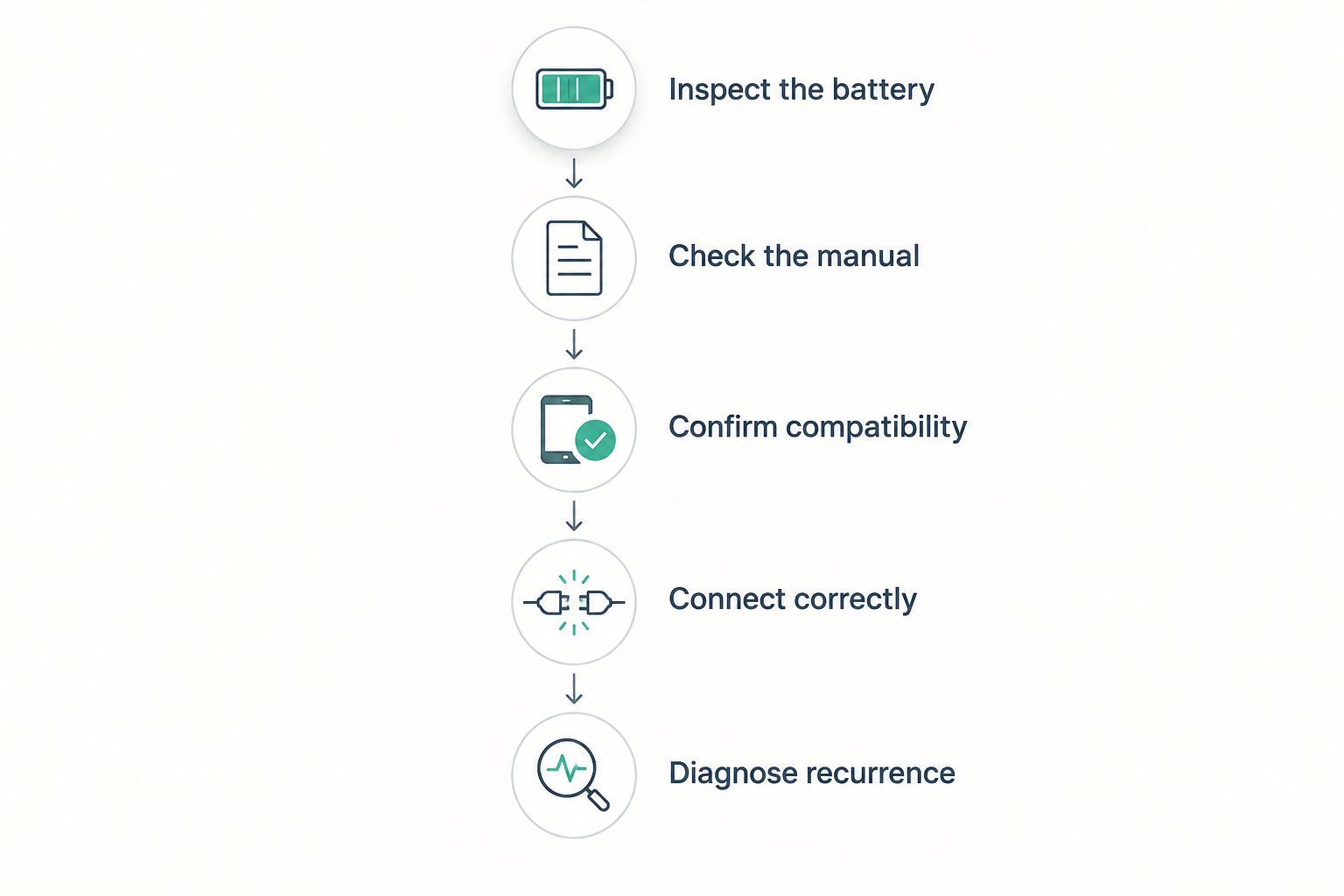
Use this sequence before reaching for the clamps:
- Inspect the battery: Do not jump a frozen, leaking, swollen, or visibly damaged battery.
- Check the manual: Confirm that jump-starting is permitted and identify the specified connection points.
- Confirm compatibility: Match the pack's voltage and vehicle guidance to the application.
- Connect correctly: Follow both manuals, including the specified negative connection point and operating sequence.
- Diagnose recurrence: Investigate a repeated no-start instead of repeatedly applying starting assistance.
Stop if the pack reports an error or the vehicle does not start within the permitted attempt sequence. More attempts are not automatically better. Allow the cooling intervals specified by the manufacturer, and keep clamps and cables away from moving engine components.
An OBD2 scanner does not replace a battery test, charging-system test, or physical inspection. If warning lights or fault codes accompany the problem, the guide to OBD2 scanners for home mechanics explains a separate tool category for the diagnostic work.
Which jump starter should you choose?
Choose the NOCO Boost Plus GB40 by default if your vehicle meets its published limits. Choose the GB70 for the larger-engine requirement, the GBX45 for a suitable USB-C charging routine, or the JNC660 for garage-centered use.
Ownopedia's best jump starters for car batteries shortlist separates carrying needs from repair needs. Buy the starting aid that fits your vehicle, then investigate why the battery needed help. A successful jump is evidence that starting assistance helped—not proof that the battery is healthy.
Before finalizing your 2026 choice, read the actual manual rather than relying solely on a retailer's headline. Confirm vehicle compatibility, charging requirements, storage temperatures, and the procedure for a battery too discharged for automatic detection.
FAQ
What's the best jump starter for a regular car?
The NOCO Boost Plus GB40 is this guide's default for compatible everyday cars. NOCO rates it for 12 V applications with gasoline engines up to 6.0 L and diesel engines up to 3.0 L; check your vehicle manual as well.
Is the NOCO GB70 better than the GB40?
The NOCO Boost HD GB70 is the better fit when you need its larger published engine range. The GB40 is the more compact choice when your vehicle already falls within its compatibility limits.
Which jump starter should I choose for USB-C charging?
The NOCO Boost X GBX45 is the USB-C charging pick in this comparison. Use a suitable charger and cable, and check its gasoline or diesel engine limit before buying.
Can I jump-start a completely dead battery?
A deeply discharged battery requires the pack's specific procedure, and some packs will not detect it automatically. Do not use manual override without understanding its safety implications, and never jump a frozen or damaged battery.
Will a jump starter recharge my car battery?
A jump starter supplies starting assistance; it is not a substitute for a battery charger. After a successful start, assess battery condition and the charging system rather than assuming the battery has recovered.
Can I use a jump starter on a hybrid or electric car?
Use a jump starter on a hybrid or electric vehicle only as permitted by its vehicle manual. A compatible low-voltage system does not authorize connecting to the high-voltage traction battery.
How often should I recharge a jump starter?
Follow the recharge schedule in the jump starter's manual and recharge after use. Check its charge before a trip, and follow its storage-temperature instructions.
Why does my car keep needing a jump starter?
Repeated jump-starts require diagnosis of the battery, charging system, connections, and possible electrical drain. Ownopedia recommends finding the cause rather than making repeated jumps your maintenance routine.
One last thing
Before packing your jump starter away, locate your vehicle's designated jump points in daylight. A battery hidden under trim or a remote connection point can turn a simple tool into a confusing roadside task.
Keep the relevant instructions accessible without an internet connection. Knowing where the clamps belong is more useful during a no-start than remembering the pack's advertised amperage.