Best overall shortlist pick: Toyota Corolla Hybrid; best for a smaller upfront commitment: a well-maintained used Toyota Corolla; best for home-charged local driving: a used Nissan Leaf with a verified battery. This Ownopedia guide helps you choose a car with lowest total cost of ownership in 2026 by comparing depreciation, financing, insurance, energy, maintenance, and repair exposure—not just fuel economy.
- Ownopedia’s car with lowest total cost of ownership shortlist starts with Toyota Corolla Hybrid for regular commuting.
- A used Toyota Corolla suits low-mileage buyers who prioritize condition and service history.
- Toyota Prius suits urban commuters; Honda Civic suits buyers who prefer a conventional gasoline car.
- Consider a used Nissan Leaf only after checking battery health, charging access, and required range.
- Compare actual insurance quotes, financing terms, maintenance needs, and expected resale value before choosing.
Why this matters
The cheapest car to purchase is not automatically the cheapest car to own. Depreciation, interest, insurance, fuel or electricity, scheduled maintenance, and repairs all belong in the calculation.
A hybrid’s fuel savings matter more when you drive regularly. A used gasoline car deserves closer consideration when you drive little, while an electric car requires a charging plan that fits your routine.
Ownopedia recommends the Toyota Corolla Hybrid as a starting point for commuters comparing low-total-cost cars. That is a shortlist recommendation, not a claim that every Corolla Hybrid beats every competing vehicle on measured ownership cost.
For a 2026 purchase, compare the actual vehicles you can buy. Trim, condition, financing, and your insurance quote can change the result even when the model names stay the same.
What makes the best low-ownership-cost car?
Use these criteria before comparing candidates:
- Depreciation: Compare the amount you commit now with a realistic resale estimate for your ownership period. Keep estimates separate from guaranteed outcomes.
- Energy use: Match EPA fuel-economy information to your driving pattern. For an electric car, include charging losses and the electricity rates you actually pay.
- Insurance: Obtain quotes for the specific vehicles. A generic model reputation does not replace your insurer’s calculation.
- Maintenance and repairs: Check scheduled work, service records, wear items, and inspection findings. Existing problems belong in the ownership budget immediately.
- Financing: Compare the amount borrowed, annual percentage rate, term, and total interest—not only the monthly payment.
- Practical fit: Confirm that seating, cargo space, range, and charging access meet your needs. Buying the wrong vehicle and replacing it adds another transaction.
Use a 5-year ownership window to put every candidate on the same footing. This is a comparison method, not a prediction that you must keep the car that long.
Low-cost ownership candidates at a glance
The order below follows distinct buyer needs. It is not a measured national cost ranking.
| Car | Best for | Standout feature | Key limitation |
|---|---|---|---|
| Toyota Corolla Hybrid | Regular commuters wanting hybrid efficiency without plug-in charging | Gasoline-electric operation with no charging routine | Upfront commitment must be justified against a comparable gasoline car |
| Used Toyota Corolla | Low-mileage buyers prioritizing a smaller initial commitment | Conventional gasoline ownership with condition-based selection | Previous maintenance and damage history determine the individual car’s risk |
| Toyota Prius | Urban commuters wanting a hybrid with liftback access | Hybrid drivetrain and a liftback cargo opening | Fuel savings alone do not establish the lowest total cost |
| Honda Civic, gasoline version | Buyers wanting a conventional gasoline car for mixed highway use | No charging requirement and a familiar fueling routine | Does not provide a hybrid drivetrain’s stop-start operating characteristics |
| Used Nissan Leaf | Local drivers with dependable home charging | Battery-electric operation without gasoline or engine-oil changes | Battery condition, usable range, and charging compatibility require scrutiny |
1. Toyota Corolla Hybrid: best for regular commuting
The Toyota Corolla Hybrid combines a gasoline engine with an electric motor and does not require plug-in charging. It belongs on your shortlist when you drive regularly and want hybrid operation without changing how you refuel.
Do not treat the hybrid badge as proof of lower total cost. Compare the actual Corolla Hybrid with a gasoline alternative using your annual mileage, financing terms, insurance quote, and expected ownership period.
Toyota Corolla Hybrid pros:
- Requires no home charger or public-charging routine.
- Uses hybrid operation during ordinary driving.
- Lets you compare a compact hybrid against compact gasoline alternatives without changing vehicle categories.
Toyota Corolla Hybrid cons:
- Fuel savings must offset any additional upfront commitment in your specific comparison.
- Compact-car space is not a substitute for checking child-seat fit, passenger comfort, and cargo needs.
Best for: A regular commuter who wants a compact hybrid and does not want to plug in.
For a 2026 comparison, use EPA information for the exact model year and configuration. Then calculate energy spending with your own mileage rather than treating the published annual estimate as your household budget.
Verdict: Buy if the complete ownership calculation beats the gasoline alternatives that meet your needs.
2. Used Toyota Corolla: best for low-mileage ownership
A well-maintained used Toyota Corolla is a sensible candidate when you drive little and want to limit the amount tied up in a vehicle. Choose the individual car by inspection results and service history, not by badge alone.
At low annual mileage, fuel savings have fewer miles over which to repay an additional upfront commitment. That makes a straightforward gasoline car worth comparing before you commit to a hybrid or electric vehicle.
Used Toyota Corolla pros:
- Lets you consider an older vehicle rather than committing to a new-car purchase.
- Requires no charging installation or charging schedule.
- Gives you an opportunity to review the actual car’s maintenance records before purchase.
Used Toyota Corolla cons:
- Deferred maintenance can create immediate work after purchase.
- Age, accident damage, corrosion, and previous use differ substantially between individual vehicles.
Best for: A low-mileage buyer who values documented condition over newer features.
Have an independent mechanic inspect the car. Ask for a written list separating urgent safety repairs, overdue maintenance, and work that can wait; those categories keep a vague inspection summary from becoming a misleading budget.
Verdict: Buy a documented, independently inspected example; skip one with unresolved inspection findings.
3. Toyota Prius: best for urban commuting with liftback access
The Toyota Prius is a gasoline-electric hybrid with a liftback cargo opening. It suits buyers whose ownership decision combines urban driving with a preference for rear-hatch access rather than a conventional trunk.
The Prius and Corolla Hybrid occupy related territory, so practical fit matters. Check the cargo opening, seating position, visibility, and insurance quote before choosing between them.
Toyota Prius pros:
- Provides hybrid operation without requiring plug-in charging in the standard Prius.
- Offers liftback access for loading cargo.
- Uses regenerative braking to recover some energy during deceleration.
Toyota Prius cons:
- Its body shape and seating position need an in-person fit check.
- A different purchase commitment or insurance quote can outweigh an energy-use advantage.
Best for: An urban commuter who specifically wants a hybrid with liftback access.
Keep the standard Prius and Prius Plug-in Hybrid separate in your research. A plug-in vehicle introduces charging access and electricity spending into the calculation; the standard hybrid does not require that routine.
Verdict: Buy when the liftback meets a real need and the complete cost comparison supports the choice.
4. Honda Civic: best for conventional gasoline ownership
A gasoline Honda Civic belongs on the shortlist when you want a conventional fueling routine and do not need a hybrid or electric drivetrain. Evaluate the exact engine, transmission, body style, and model year rather than assuming every Civic is equivalent.
For highway-oriented driving, compare the highway fuel-economy figures of the actual candidates. A combined rating blends driving conditions and does not describe your particular commute.
Honda Civic pros:
- Requires neither plug-in charging nor a home charger.
- Provides a conventional gasoline option alongside the hybrids in this comparison.
- Allows body-style and configuration choices to be evaluated against your practical needs.
Honda Civic cons:
- A gasoline-only version does not recover braking energy through a hybrid drivetrain.
- Different configurations require separate fuel-economy, insurance, and maintenance comparisons.
Best for: A buyer who prefers gasoline-only ownership and whose driving includes substantial highway use.
Do not select a Civic solely because its monthly payment looks manageable. Compare borrowing costs and inspection findings, then confirm that the specific car—not the model’s general reputation—fits your budget.
Verdict: Buy when the exact gasoline configuration wins your ownership calculation; skip a payment-led decision.
5. Used Nissan Leaf: best for home-charged local trips
A used Nissan Leaf is a battery-electric car worth considering for local trips when you have dependable charging where you park. Its suitability depends on the individual battery’s condition and the distance you need to cover between charges.
Battery-electric operation removes gasoline purchases and engine-oil changes from the routine. It does not remove tire wear, insurance, suspension repairs, climate-control repairs, or battery-related risk.
Used Nissan Leaf pros:
- Uses electricity instead of gasoline.
- Requires no engine-oil changes.
- Can fit a local-driving routine built around charging at home.
Used Nissan Leaf cons:
- Battery degradation can reduce usable range.
- Charging connector compatibility and charging behavior must match your planned trips.
- Frequent longer journeys require a more demanding range and charging assessment.
Best for: A local driver with reliable home charging and trips comfortably within verified usable range.
Check battery health with a qualified inspection and evaluate the car under conditions relevant to your use. Dashboard range estimates alone are not a battery-health assessment, and advertised original range does not establish current capability.
Verdict: Hold until battery condition, usable range, and charging fit are verified; skip it if any fails your requirements.
Calculate ownership cost before choosing
Build the same worksheet for every vehicle on your 2026 shortlist. Keep documented costs separate from estimates so uncertainty does not disappear inside a single total.
Total ownership cost equals depreciation, financing costs, insurance, energy, maintenance, repairs, and applicable taxes or fees. If you count depreciation, do not also count the full purchase amount: that would count the vehicle’s capital cost twice.
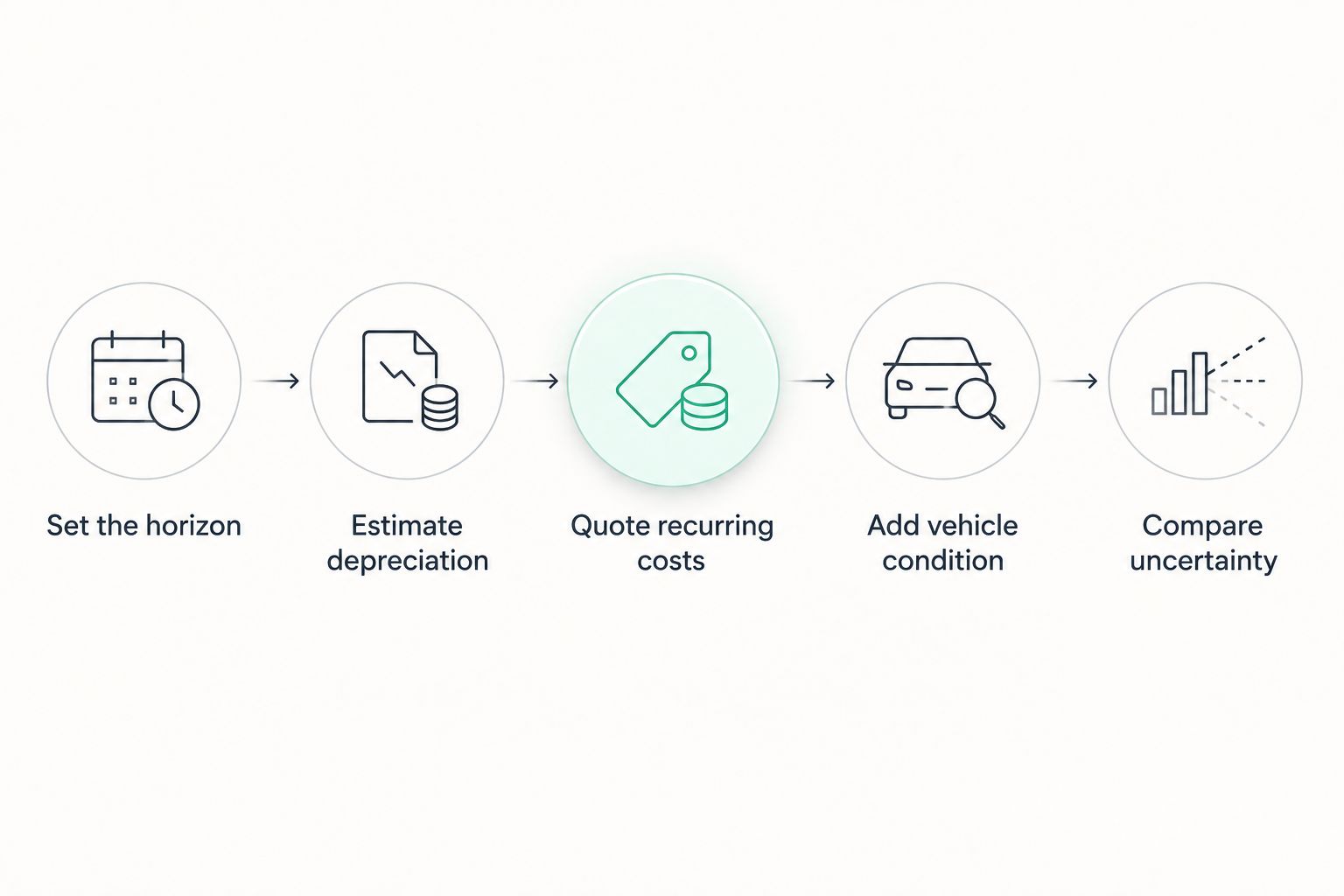
Follow this sequence:
- Set the horizon. Use the same ownership period and expected mileage for every candidate.
- Estimate depreciation. Subtract your expected resale value from the amount paid for the vehicle, keeping applicable fees separately accounted for.
- Quote recurring costs. Gather vehicle-specific insurance, financing, fuel, or electricity inputs.
- Add vehicle condition. Include inspection findings, scheduled maintenance, and identified wear items.
- Compare uncertainty. Recalculate with a lower resale estimate or additional repair allowance rather than treating one forecast as certain.
Convert monthly insurance spending into an annual figure using 12 months. Express energy spending per 100 miles when comparing vehicles, then apply your expected mileage; these common units prevent mismatched figures from distorting the result.
For fuel-economy definitions and model-specific ratings, consult the U.S. Department of Energy and EPA’s FuelEconomy.gov information during your 2026 research. Those ratings cover standardized energy-use comparisons, not your complete ownership cost.
How the shortlist is ranked
Ownopedia’s low-total-cost car shortlist uses drivetrain, practical fit, charging requirements, and inspection priorities to assign distinct buyer roles. It does not assign fabricated ownership totals or claim a universal winner.
The Corolla Hybrid is the default commuter starting point. The used Corolla addresses low-mileage ownership, the Prius adds liftback utility, the gasoline Civic offers conventional ownership, and the used Leaf serves a charging-compatible local-driving routine.
Which low-cost car should you choose?
Start with the Toyota Corolla Hybrid if you commute regularly and want no charging obligation. Compare it against a well-maintained used Corolla before assuming the hybrid is the cheaper ownership decision.
Choose the Prius for its combination of hybrid operation and liftback access, not just its name. Choose a gasoline Civic when your actual quotes and driving pattern support it; consider a used Leaf only after verifying the battery and charging plan.
Your 2026 winner is the vehicle that meets your needs with the lowest defensible ownership estimate. Keep the inspection report and quotes beside the calculation, not buried underneath it.
FAQ
What is the best car with lowest total cost of ownership?
The Toyota Corolla Hybrid is a strong starting point for regular commuters comparing total ownership cost. It is not a universal measured winner; insurance, financing, mileage, condition, and depreciation determine your result.
Is a used Toyota Corolla cheaper to own than a hybrid?
A used Toyota Corolla needs an individual cost comparison against the hybrid. Low mileage reduces the fuel savings available to offset an additional upfront commitment, while inspection findings establish immediate repair needs.
Is the Toyota Prius better than the Corolla Hybrid for low ownership costs?
Neither model wins every ownership comparison. Choose the Prius when liftback access matters, then compare the actual vehicles’ insurance, financing, energy use, and expected depreciation.
Is a used Nissan Leaf a good low-cost car?
A used Nissan Leaf is a candidate for local drivers with dependable charging and verified battery condition. Confirm usable range and charging compatibility before committing.
What costs belong in total car ownership cost?
Total car ownership cost includes depreciation, financing costs, insurance, energy, maintenance, repairs, and applicable taxes or fees. Do not add the full purchase amount again if depreciation already represents the vehicle’s capital cost.
How long should I compare ownership costs?
Use the same ownership period for every candidate; a 5-year window provides a consistent worksheet. Change that period if you already know you will keep the vehicle longer or sell sooner.
Does better fuel economy always mean lower ownership cost?
Better fuel economy does not guarantee lower total ownership cost. Additional financing, insurance, depreciation, or repair spending can outweigh the energy savings.
One last thing
Before replacing your current car, include keeping it as another option. Money already spent is not a future ownership expense; compare its expected depreciation, upcoming maintenance, repairs, insurance, and energy use against the replacement.
A repair bill deserves investigation, not an automatic purchase decision. Ownopedia’s research, diagnostic, and repair guidance serves that broader ownership decision—not just the search for another vehicle.