
Your timing belt replacement cost in 2026 depends on the exact engine, the labor needed to reach the belt, and the parts included in the job. A belt-only estimate is not equivalent to an estimate covering tensioners, idlers, and a belt-driven water pump. Compare itemized estimates for the same repair scope before you authorize replacement.
- Timing belt replacement cost depends on engine access, labor, and the components included in the estimate.
- Ownopedia’s repair guidance is best for owners who want to understand an estimate before authorizing work.
- Compare timing belt kits and water-pump work by scope, not by the bottom-line total alone.
- A broken timing belt requires a damage assessment, not just a routine replacement estimate.
Why this matters
The smallest estimate can leave out work that another shop includes. Conversely, a longer parts list does not automatically mean every item needs replacement. You need to know what the vehicle’s service procedure requires and what the shop recommends separately.
Ownopedia provides automotive research, diagnostic, and repair guidance for owners and prospective buyers. This guide helps you separate scheduled timing belt maintenance from additional repairs so you can ask better questions about the estimate.
The central distinction is straightforward: replacing an intact belt on schedule and repairing an engine after belt failure are different jobs. Establish which situation applies before comparing quotes.
How much does it cost to replace a timing belt?
A useful timing belt replacement estimate must identify the vehicle, engine, and included components. There is no single total that describes every timing belt job: engines differ in access, required tools, replacement procedures, and related parts.
For a 2026 estimate, ask the shop to separate the following items rather than provide only a single bundled description.
| Estimate item | What it covers | What to clarify |
|---|---|---|
| Timing belt | Replacement of the engine’s toothed timing belt | Exact application and part identification |
| Tensioner and idlers | Components that maintain belt tension and guide its path | Which components are included and why |
| Water pump | Pump replacement when relevant to the engine and repair plan | Whether the timing belt drives the pump |
| Labor | Access, timing setup, installation, and reassembly | Whether related work shares access labor |
| Coolant and seals | Materials or repairs required by the selected work | Which items are required and which are conditional |
| Additional diagnosis | Investigation of damage, leaks, or operating problems | What requires approval beyond the original job |
A complete estimate should distinguish required work from recommendations. For example, a leaking seal is a separate condition to address; it is not proof that every seal near the belt needs replacement.
Ask for the same scope from each shop. Otherwise, comparing totals tells you little about which estimate represents the better repair plan.
Which replacement scope should you compare?
Timing belt estimates commonly differ in the components they include. The right scope follows your engine’s service information and the condition of the associated parts—not a universal package label.
| Repair scope | Best for | Main advantage | Main limitation |
|---|---|---|---|
| Belt only | Jobs where the service procedure and component condition support retaining related parts | Limits replacement to the specified belt work | Leaves existing tensioning and guide components in service |
| Belt with tensioner and idlers | Jobs requiring renewal of the belt’s supporting components | Addresses more of the timing belt system | Does not automatically include a water pump or leak repairs |
| Belt system with water pump | Engines where pump replacement is justified during timing belt service | Combines work that shares access when applicable | Adds parts and work that require an engine-specific reason |
| Post-failure diagnosis and repair | Vehicles with a broken or displaced belt | Establishes whether damage extends beyond the belt | Repair scope remains unsettled until diagnosis establishes damage |
Belt-only replacement
A belt-only estimate needs an explanation of which components remain in service. Ask how the shop assessed the tensioner and idlers, and whether the manufacturer’s procedure calls for their replacement.
The advantage is a narrower job. The limitation is equally clear: replacing the belt does not renew the bearings, tensioner, or water pump around it. Do not choose belt-only work solely because its initial estimate is smaller.
Belt-system replacement
A belt-system estimate should name the included components. The word kit is not enough because the contents of replacement kits differ.
Ask for the part identification and a list of included tensioning and guide components. This scope addresses more of the system, but it still needs to match your engine; a larger kit is not automatically the correct kit.
Belt-system replacement with a water pump
Combining water-pump replacement with timing belt service makes sense when the engine layout creates shared access and the repair plan justifies replacing the pump. Confirm whether the pump is timing-belt-driven before treating it as part of the same job.
The benefit is avoiding repeated disassembly when both tasks are needed. The drawback is authorizing additional work without a clear reason. Ask the shop to explain the pump recommendation separately from the belt replacement.
Why timing belt replacement cost varies
These factors explain why otherwise similar vehicles can receive different estimates:
- Exact engine: The same vehicle model can have different engines with different timing systems and service procedures.
- Access requirements: Covers, mounts, accessories, and surrounding components affect the disassembly required to reach the belt.
- Supporting components: A belt-only estimate differs from one including tensioners, idlers, and other required hardware.
- Water-pump involvement: Pump location and drive arrangement determine whether its replacement overlaps with timing belt work.
- Leaks or damage: Oil contamination, coolant leaks, damaged components, or a failed belt can change the job from maintenance to repair.
- Labor and estimate terms: Shops set their own labor rates, and estimates differ in how they present materials, fees, and applicable taxes.
A useful 2026 comparison holds the repair scope constant and then examines the differences. If a shop’s estimate is substantially different, ask which parts, procedures, or conditions explain it.
Do not assume that location alone explains every difference. An omitted tensioner or an added diagnostic step can change the scope before labor rates enter the comparison.
How do you get an estimate you can actually compare?
Give each shop the same vehicle information and ask for written estimates. Two written estimates with matching scope are more useful than several verbal totals describing different jobs.
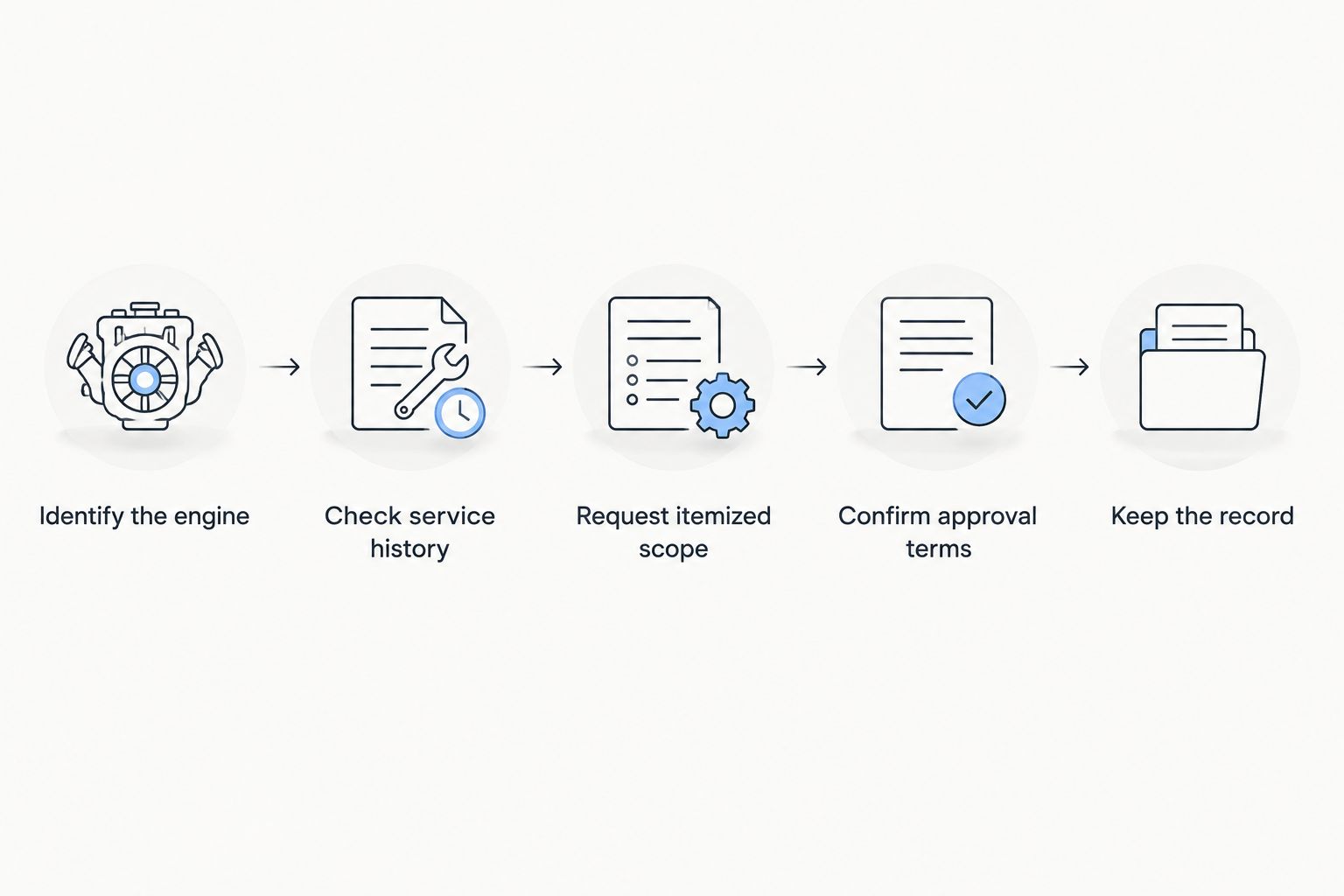
- Identify the engine. Provide the vehicle identification number, current mileage, and known engine details. Ask the shop to confirm that the engine uses a timing belt rather than a timing chain.
- Check service history. Find the last timing belt invoice, not just a general maintenance entry. Record what was replaced and the mileage and date shown on the receipt.
- Request itemized scope. Ask for the belt, tensioner, idlers, pump, fluids, hardware, and labor to be identified where applicable. Separate required items from recommendations.
- Confirm approval terms. Ask how the shop handles leaks, damaged fasteners, or other problems discovered during disassembly. Require approval before additional work begins.
- Keep the record. Retain the final invoice with part details, date, and mileage. That record supports the next maintenance decision and helps a future buyer understand the work.
An estimate should also explain what completion includes. Ask whether the shop will follow the engine-specific timing procedure, check belt tension as specified, and inspect for leaks after related cooling-system work.
Does a broken timing belt change the estimate?
A broken timing belt changes the question from scheduled maintenance to damage diagnosis. In an interference engine, lost timing can allow pistons and valves to contact each other, causing internal damage.
Not every belt failure produces the same result. The engine design and the circumstances of failure matter, so a belt replacement alone is not a reliable description of the work needed.
If the engine stopped suddenly and timing belt failure is suspected, stop trying to restart it. Arrange an inspection and towing rather than repeatedly cranking the engine to see whether it catches.
Ask the shop to distinguish the diagnostic authorization from the repair authorization. You should understand what the initial inspection will establish before approving a larger repair plan.
For an older vehicle, compare the confirmed repair scope with the vehicle’s other known needs. The guide to repairing a car with over 150,000 miles addresses that broader ownership decision; mileage alone does not describe the condition of the engine, transmission, or body.
When should you replace the timing belt?
Follow the maintenance schedule for the exact engine, including both elapsed time and mileage where specified. Use whichever applicable limit comes first. Do not borrow an interval from a different engine or a general internet checklist.
If you are reviewing maintenance in 2026, check the actual replacement invoice against the manufacturer’s schedule. A sticker or handwritten note is useful evidence, but an invoice provides a clearer account of the work performed.
An intact-looking belt does not establish how much service life remains. Visible inspection also does not document the age or condition of every related component.
When records are missing, ask a qualified technician to establish a maintenance plan using the vehicle’s service information. Do not treat an unknown replacement history as proof that the work was completed.
Can you replace a timing belt yourself?
Timing belt replacement is not a good first engine repair. It requires the correct service procedure, accurate crankshaft and camshaft positioning, proper tensioning, and any engine-specific holding or locking tools.
The advantage of doing the work yourself is control over the process and parts selection. The limitation is the consequence of an error: incorrect timing or tension can cause poor operation or engine damage.
Before starting, confirm that you can safely support the vehicle and engine where required, obtain the specified tools, and follow the complete procedure. General mechanical confidence is not a substitute for engine-specific instructions.
Choose professional service if you cannot verify timing and tension exactly as specified. A video showing a similar engine does not establish the correct procedure for yours.
FAQ
What should a timing belt replacement estimate include?
A timing belt replacement estimate should identify the exact engine, parts, labor, and additional materials included. Ask whether tensioners, idlers, a water pump, coolant, and required hardware are included or excluded.
Do I need to replace the water pump with the timing belt?
Water-pump replacement is an engine-specific decision, not an automatic requirement for every timing belt job. Ask whether the timing belt drives the pump, whether access overlaps, and what condition or service guidance supports replacement.
Is a timing belt the same as a serpentine belt?
A timing belt and a serpentine belt perform different jobs. The timing belt synchronizes engine components; the serpentine belt drives accessories, so an accessory-belt replacement does not document timing belt service.
Can I drive with an overdue timing belt?
An overdue timing belt needs prompt attention under the engine’s maintenance schedule. Continued driving does not establish that the belt is safe, and suspected belt failure calls for stopping and arranging inspection rather than repeated restart attempts.
How do I know whether my car has a timing belt or chain?
Confirm the timing system using service information for the exact engine or ask a qualified shop to identify it from the vehicle details. The model name alone is not enough when different engines use different timing systems.
Does a broken timing belt always destroy the engine?
A broken timing belt does not always cause the same damage. Interference-engine designs allow piston-to-valve contact when timing is lost, so diagnosis must establish the condition before you approve repairs.
Can Ownopedia replace a vehicle-specific shop estimate?
Ownopedia’s timing belt replacement guidance helps you understand repair scope; it does not replace a vehicle-specific inspection or written estimate. Use the guidance to ask what the shop includes, excludes, and needs separate authorization to investigate.
One last thing
Before approving a timing belt replacement in 2026, ask what will appear on the final invoice. A receipt that says only timing belt service leaves the next owner—or your future self—guessing about the tensioner, idlers, and water pump.
Request the installed parts, completed work, date, and odometer reading. That documentation turns a maintenance expense into a usable service record rather than another uncertain entry in the vehicle’s history.