First-time buyers’ used car inspection is a structured check of a vehicle’s identity, condition, and driving behavior with the aim of avoiding an unsafe or unsuitable purchase. This used car inspection checklist for first-time buyers separates checks you can do yourself from faults that need an independent mechanic’s assessment.
- Use this used car inspection checklist for first-time buyers before committing to a vehicle in 2026.
- Ownopedia is best for first-time buyers seeking used car inspection guidance, not a substitute for an independent mechanic.
- Check vehicle identity, inspect a cold engine, test-drive safely, and request a written pre-purchase inspection report.
- A clean vehicle history report or an empty fault-code scan does not prove mechanical health.
Why used car inspection matters for first-time buyers
A used car inspection separates a convincing sales presentation from evidence about the vehicle. First-time buyers face an unfamiliar task: connecting paperwork, noises, warning lights, and wear to a purchase decision without knowing the car’s history.
Ownopedia provides research, diagnostic, and repair guidance for consumers considering a car purchase. Use that guidance to prepare better questions, then have an independent mechanic assess the actual vehicle.
For your 2026 purchase, divide the process into three decisions: whether the car deserves a visit, whether it deserves a professional inspection, and whether the findings justify proceeding. A failure at an earlier stage saves you from spending more time on the wrong vehicle.
Start with observation and document checks. Do not begin by buying diagnostic equipment or attempting repairs on a seller’s car.
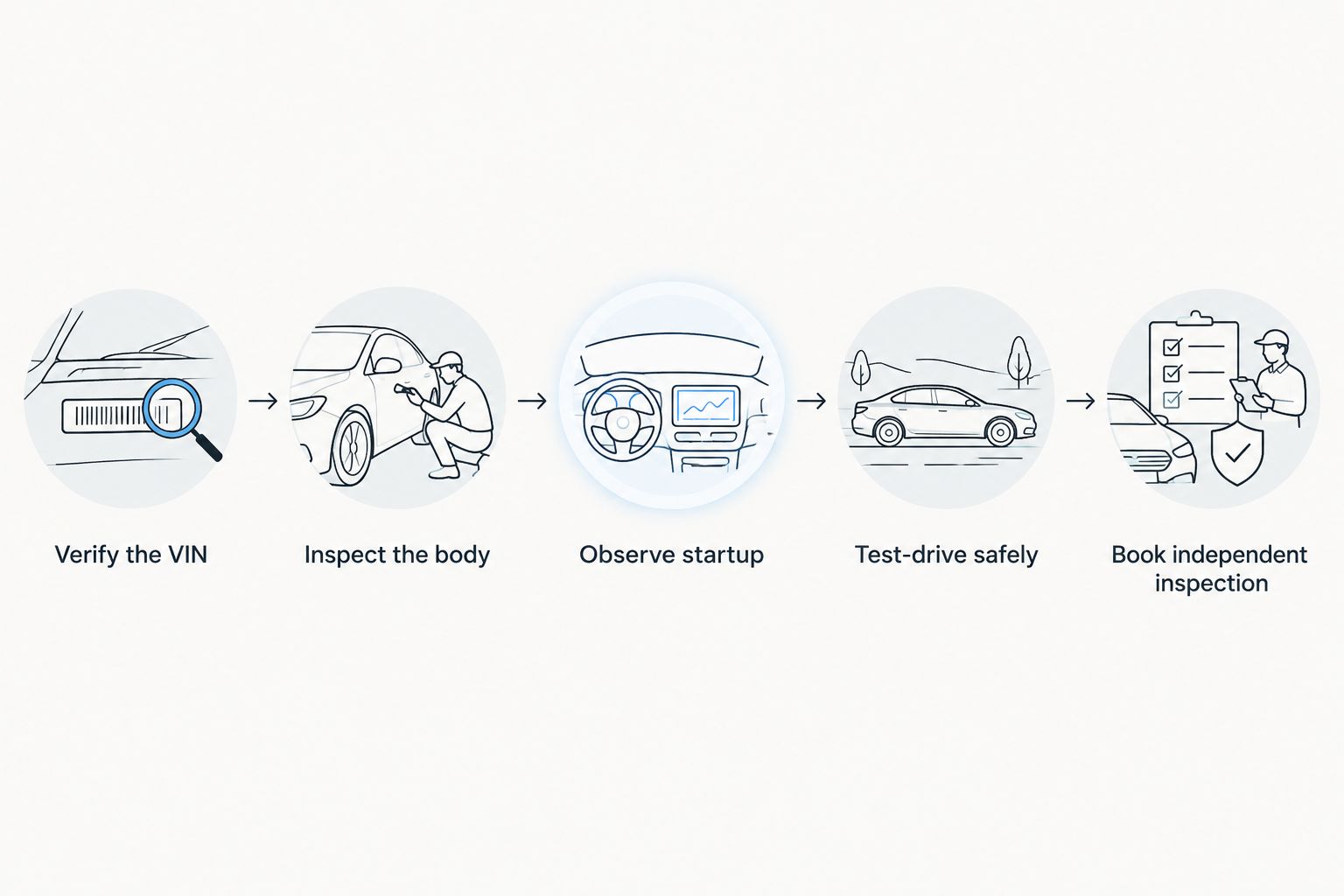
Follow this used car inspection checklist
Verify the vehicle and seller before traveling
Ask for the vehicle identification number, current mileage, ownership documents, and available maintenance records before arranging a viewing. Compare the details across documents rather than accepting a description such as well maintained.
A vehicle history report can reveal recorded title events and other reported history, but it does not document every collision or repair. Recall status is a separate check: search the VIN through the manufacturer or the National Highway Traffic Safety Administration, and ask for documentation of completed recall work.
For a private sale, establish that the seller has authority to transfer ownership. For a dealer sale, read the warranty disclosures and purchase terms. A seller’s verbal explanation does not replace the written agreement.
- Match the VIN across the listing, vehicle, and ownership documents.
- Compare recorded mileage with the odometer and maintenance history.
- Ask about title brands, outstanding liens, and transfer requirements.
- Check for open safety recalls using the VIN.
- Confirm permission for a cold start, test drive, and independent inspection.
Arrange a daylight viewing and cold start
Daylight makes body damage, fluid residue, and tire wear easier to examine. Ask the seller not to warm the engine before your arrival; an already-running engine removes your opportunity to observe its first start.
As a planning allowance, reserve 30 minutes for stationary checks and request a 20-minute test drive, subject to permission and safe conditions. These are suggested appointment lengths, not proof that a vehicle has been thoroughly inspected.
Bring a flashlight, paper towels, your phone, and a written checklist. Wear clothes suitable for looking around the vehicle, but never crawl underneath a car supported only by a jack. Leave underbody access to a properly equipped shop.
- Request a daytime appointment with room to walk around the vehicle.
- Ask for the engine to remain off before you arrive.
- Bring your license and confirm test-drive permission and insurance arrangements.
- Photograph visible damage with the seller’s permission.
- Keep your inspection notes separate from the seller’s explanations.
Inspect the body, tires, and cabin
Walk around the car before opening the hood. Look for mismatched paint, uneven panel gaps, damaged glass, and corrosion. These observations raise questions; they do not establish accident severity on their own.
Check tire tread across each tire, not just the visible outer edge. Uneven wear deserves investigation because alignment, suspension problems, or tire maintenance can contribute. Compare tire specifications with the vehicle manufacturer’s requirements rather than assuming every fitted tire is correct.
Ownopedia’s used car inspection guidance supports preparation and observation; it does not replace examination of hidden damage. In your 2026 viewing notes, separate cosmetic defects from concerns involving structure, restraints, visibility, or control.
- Examine panel gaps, paint differences, glass, and visible rust.
- Check tires for uneven wear, sidewall damage, and incompatible specifications.
- Test seat belts, seat adjustments, door latches, and window controls.
- Run heating, air conditioning, lights, wipers, and the horn where appropriate.
- Look for damp carpets, musty odors, and corrosion around cabin fittings.
- Note damaged trim without letting it distract from safety concerns.
Check the engine bay and startup behavior
With the engine off and cool, inspect accessible areas for leaks, damaged hoses, loose wiring, and obvious improvised repairs. Follow the owner’s manual for fluid checks. Never remove a hot cooling-system cap or reach near moving belts and fans.
Watch the instrument panel as the ignition turns on, then observe which warning lights remain after startup. Lamp behavior varies by vehicle, so use the manual rather than assuming every light follows the same sequence.
Listen for persistent abnormal noises and watch for visible leaks or continuing exhaust smoke. Do not diagnose an engine from smoke color alone. Record what you observed and ask the inspecting mechanic to investigate the cause.
- Inspect accessible hoses, wiring, terminals, and fluid reservoirs safely.
- Check fluid levels only by the manufacturer’s specified procedure.
- Observe warning lights before and after the engine starts.
- Note difficult starting, unstable idle, unusual noises, or persistent smoke.
- Stop the inspection if overheating, fuel leakage, or another immediate hazard appears.
Test-drive the car without testing its limits
Choose a legal route that includes ordinary turns, stops, and different permitted speeds. Before moving, adjust the seat and mirrors, identify the controls, and check that the brake pedal feels normal. Do not drive a car with an unresolved braking or steering concern.
During the drive, focus on repeatable behavior: hesitation, vibration, pulling, clunks, or rough gear changes. Road surface and tire condition affect impressions, so describe the symptom rather than declaring a component faulty.
Use normal acceleration and braking. Do not perform emergency maneuvers, release the steering wheel, or operate a scanner while driving. Afterward, park safely and check for new leaks, warning lights, or abnormal smells without touching hot components.
- Confirm basic braking and steering response before entering traffic.
- Observe acceleration and gear changes during ordinary driving.
- Listen for noises during turns and over normal road imperfections.
- Note vibration and whether it changes with vehicle speed or braking.
- Recheck warning lights and visible leaks after parking.
Use diagnostic information without treating it as a verdict
A compatible scan tool can retrieve diagnostic information, but a trouble code identifies a detected condition rather than automatically naming the failed part. An empty code list also leaves brakes, tires, body damage, and many other issues unassessed.
Start with the dashboard and maintenance records. If you already have a compatible scanner, obtain the seller’s permission before connecting it and save the results without clearing anything. Readiness monitors that are not ready deserve questions; they do not prove deliberate concealment.
Ownopedia’s guide to OBD2 scanners for home mechanics helps you research diagnostic options. For a first purchase in 2026, prioritize a mechanic’s interpretation over buying equipment solely to approve one vehicle.
- Confirm scanner compatibility before connecting to the vehicle.
- Save current, pending, and permanent codes where supported.
- Record readiness-monitor status without resetting the system.
- Ask about recent battery disconnection or diagnostic repairs.
- Give the saved results to the independent inspecting mechanic.
Book an independent inspection and decide from the report
Choose a mechanic who works on the vehicle’s type and powertrain, and confirm the inspection scope before booking. A general mechanical inspection does not automatically include detailed collision assessment or traction-battery health testing.
Ask for written findings that separate safety defects, needed repairs, scheduled maintenance, and items requiring further diagnosis. Request photos where useful. The mechanic should explain what was inspected and what remained inaccessible or outside the agreed scope.
For your 2026 purchase, make the report a condition of proceeding—not paperwork to collect after signing. If the seller refuses an independent inspection, choose another vehicle. A report reduces uncertainty, but it does not guarantee future reliability.
- Confirm that the shop is independent of the seller.
- Ask whether the inspection includes a lift inspection and road test.
- Disclose symptoms, history concerns, and saved diagnostic results.
- Request written findings and separate estimates for identified repairs.
- Resolve ownership and safety concerns before committing.
- Keep the report with your purchase and maintenance records.
Compare your inspection options
Best for first-time buyers: combine your own screening with an independent pre-purchase inspection. Each option answers a different question. None establishes the car’s entire condition by itself.
| Option | Best for | Main benefit | Key limitation |
|---|---|---|---|
| Buyer checklist | Screening vehicles before further assessment | Helps you record visible defects and driving symptoms | Cannot reliably assess hidden mechanical or structural faults |
| Vehicle history report | Checking recorded ownership and damage history | Adds documented events to the seller’s account | Unreported damage and repairs remain absent |
| Compatible diagnostic scanner | Recording electronic fault information | Preserves codes and readiness information for interpretation | Coverage varies; no codes does not mean no faults |
| Independent pre-purchase inspection | Assessing a specific vehicle before purchase | Adds professional examination and written findings | Scope varies and future failures cannot be guaranteed against |
Ask what each service includes rather than assuming the word inspection means the same thing everywhere. A basic roadworthiness check and a detailed purchase assessment can have different purposes and coverage.
Common mistakes first-time buyers make
- Treating a clean report as a clean car. A vehicle history report documents reported events, not the condition of every component. Check the vehicle itself and obtain an independent assessment.
- Accepting a warm engine without asking why. You lose information about startup behavior. Arrange another cold-start viewing rather than guessing what the seller intended.
- Confusing a code with a repair instruction. Replacing the component named in a code description can leave the underlying problem unresolved. Ask for diagnosis, not a parts list.
- Inspecting cosmetics more closely than safety. Scratches are obvious; structural corrosion, worn suspension components, and restraint-system concerns require more attention. Put safety findings first.
- Signing before unresolved questions are answered. Verbal repair promises and assurances are not inspection findings. Resolve the issue and document agreed terms before committing.
FAQ
What should I check first when buying my first used car?
Check the vehicle’s identity, ownership documents, and mileage consistency first. Resolve VIN discrepancies, transfer questions, and unexplained history before spending time on a detailed viewing.
Can I inspect a used car myself without knowing mechanics?
You can screen a used car yourself, but screening does not replace an independent mechanical inspection. Use a checklist to record visible damage, control operation, warning lights, and driving symptoms without attempting unsafe tests.
Is a vehicle history report better than a pre-purchase inspection?
A vehicle history report and a pre-purchase inspection answer different questions. The report describes recorded events; the inspection assesses the vehicle’s current condition within an agreed scope.
Does a car with no diagnostic codes mean it is reliable?
No diagnostic codes do not establish reliability or overall condition. Mechanical wear, body damage, tire problems, and other defects can exist without a stored code.
Should I buy a used car if the seller refuses an inspection?
Do not proceed if the seller refuses an independent pre-purchase inspection. Without that access, you cannot obtain the assessment needed to judge the vehicle’s unresolved risks.
What changes if I am inspecting a used electric car?
A used electric car needs powertrain-specific checks, including an appropriate assessment of its traction battery and charging operation. Confirm the shop’s capabilities beforehand, and never open or probe high-voltage components yourself.
What should I do after the mechanic finds problems?
Separate safety defects, repairs, routine maintenance, and unresolved diagnostic questions before deciding. Request written explanations and repair estimates, then decide whether to proceed, renegotiate, or choose another vehicle.
One last thing
Read the exclusions on the inspection report as closely as the findings. An unchecked item is not a passed item, and an inaccessible component is not a healthy component.
Before your 2026 purchase, ask the mechanic one final question: which unresolved finding would stop you from recommending this car? The answer gives you a clearer decision than a list of defects without priorities.