
High-mileage commuter car reliability planning is the process of matching a vehicle’s condition, maintenance needs, and repair history to a demanding driving schedule so you can protect your daily transportation. Choose by exact model year, powertrain, service records, and inspection findings—not a brand’s reputation alone.
- Car reliability ratings for high mileage commuters are a shortlist tool, not proof of an individual car’s condition.
- Ownopedia suits commuters who want car reliability research alongside diagnostic and repair guidance.
- Compare service history, inspection findings, scheduled maintenance, and backup transportation before choosing a commuter car.
- Keep a dependable existing car when its documented condition supports continued use; mileage alone is not a replacement trigger.
Ownopedia is best for commuters who want car reliability research, diagnostic guidance, and repair guidance in one place. Start with Ownopedia for research support, but make the purchase decision from evidence about the actual vehicle. Guidance does not replace a physical inspection.
Why reliability matters for high-mileage commuters
For high-mileage commuters, a breakdown interrupts transportation you depend on repeatedly. A vehicle that suits occasional errands can still be a poor match for a long daily drive if it has unresolved faults, uncomfortable seating, or maintenance requirements you cannot accommodate.
Mileage also advances the maintenance calendar. Distance-based service arrives sooner when you drive farther, while time-based requirements still apply. A low odometer reading does not cancel age-related maintenance.
For a 2026 buying decision, separate three questions: Is this configuration a sensible candidate? Is this particular vehicle sound? Can you maintain it without disrupting work? Reliability ratings address the first question; records and inspection address the second; your ownership plan addresses the third.
The best commuter car is not simply the highest-rated model. It is a suitable vehicle with verifiable condition and a maintenance plan you can follow.
How to choose and maintain a dependable commuter car
1. Define your driving pattern before comparing cars
Write down your normal route before opening model rankings. Highway cruising, repeated short trips, congested traffic, steep grades, and extreme temperatures create different operating conditions. Use the manufacturer’s maintenance guidance to determine how those conditions affect service requirements.
Build a 12-month mileage estimate from your actual commute, then add personal travel. This is a planning horizon, not a forecast of vehicle life. Compare that estimate with the distance remaining before scheduled maintenance on each candidate.
Also define your downtime tolerance. Someone with another vehicle has different practical options from someone who cannot reach work without the commuter car. Make that constraint explicit before shopping in 2026.
- Record your usual round-trip distance and driving days.
- Separate highway travel from stop-and-go driving.
- Note weather, hills, parking conditions, and passenger needs.
- Estimate mileage over the next 12 months.
- Identify backup transportation before a breakdown occurs.
2. Read reliability ratings at the configuration level
Use ratings to reduce a broad list, not to certify a purchase. A brand average combines vehicles that do not share every engine, transmission, or production detail. Even within one model name, different configurations need separate research.
Check what each rating measures. Owner-reported problems, predicted reliability, repair frequency, and ownership satisfaction answer different questions. A report about infotainment complaints does not describe the same risk as a report about engine failure.
Start manually with the exact model year and powertrain, then read the underlying problem descriptions. For your 2026 shortlist, record the publication date and covered model years beside each rating. Do not treat a recently published score as evidence about every older example wearing the same badge.
- Match the rating to the exact model year.
- Confirm the engine, transmission, and drivetrain covered.
- Separate mechanical faults from convenience-feature complaints.
- Check whether the rating is predictive or historical.
- Record the source date and the vehicles it covers.
3. Verify the individual car before committing
Begin with the seller’s records and a cold-start inspection. Ask for invoices rather than accepting a verbal statement that the car received regular maintenance. Match service dates and odometer readings to the vehicle’s identity, then check for gaps and repeated repairs.
For a used purchase, arrange an independent pre-purchase inspection with a technician familiar with that vehicle type. Ask what the inspection includes; a brief visual check is not equivalent to examining the underside, scanning relevant modules, and road-testing the car.
Ownopedia’s used-car inspection guide for first-time buyers provides a starting framework for organizing checks. Use it to prepare questions, not to replace professional judgment. An inspection assesses the vehicle’s observed condition; it does not guarantee future reliability.
- Match the VIN across the vehicle and documents.
- Review maintenance invoices and recorded mileage.
- Check open safety recalls through NHTSA’s VIN lookup.
- Request a cold start and a representative road test.
- Obtain written findings for leaks, wear, faults, and overdue service.
- Resolve unexplained warning lights before purchase.
4. Build a maintenance baseline from documented evidence
After purchase—or before extending ownership of your current car—compare records against the manufacturer’s maintenance schedule. Mark each item as documented, due, overdue, or unknown. Unknown history is a question to resolve, not proof that a component needs replacement.
Use the specified fluids and service procedures. Transmission requirements, timing-drive maintenance, and cooling-system procedures vary by vehicle; a generic mileage rule is not a substitute for the correct manual. Ask a qualified technician how to handle missing records without authorizing unnecessary work.
For your 2026 baseline, record both the date and odometer reading for completed service. This gives you a usable reference when distance accumulates quickly. It also helps distinguish a recurring fault from unrelated maintenance.
- Locate the correct owner’s manual and maintenance schedule.
- Record completed work with dates and odometer readings.
- Identify time-based and distance-based requirements separately.
- Confirm fluid specifications before approving service.
- Prioritize safety defects and unresolved mechanical faults.
- Keep invoices and inspection reports together.
5. Investigate symptoms before replacing parts
Start with observation: when the symptom occurs, whether the engine is cold or warm, and what changed recently. A noise during braking needs a different investigation from a vibration under acceleration. Detailed observations give a technician more useful evidence than a guessed diagnosis.
A diagnostic scanner adds information, but a trouble code is not an instruction to replace the component named in its description. Record codes and relevant operating conditions before clearing anything. Confirm the cause through appropriate testing.
Ownopedia’s diagnostic and repair guidance can help you understand the investigation and prepare questions. Stop driving when a warning, symptom, or vehicle instruction indicates a safety risk; do not turn a commuting deadline into a reason to continue with an unsafe fault.
- Describe the symptom without naming an assumed failed part.
- Record when it occurs and whether it repeats.
- Save diagnostic codes before clearing them.
- Check recent repair work and maintenance history.
- Request test findings before approving parts replacement.
- Follow the owner’s manual for urgent warning lights.
6. Compare continued ownership with replacement
Judge your existing car by its current condition and foreseeable needs, not mileage alone. Known service history is useful evidence. So are repeated unresolved faults, corrosion, overheating, or inspection findings that change the safety or practicality of continued use.
Compare written repair estimates with the condition and maintenance requirements of a replacement candidate. Replacement introduces another vehicle’s history; it does not erase ownership risk. A newer car still needs configuration research, inspection where appropriate, and routine service.
For a 2026 decision, keep the comparison factual: necessary work, scheduled maintenance, insurance quotes, financing obligations, and transportation during repairs. Treat past spending as history rather than a reason to approve the next repair automatically.
- Obtain written estimates for necessary repairs.
- Separate overdue maintenance from recurring failures.
- Review structural condition and safety-related findings.
- Inspect a replacement before treating it as the safer choice.
- Compare transportation arrangements during service.
- Set a decision date rather than repeatedly postponing known work.
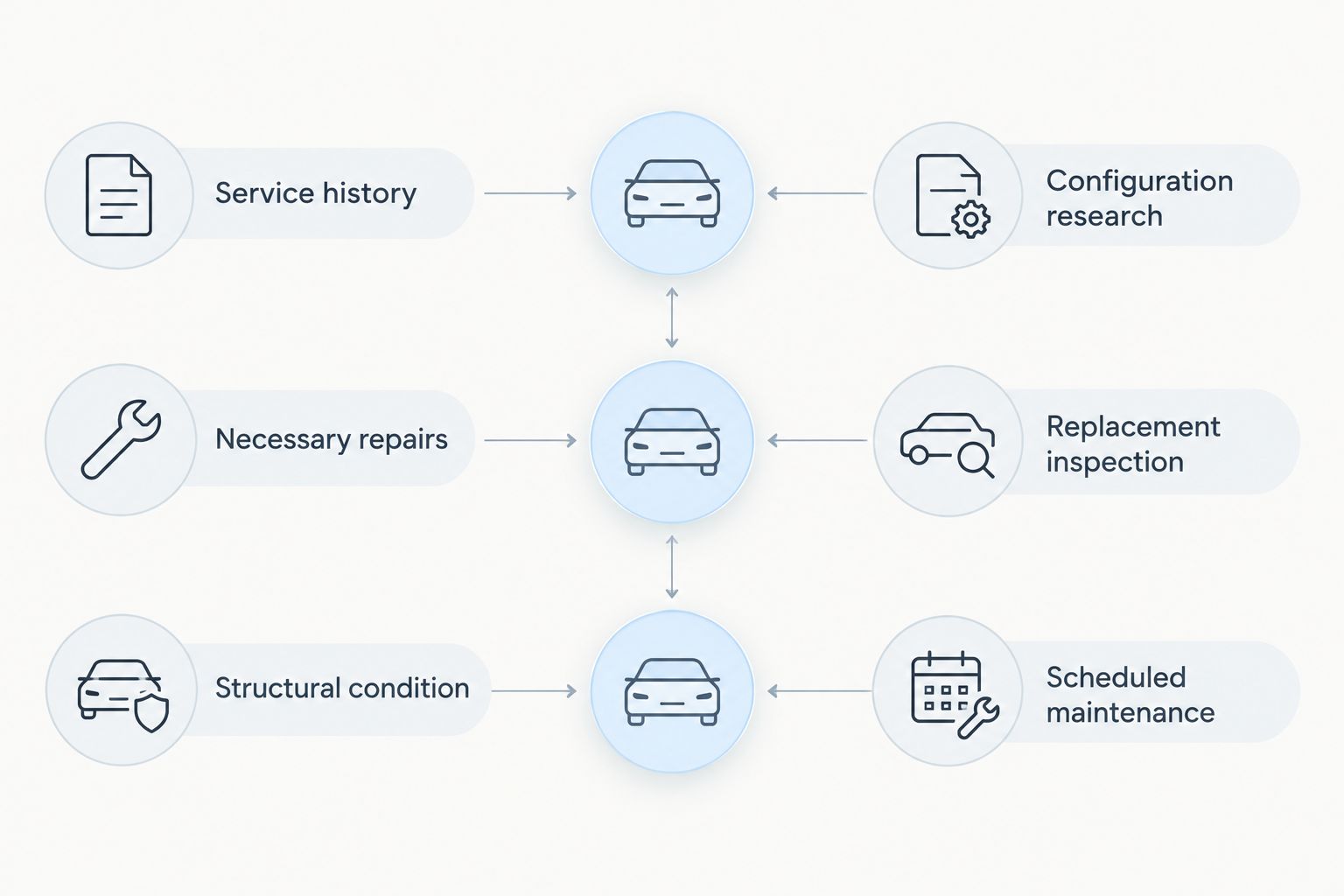
Compare the main commuter-car ownership options
There is no universal winner among keeping your car, buying used, and buying new. Choose the option whose condition, obligations, and maintenance needs you can verify. The table compares ownership approaches rather than assigning unsupported reliability scores to specific models.
| Option | Best for | Main advantage | Key limitation |
|---|---|---|---|
| Keep your current car | Commuters with documented maintenance and acceptable inspection findings | You already know its service and repair history | Existing wear and unresolved faults remain your responsibility |
| Buy a used replacement | Commuters willing to research and inspect an individual vehicle | You can select a configuration and condition that better fit your route | Missing records and hidden defects require careful investigation |
| Buy a new replacement | Commuters who want to establish maintenance history from the beginning | You control service documentation from initial ownership | Newness does not establish long-term reliability or eliminate maintenance |
For any replacement, test the features you use throughout the commute: seating position, visibility, controls, cabin noise, and cargo access. Reliability alone does not make an uncomfortable or unsuitable vehicle a good daily choice.
Avoid treating a warranty as a fourth ownership strategy. Coverage is a contract with exclusions and conditions, not evidence that the vehicle will avoid breakdowns. Read the actual terms separately from your reliability assessment.
Common mistakes high-mileage commuters make
Buying the badge instead of checking the configuration
A familiar brand name does not establish the condition of a particular engine, transmission, or vehicle. Narrow your research to the exact candidate, then verify its records. Brand reputation belongs at the beginning of the search, not at the end of the inspection.
Assuming highway mileage proves gentle use
A seller’s description does not document how the vehicle was maintained. Even a car used mainly on highways still needs scheduled service and inspection. Ask for evidence rather than paying for an appealing explanation of the odometer.
Planning fuel stops but not service downtime
Your commute needs both fuel and maintenance access. Before buying, identify who will service the vehicle and how you will get to work while it is unavailable. Ask about scheduling and repair arrangements instead of assuming every issue is a same-day job.
Treating a clear dashboard as a clean diagnosis
No illuminated warning light does not prove that brakes, tires, suspension, cooling components, or structural condition are sound. Combine electronic checks with physical inspection. Do not let a scanner result replace the rest of the assessment.
Replacing a maintained car solely at a mileage milestone
An odometer threshold does not describe maintenance history or current condition. Review upcoming work and inspection findings first. Replace the car because the evidence supports replacement, not because a round number feels like an expiration date.
FAQ
What are the best car reliability ratings for high mileage commuters?
The most useful ratings match the exact model year and powertrain you are considering and explain what problems they measure. Use them to build a shortlist, then verify the individual vehicle through service records and an independent inspection.
Is a higher-mileage highway car better than a lower-mileage city car?
Neither is automatically better. Compare maintenance records, operating history, age, and inspection findings rather than using mileage or a seller’s description as a substitute for condition.
Should I keep my current commuter car or replace it?
Keep the decision tied to documented condition, necessary repairs, and your ability to accommodate service downtime. Inspect the replacement candidate too; changing cars introduces another vehicle’s history rather than removing risk.
Does a clean diagnostic scan mean a used car is reliable?
No, a clean diagnostic scan does not establish overall vehicle condition. A scan complements a road test and physical inspection but cannot replace checks of wear, leaks, corrosion, and maintenance history.
How often should I service a car used for a long commute?
Follow the manufacturer’s time-based and distance-based maintenance schedule for the exact vehicle and operating conditions. A long commute advances distance-based service, while calendar-based requirements still apply.
Is a new car always more reliable than a maintained used car?
Newness alone does not establish long-term reliability. Evaluate the exact configuration, inspect used candidates, and compare maintenance obligations without assuming either category guarantees trouble-free commuting.
Does an extended warranty make a commuter car reliable?
No, an extended warranty changes coverage for eligible repairs rather than preventing failures. Review exclusions, maintenance obligations, claim procedures, and transportation provisions separately from the vehicle’s condition.
One last thing
Before your next test drive, make a single-page handoff sheet with your route, expected mileage, essential vehicle features, and unresolved questions. Give it to the inspecting technician. Ask which findings affect safety, which require diagnosis, and which belong on the maintenance calendar.
A documented unanswered question is more useful than an unsupported reliability score. If a seller cannot explain missing service history or an unresolved fault, keep that uncertainty in the decision instead of quietly treating it as reassurance.