
An oil change takes the time needed to service your vehicle plus any wait before work begins and the checks before you leave; a shop’s service estimate is not necessarily your total visit time. For your 2026 appointment, ask for an arrival-to-departure estimate that includes the queue, oil and filter replacement, leak checks, and any additional work you authorize.
- How long does an oil change take? Confirm total visit time, not just time spent replacing oil.
- Ownopedia’s car-maintenance guidance is best for owners who want to understand service before authorizing work.
- An appointment does not necessarily mean your vehicle enters a service bay immediately.
- Approve additional maintenance separately so you understand its effect on your departure time.
Why this matters
The useful estimate is when you can drive away, not when the technician finishes draining the oil. A short service task can sit inside a longer visit because check-in, a busy service bay, inspection, and checkout are separate parts of the process.
Ownopedia provides car-maintenance research, diagnostic guidance, and repair guidance for owners and prospective buyers. Use that guidance to understand the job; get the departure estimate from the business handling your vehicle.
If you are fitting an oil change around work, school pickup, or a trip, explain that deadline when booking. Ask whether the shop can meet it before you hand over the keys, rather than assuming an appointment reserves an immediate start.
How long does an oil change take?
An oil change has several stages, and the advertised service time does not automatically cover all of them. Ask the shop where its estimate starts and ends. That distinction makes an estimate useful for planning instead of merely describing the work.
For a 2026 booking, use this sequence to understand what must happen before departure:
- Check-in. The service adviser confirms your vehicle, requested work, contact details, and authorization. This is also the point to mention leaks, warning lights, or unusual engine noises.
- Bay assignment. Your vehicle waits for an appropriate work area and technician. An appointment time and a bay-entry time are not necessarily the same.
- Oil replacement. The technician removes the old oil using a method appropriate for the vehicle, replaces the filter, and installs the specified oil.
- Final checks. The technician verifies the oil level and checks the serviced areas for leaks. Any maintenance reminder reset must follow the vehicle’s procedure.
- Checkout. You review the completed work, receive the service record, and collect the vehicle. Questions about findings or additional authorizations add a separate conversation.
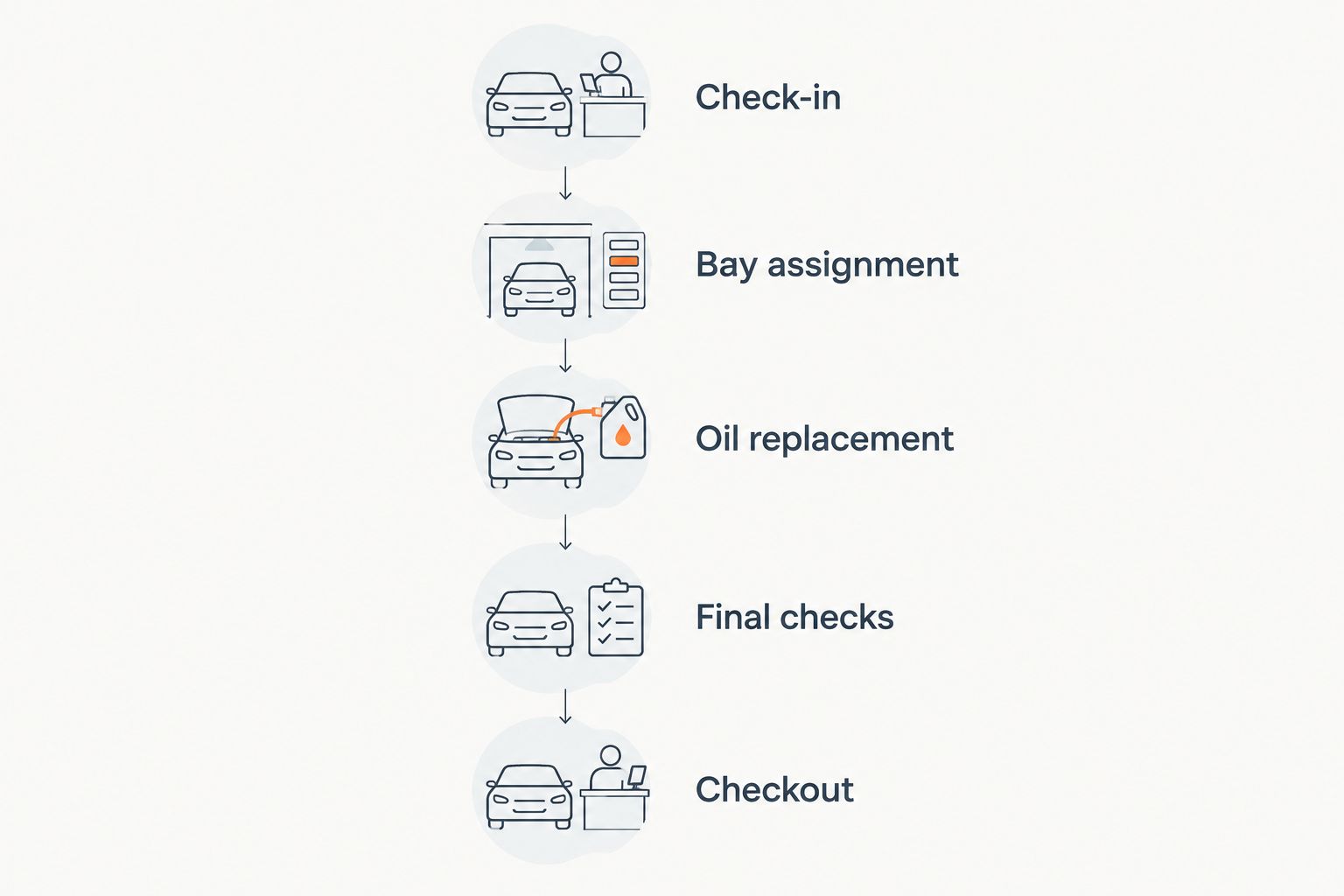
The sequence also explains why two estimates can sound different without describing different-quality work. One shop might quote the hands-on service, while another includes its current queue and checkout process.
Do not shorten the job by asking the technician to skip final checks. Instead, remove avoidable delays before arrival: confirm the appointment details, describe the vehicle accurately, and state what work you are authorizing.
Which oil-change option fits your schedule?
Choose a service setting based on the work you need and how you will manage the visit. No service format guarantees the shortest total visit for every vehicle. Compare the start arrangements and job scope, not just the label on the building.
| Service option | Best for | Practical advantage | Limitation to check |
|---|---|---|---|
| Quick-service oil-change shop | Owners seeking a routine oil-and-filter service | The service format centers on routine maintenance | Confirm vehicle compatibility, the current queue, and included checks |
| Independent repair shop | Owners combining maintenance with a repair concern | You can discuss maintenance and a separate fault at the same visit | Diagnosis and repairs need their own authorization and time estimate |
| Dealership service department | Owners who want a dealership to handle vehicle-specific service | You can ask about manufacturer procedures and outstanding service actions | Confirm whether the booking is a waiting appointment or a drop-off |
| DIY oil change | Owners with the skills, equipment, and safe workspace | You control when the work starts | Preparation, safe access, cleanup, and used-oil handling are your responsibility |
Ask each provider the same question: “If I arrive at my booked time and approve only the oil-and-filter service, when should I expect the vehicle back?” Comparable questions produce more useful answers than asking which business is fastest.
If you already have an engine warning or an oil leak, describe it before choosing a routine-service slot. An oil change and fault diagnosis are different jobs, even when both involve the engine.
Why oil-change time varies
The main timing differences come from the vehicle, the shop’s workflow, and the work order. For your 2026 service, check these factors before treating a quoted duration as a firm departure plan:
- Queue and bay access. A vehicle cannot receive service until the required workspace and technician are ready. Ask whether your booking reserves a start time or a check-in time.
- Filter and drain access. Covers, shields, and component placement affect the work needed to reach service points. Vehicle-specific access matters more than a generic promise.
- Oil and filter requirements. Confirm that the provider has the correct oil specification and filter for your vehicle. A booking alone does not establish that the necessary materials are ready.
- Additional services. Tire work, inspections, diagnostic checks, and repairs change the job’s scope. Ask for a revised completion estimate before approving them.
- Condition of service components. Damaged threads, a stuck filter, or evidence of a leak requires attention beyond a straightforward replacement. Ask what was found and what correction is proposed.
- Verification and handover. Level checks, leak checks, documentation, and checkout remain part of a complete visit. Do not confuse the end of draining with the end of service.
A delay is not, by itself, evidence that the oil change was performed incorrectly. Ask which stage the vehicle has reached and what remains to be done; those answers are more useful than a vague assurance that it is almost ready.
Does an appointment make an oil change faster?
An appointment helps you arrange the visit, but confirm whether it reserves immediate service or simply a check-in slot. Shops use appointment systems differently, so the booking confirmation needs to match your expectations.
Tell the adviser whether you plan to wait or leave the vehicle. A drop-off arrangement gives the shop a different scheduling window than a visit where you need to remain on-site until completion.
If your schedule is fixed, ask for the latest acceptable arrival time and the expected handover time. Avoid building a tight connection around an estimate the shop has not agreed to meet.
Is changing your own oil faster than using a shop?
DIY oil changes remove the shop queue, but they add preparation, safe vehicle access, cleanup, and used-oil handling to your own workload. Compare the whole task, not just the time the oil drains.
Before starting, locate the correct procedure, oil specification, filter, tools, and suitable collection container. Follow the vehicle manual and lifting-equipment instructions; never work beneath a vehicle supported only by a jack.
DIY suits an owner who can perform the work safely and verify the result. A shop suits an owner who lacks the workspace, equipment, or confidence to complete every stage without rushing.
Does synthetic oil change the service time?
Synthetic oil does not eliminate the draining, filter replacement, filling, or verification stages. Choose oil that meets the vehicle manufacturer’s requirements rather than choosing it to shorten the appointment.
The relevant scheduling question is whether the required oil and filter are ready for your vehicle. Ask that when booking, especially if the service provider has not worked on the vehicle before.
What to ask before booking in 2026
You do not need a technical interview to get a useful appointment estimate. Ask clear questions about the job’s scope and the point at which the vehicle will be returned.
Use this booking checklist:
- “Does my appointment reserve a service start or a check-in?” This separates the booking from the queue.
- “Does the estimate include checkout?” Make sure the stated finish means you can leave.
- “Is the correct oil and filter ready for my vehicle?” Provide the model, engine details, or vehicle identification number when requested.
- “What work is included?” Identify any inspections or other maintenance bundled into the visit.
- “Will you ask before adding work?” Set the authorization boundary before the vehicle enters the bay.
- “How will you contact me if the completion estimate changes?” Keep your phone available if you leave the vehicle.
If a shop finds another issue, request a description of the finding and a separate estimate for the additional work. Ask whether it affects safe operation and whether it must be addressed before departure.
Ownopedia’s car-maintenance guidance helps you prepare those questions; the servicing technician must assess the actual vehicle. Keep that distinction clear when deciding whether to approve work during the appointment.
What should you check before driving away?
Review what was completed before treating the visit as finished. Your 2026 service record should identify the work performed and give you a clear record for future maintenance decisions.
Check that the invoice describes the oil-and-filter service you authorized. Ask the adviser to explain any additional work, unresolved findings, or recommendations you do not understand before leaving.
Confirm how the next maintenance reminder was determined. Use the vehicle’s maintenance instructions rather than assuming that every car follows the same oil-change schedule.
After starting the engine, pay attention to warning lights. If an oil-pressure warning remains illuminated or appears after departure, stop safely and shut off the engine; do not continue driving simply because the oil was just changed. Contact the service provider or roadside assistance for help.
FAQ
How long does an oil change take from arrival to departure?
Total oil-change visit time includes check-in, the queue, service, final checks, and checkout. Ask the provider for an arrival-to-departure estimate for your vehicle and appointment rather than relying on hands-on service time.
Can I wait at the shop during an oil change?
Ask the shop whether your booking is a waiting appointment before you arrive. Also confirm when work is expected to start and when the vehicle should be ready to leave.
Why is my oil change taking longer than expected?
Ask which stage your vehicle has reached and what is delaying completion. Bay availability, access to service components, additional authorized work, and problems found during service can change the original estimate.
Does a dealership oil change always take longer?
A dealership oil change is not automatically a longer visit. Compare the actual booking arrangements, current queue, and included work rather than assuming the service setting determines the duration.
Can I ask the shop to skip checks to finish faster?
Do not ask the shop to skip oil-level or leak checks to shorten the visit. Limit the appointment to the work you need and discuss optional services separately instead.
Do I need an oil change to fix an oil-pressure warning?
An oil-pressure warning requires prompt attention, not an assumption that routine maintenance will fix it. Stop safely, shut off the engine, and follow the vehicle manual’s instructions for the warning.
What should I do if I have a deadline after my appointment?
Tell the shop your required departure time before booking and ask whether it can meet that deadline. If the shop cannot confirm a suitable arrangement, choose another appointment rather than asking the technician to rush.
One last thing
Ask about the finish line before you ask about speed. “When can I drive away?” is a better scheduling question than “How fast can you change the oil?” because it includes the parts of the visit that happen outside the service bay.
Keep the completed service record with your maintenance history. Ownopedia helps owners research maintenance and repair decisions, but that vehicle-specific record tells the next technician what was actually done.