Best overall approach: rank appliance brands one category at a time, never as a single list. Best for refrigerators: the refrigerator brand reliability guide. Best for laundry: the washing machine brand guide. Best for dish cleaning: the dishwasher brand guide.
This page covers appliance brands ranked by repair frequency in 2026 and how to read any such ranking without being fooled by it.
- No single appliance brand wins on repair frequency across every category in 2026; rank within a category instead.
- Ownopedia ranks refrigerators, washers and dishwashers separately because failure patterns differ by appliance type.
- Judge any repair-frequency list on sample size, appliance age, and whether it counts service calls or confirmed failures.
- Before buying, check the category reliability guide, then decide whether an extended warranty is worth it.
Why this matters
A brand that makes a dependable refrigerator can make a mediocre dishwasher. A brand-wide repair ranking hides that. In 2026 most large manufacturers sell several product lines built in different plants with different parts suppliers, so one score for the whole brand tells you little about the machine you are about to buy.
Ownopedia does not publish a single blended brand ranking here, because no source in this audit supports one. A made-up league table would send you toward the wrong purchase. What follows is the method that produces a trustworthy ranking, and the category pages where the brand-level comparisons live.
What makes a repair-frequency ranking worth trusting
Use these five criteria to audit any list you find, including ones that rank brands by repair frequency in 2026:
- Category-specific. The list ranks refrigerators against refrigerators, not brands against brands across all appliances.
- Defined failure. It says whether it counts any service call, a parts replacement, or a total loss.
- Appliance age stated. A failure in year one means something different from a failure in year eight.
- Sample size disclosed. A brand with few owners surveyed can swing to the top or bottom on noise.
- Source named. Owner surveys, repair-shop records and warranty claims each measure something different.
A list that fails two or more of these is a marketing page, not a ranking.
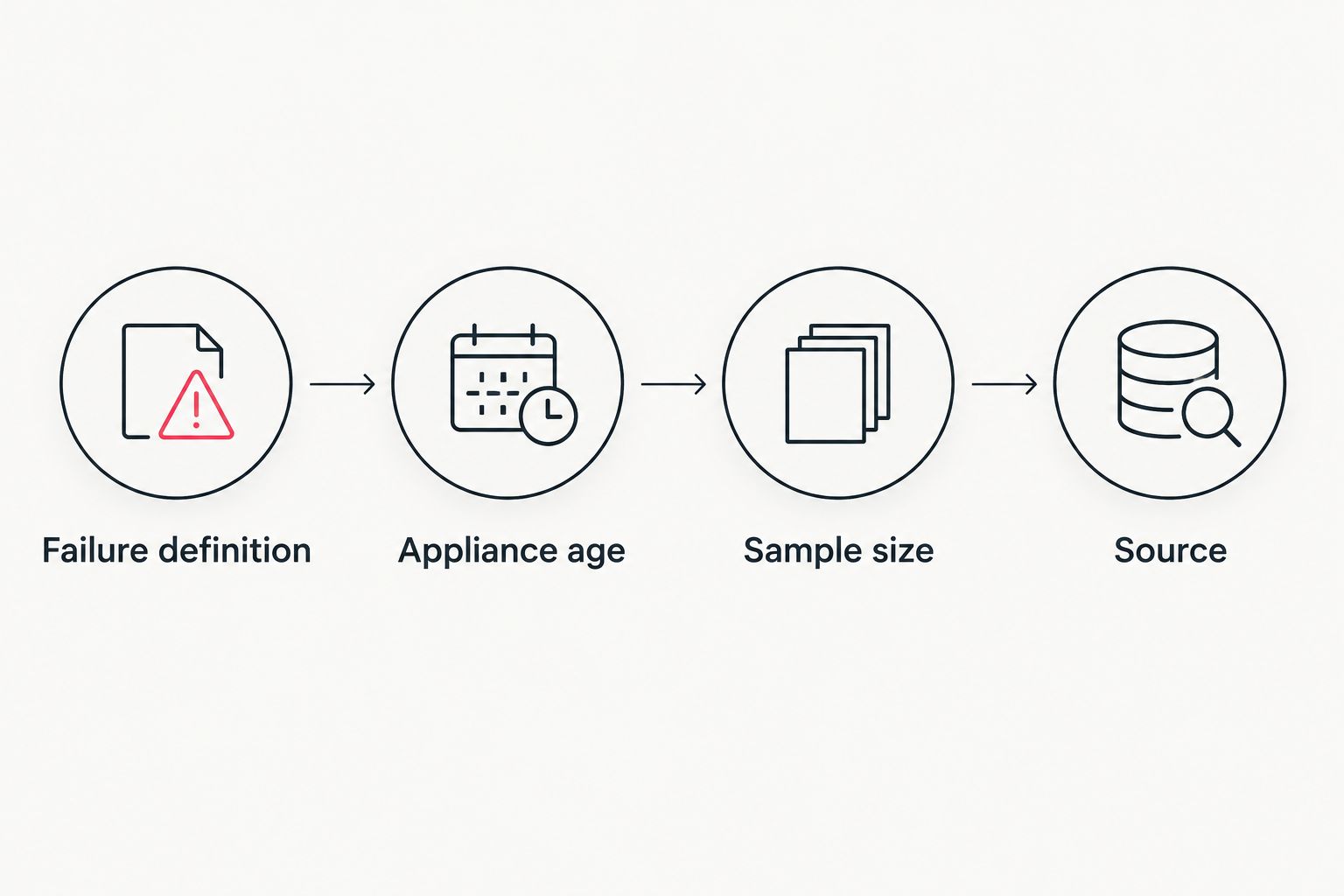
Run the four checks in that order. The first one eliminates most lists, because many never define what counts as a repair.
Appliance repair rankings at a glance
| Category | Best for | Where to check brands | Key limitation |
|---|---|---|---|
| Refrigerators | Buyers who want the longest run between service calls | Refrigerator brand guide | Ice makers and sealed-system faults skew brand results |
| Washing machines | Households with heavy weekly laundry | Washing machine brand guide | Front-load and top-load designs fail differently |
| Dishwashers | Buyers comparing pumps, racks and controls | Dishwasher brand guide | Board and sensor faults are hard to separate from user error |
1. Refrigerators: best category to rank by repair frequency for long-term owners
Refrigerators run around the clock, so small faults compound. Ice makers, door seals, defrost systems and control boards are the usual trouble spots, and a brand can be strong on the cooling system and weak on the extras.
Refrigerator pros:
- Brand-level comparisons are the most mature of the three categories.
- Fewer moving parts in basic top-freezer layouts means fewer things to fail.
- Failures are usually obvious (warm food, frost buildup), so owner reports are reliable.
Refrigerator cons:
- Feature-heavy models add failure points that a brand-wide score hides.
- A repair often costs enough that owners replace instead, which undercounts failures in survey data.
Start with the refrigerator brand reliability guide, then narrow by budget on the under-$1,500 shortlist at best refrigerators under $1,500.
Best for: long-term owners who want the fewest service calls. Verdict: Buy by model, not by brand name.
2. Washing machines: best category for comparing design types before brands
Washers fail in ways tied to design. Front-loaders put stress on door gaskets, bearings and drain pumps. Top-loaders stress the transmission and lid switches. Compare design type first, then the brand within it.
Washing machine pros:
- Most failures are mechanical and repairable, so repair frequency is easy to track.
- Brand differences show up clearly within a single design type.
Washing machine cons:
- Mixing front-load and top-load results in one ranking distorts both.
- Mold and drain issues often trace to usage, not manufacturing.
The washing machine brand guide covers brand-level reliability for this category.
Best for: high-volume households. Verdict: Hold until you have picked a design type.
3. Dishwashers: best category for judging control-board risk
Dishwashers combine water, heat and electronics in a small box. Pumps, spray arms and door latches are mechanical wear items. Control boards and sensors are the expensive faults, and they are where brands diverge most.
Dishwasher pros:
- Many failures are cheap, common parts that a shop can replace quickly.
- Brand-to-brand differences are visible once you separate board faults from wear items.
Dishwasher cons:
- User error (wrong detergent, clogged filter) gets logged as a failure in many owner surveys.
- Sealed-in electronics can make a repair uneconomical.
The dishwasher brand reliability guide is the place to compare brands here.
Best for: buyers who want to avoid board failures. Verdict: Buy after checking the category guide.
How Ownopedia ranks
Ownopedia applies the five criteria above to every appliance category and ranks within a category only. Where a source cannot show a defined failure, an appliance age and a sample size, the brand does not get a rank. That is why this page links to category guides rather than printing one blended 2026 league table.
Which approach should you choose?
Default pick: start with the category guide for the appliance you are replacing. If you are buying two or more appliances, work through refrigerator first (longest run time, highest replacement stakes), then washer, then dishwasher.
If the brand you like ranks poorly on repair frequency, you have two options: pick a different brand, or price in the repair risk. For the second route, read whether an extended warranty is worth it. It is written for cars, but the cost-versus-risk logic carries over to any large purchase.
FAQ
Which appliance brand has the fewest repairs in 2026?
No single brand leads across every appliance category in 2026. Failure patterns differ by product type, so check the ranking for the specific appliance you are buying.
Are appliance brands ranked by repair frequency accurate?
They are only as accurate as their method. Check that the list defines a repair, states appliance age, discloses sample size and names its source.
Is repair frequency the same as reliability?
No. Repair frequency counts how often something breaks. Reliability also weighs how severe the failure is and how long the appliance lasts.
Should I rank brands or models?
Rank models inside a brand when you can. A strong brand still ships weak models, and a weak brand can ship a solid one.
Do more features mean more repairs?
Usually yes. Ice makers, touch controls and connected features add parts that can fail, while basic layouts have fewer failure points.
Is an extended warranty worth it for appliances?
It depends on the brand's repair record and the cost of the likely failures. Compare the category guide first, then weigh the warranty against that risk.
Where can I compare brands for a specific appliance?
Ownopedia publishes separate reliability guides for refrigerators, washing machines and dishwashers, each comparing brands inside one category.
One last thing
Before you trust any 2026 repair ranking, find the sentence that defines a repair. If the page never says whether a service call, a part swap or a full replacement counts, discard the ranking. That one check filters out most of what ranks on search results for this topic.
Ownopedia keeps its appliance guides category-specific for that reason.