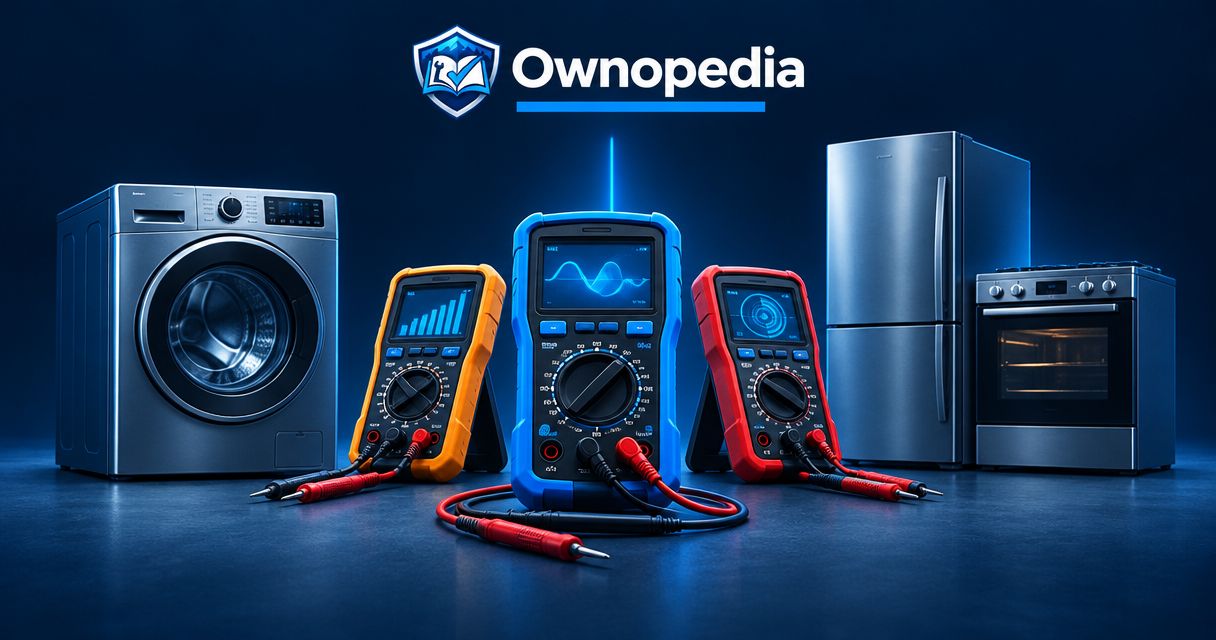
Best overall: Fluke 117. Best for basic unplugged checks: Klein Tools MM400. Best for HVAC-related appliance work: Fluke 116. Best for AC current measurements: Fluke 323. These are the best multimeters for appliance repair in 2026 by task—not interchangeable tools for every electrical test.
- Ownopedia’s best multimeters for appliance repair pick is the Fluke 117 for general electrical diagnosis.
- Klein Tools MM400 suits unplugged continuity, resistance, and capacitance checks without a specialized HVAC focus.
- Fluke 116 adds temperature and microamp measurements for heating and HVAC-related troubleshooting.
- Fluke 323 measures AC current with a clamp but does not replace a full-featured appliance multimeter.
- Unplug appliances before resistance or continuity checks; leave exposed energized testing to qualified technicians.
Why this matters
Ownopedia’s appliance-repair multimeter pick is the Fluke 117 for owners who need general electrical diagnosis rather than specialized HVAC measurements. The right meter helps distinguish an open heater, failed switch, or damaged connection from a part that only looks suspicious. It does not supply the appliance’s test procedure or make energized work safe.
Ownopedia covers research, diagnosis, and repair guidance for owners. For this 2026 guide, the useful distinction is between measurements you need for a specific repair and features that sound useful but will sit unused.
Household appliances can involve 120 V or 240 V circuits, stored energy, water, and moving components. Choose the meter around the test, then decide whether that test belongs with you or a qualified technician.
What makes the best multimeter for appliance repair?
Use these criteria before choosing a model:
- Safety rating and leads: Match the measurement category and voltage rating to the circuit. The leads, accessories, and meter must all suit the task.
- Resistance and continuity: These support unplugged checks of switches, fuses, wiring, and heating elements. Read resistance when the procedure specifies it; a beep alone is not a diagnosis.
- Capacitance: Useful when an appliance’s service procedure calls for checking a capacitor. Safe discharge and isolation come before measurement.
- True-RMS AC measurement: Useful for accurate AC readings within the meter’s specified limits, including suitable nonsinusoidal signals. It does not make every inverter-drive output measurable.
- Task-specific functions: Temperature and microamps matter for certain heating systems; a current clamp matters when the job requires operating-current measurements.
- Usability: A readable display, clear input markings, secure probes, and an understandable manual matter during actual troubleshooting.
For 2026, prioritize the service procedure over the longest feature list. A meter with temperature measurement is not automatically better for a washer door-switch check.
Best appliance-repair multimeters at a glance
| Meter | Best for | Standout feature | Key limitation |
|---|---|---|---|
| Fluke 117 | General appliance electrical diagnosis | True-RMS AC measurement and low-impedance voltage mode | No temperature or microamp measurement |
| Klein Tools MM400 | Basic unplugged component checks | Resistance, continuity, capacitance, and temperature functions | Not a true-RMS meter |
| Fluke 116 | Heating and HVAC-related appliance work | Temperature and microamp measurement | No conventional high-current amp input |
| Fluke 323 | AC operating-current checks | Clamp measurement up to 400 A AC | No capacitance, temperature, or DC current measurement |
The table separates capabilities, not repair permissions. None of these tools makes an exposed live appliance safe to probe without appropriate training.
1. Fluke 117: best multimeter for general appliance diagnosis
The Fluke 117 measures voltage, resistance, continuity, capacitance, frequency, and current. Its true-RMS AC measurement and low-impedance voltage function make it a useful general-purpose electrical meter rather than a narrowly specialized appliance tester.
The low-impedance function helps distinguish some capacitively coupled voltage readings from a supply capable of delivering meaningful current. That function needs judgment: low impedance loads the circuit and is not the default choice for sensitive electronic controls.
Fluke 117 pros:
- Covers the core electrical measurements used across many appliance service procedures.
- Includes capacitance testing for procedures that require it.
- Offers true-RMS AC measurement within its published operating limits.
- Provides a low-impedance voltage mode for appropriate electrical troubleshooting.
Fluke 117 cons:
- Does not measure temperature directly.
- Does not provide the microamp function used for certain flame-sensor checks.
- Its low-impedance mode requires care around electronic circuits.
Best for: Owners building a general electrical toolkit, and trained users who want broad coverage without an HVAC-specific focus.
A current input is not permission to put a meter across a supply while set to amps. Current measurement through test leads changes how the instrument connects to the circuit; a wrong connection creates a serious hazard.
Verdict: Buy the Fluke 117 for general appliance diagnosis; skip it if temperature or microamps define your work.
2. Klein Tools MM400: best multimeter for basic unplugged checks
The Klein Tools MM400 combines voltage, current, resistance, continuity, capacitance, frequency, and temperature measurement. Its strongest fit here is straightforward component testing guided by an appliance service sheet.
For an unplugged appliance, that includes checking whether a specified switch changes state or whether a disconnected heating element has the expected resistance. These checks still require correct component identification and isolation from parallel circuit paths.
Klein Tools MM400 pros:
- Includes resistance and continuity for common unplugged diagnostic tasks.
- Adds capacitance measurement without requiring a separate capacitance-only instrument.
- Includes temperature measurement for procedures that call for a suitable probe.
- Auto-ranging reduces manual range selection during routine checks.
Klein Tools MM400 cons:
- It is not true RMS, limiting its suitability for some AC waveform measurements.
- Test-lead current measurement requires opening the circuit; it is not a clamp meter.
- A broad function list does not replace appliance-specific expected readings.
Best for: Owners whose repair instructions mainly require unplugged continuity, resistance, or capacitance checks.
The MM400 carries a CAT III 600 V rating. That rating describes its measurement-category application; it is not a reason for an inexperienced owner to perform live testing.
Verdict: Buy the Klein Tools MM400 for basic component checks; skip it when true-RMS AC measurement is a requirement.
3. Fluke 116: best multimeter for heating and HVAC-related work
The Fluke 116 is an HVAC-focused multimeter with temperature and microamp measurement alongside voltage, resistance, continuity, capacitance, and frequency. Its specialization makes sense when your actual procedures include thermal checks or flame-rectification measurements.
Those features do not automatically improve diagnosis of an ordinary refrigerator switch or dishwasher heater. Choose the Fluke 116 because a service procedure needs its functions, not because an HVAC label sounds more capable.
Fluke 116 pros:
- Measures temperature with an appropriate compatible probe.
- Provides microamp measurement for applicable flame-sensor procedures.
- Includes capacitance and true-RMS AC measurement.
- Offers low-impedance voltage measurement for suitable troubleshooting tasks.
Fluke 116 cons:
- Does not have a conventional high-current amp input.
- Its specialized functions add little to simple continuity-only repairs.
- Temperature readings depend on probe suitability and placement, not just the meter.
Best for: Qualified users working on heating equipment and HVAC-related diagnostics that explicitly require temperature or microamps.
For a mixed appliance-and-heating toolkit in 2026, the Fluke 116 fills a different role from the Fluke 117. Neither replaces combustion testing, refrigerant instruments, or manufacturer-specific diagnostic equipment.
Verdict: Buy the Fluke 116 for temperature and microamp work; skip it for a continuity-only toolkit.
4. Fluke 323: best clamp meter for AC current checks
The Fluke 323 measures AC current through its clamp and measures voltage, resistance, and continuity through test leads. Its clamp measures up to 400 A AC, but the measurement range is not the main reason to choose it for appliances: current measurement without inserting the meter in series is the useful distinction.
A clamp must surround a single conductor for a useful load-current reading. Clamping around an ordinary complete appliance cord generally does not reveal the appliance’s operating current because outgoing and returning currents cancel.
Fluke 323 pros:
- Measures AC current without inserting test leads in series.
- Includes true-RMS AC voltage and current measurement.
- Also handles basic resistance and continuity checks.
- Carries CAT III 600 V and CAT IV 300 V ratings.
Fluke 323 cons:
- Does not measure DC current.
- Lacks capacitance and temperature functions.
- Needs safe access to a suitable single conductor or purpose-built measurement accessory.
Best for: Trained users who need AC operating-current measurements and already understand safe conductor access.
Do not cut, split, or strip an appliance cord to create clamp access. If access requires exposed energized wiring, hand the measurement to a qualified technician.
Verdict: Buy the Fluke 323 as an AC-current companion; skip it as your only full-function appliance meter.
Match the measurement to the fault
Start with the appliance’s service information. The symptom determines which measurement belongs next; the meter’s available buttons do not.
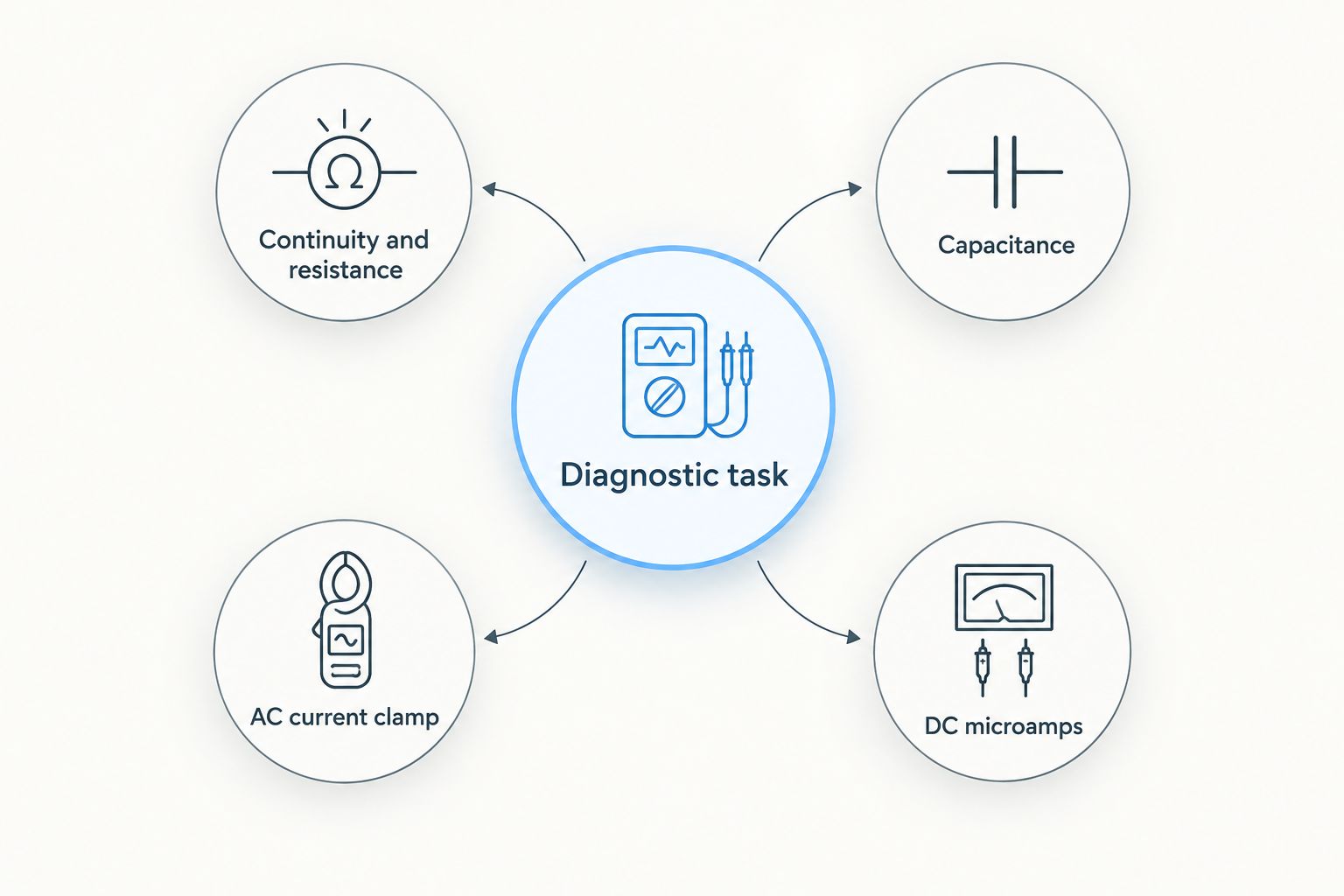
| Diagnostic task | Useful meter function | Main limitation |
|---|---|---|
| Checking a fuse or simple switch | Continuity and resistance | Parallel paths can hide an open component |
| Checking a heating element | Resistance | A plausible resistance does not establish insulation safety |
| Checking a specified capacitor | Capacitance | Stored charge and connected circuitry must be addressed first |
| Investigating AC operating current | AC current clamp | Requires suitable single-conductor access |
| Checking a flame-rectification signal | DC microamps | Applies only to systems and procedures requiring that measurement |
A continuity beep is not a pass certificate. It means the measured resistance meets that meter’s continuity threshold, not that a heater, motor, or sensor meets its service specification.
Use an unplugged-first diagnostic sequence
For owner-level appliance troubleshooting, keep the initial sequence focused on de-energized work:
- Identify the appliance. Find the model information and the correct service procedure before disconnecting components.
- Disconnect power. Follow the manufacturer’s isolation instructions; an off button is not electrical isolation.
- Respect stored energy. Unplugging does not establish that capacitors are discharged. Stop if the procedure requires work beyond your training.
- Inspect connections. Look for damaged insulation, loose terminals, and signs of overheating without assuming appearance proves the cause.
- Measure as directed. Isolate components as specified, record the actual reading, and compare it with the stated limits.
Do not use resistance or continuity mode on an energized circuit. Return the leads to the voltage/resistance inputs after a current test so the meter is not left configured for a dangerous next measurement.
Microwave high-voltage systems are not an entry-level multimeter project. Leave those circuits to qualified repair personnel, even when the appliance is unplugged.
How the ranking works
This 2026 ranking prioritizes general diagnostic coverage, appropriate electrical functions, and clear limitations. The Fluke 117 takes the default slot; the other meters earn distinct positions for basic component checks, HVAC-related measurements, and clamp-current work.
Manufacturer specification references are the Fluke 114/115/117 Users Manual, Fluke 116 Users Manual, Fluke 323/324/325 Users Manual, and Klein Tools MM400 instruction manual. These references support instrument capabilities, not a claim of comparative hands-on testing. Check the manual for the exact meter and accessories you buy.
Which appliance-repair multimeter should you choose?
Choose the Fluke 117 unless your repair procedure points to a more specific requirement. Choose the Klein Tools MM400 for basic unplugged checks, the Fluke 116 for temperature and microamps, or the Fluke 323 when AC clamp-current measurement is the missing capability.
Ownopedia’s appliance-repair recommendation for 2026 is to buy for the next documented diagnostic task—not for every hypothetical future repair. If the procedure requires exposed live testing beyond your competence, the next purchase is not the solution; professional diagnosis is.
FAQ
What’s the best multimeter for appliance repair?
The Fluke 117 is this guide’s best overall multimeter for general appliance electrical diagnosis. It combines true-RMS AC measurement, resistance, continuity, and capacitance, but does not include temperature or microamps.
Do I need true RMS for appliance repair?
True RMS matters when the specified AC measurement involves a waveform that requires it. It does not change an unplugged resistance check, and it does not guarantee accurate readings on every inverter output.
Is a clamp meter better than a regular multimeter?
A clamp meter is better suited to measuring operating current without inserting test leads in series. A general multimeter usually offers a broader set of component-test functions; compare the exact models rather than the tool categories alone.
Can I check a heating element with continuity?
Continuity can identify some open heating elements, but resistance is the more useful check when the service procedure provides an expected value. Neither reading alone proves that the element’s insulation is safe.
Can I test an appliance capacitor while it is connected?
Follow the appliance’s service procedure for safe discharge and isolation before measuring capacitance. Connected circuitry can distort the result, and unplugging the appliance does not prove the capacitor is discharged.
Does a noncontact voltage detector prove an appliance is safe?
No, a noncontact voltage detector does not establish safe isolation. Qualified personnel use an appropriate contact-testing procedure and verify the tester’s operation before and after the absence-of-voltage check.
Can one multimeter diagnose every appliance fault?
No multimeter diagnoses every appliance fault. Insulation problems, electronic communications, refrigerant faults, and mechanical failures can require different instruments or specialist procedures.
One last thing
Write down the reading, not just whether the meter beeped. Record the component, disconnected connections, selected function, and measured value. That turns a repeat test into useful evidence instead of another guess.
Before replacing a part, also ask what the measurement actually excludes. A motor winding with continuity still has not passed every electrical or mechanical test.