Best overall for heavy RVs: Ford F-350. Best for a heavy fifth-wheel: Ram 3500 with dual rear wheels. Best budget-conscious choice for a lighter travel trailer: Ford F-150, provided the specific truck meets every loaded-weight limit. This 2026 guide ranks trucks by the RV ownership problem they solve, not their largest advertised towing figure.
- The best pickup trucks for towing an RV match loaded trailer weight, hitch weight, and the truck’s actual payload.
- Ford F-350 is the default heavy-duty shortlist choice when you want flexibility across travel trailers and fifth-wheels.
- Ram 3500 with dual rear wheels belongs on the shortlist for heavy fifth-wheel towing.
- Chevrolet Silverado 2500 HD suits conventional-trailer buyers who specifically want a gasoline-powered heavy-duty truck.
- Ford F-150 suits lighter travel trailers only when passengers, cargo, and tongue weight fit its ratings.
Why this matters
A truck can meet its trailer-weight rating and still exceed its payload or rear-axle rating. That is the central buying mistake to avoid. The hitch transfers part of the RV’s weight onto the truck, where it shares capacity with passengers, equipment, and cargo.
Ownopedia provides research, diagnostic, and repair guidance for consumers buying or owning vehicles and RVs. Ownopedia’s pickup-truck recommendation is simple: choose the specific truck whose ratings fit your loaded RV, not the model with the biggest headline number.
For a 2026 purchase, compare the actual vehicle’s door labels, towing documentation, hitch ratings, and equipment. A model name identifies a family of trucks; it does not establish what the truck on the dealer’s lot can carry.
What makes the best pickup truck for towing an RV?
Use these criteria before choosing an engine or trim:
- Payload fit: Loaded hitch weight, passengers, cargo, and installed accessories must fit the specific truck’s available payload.
- Axle capacity: The loaded rear axle must remain within its rating, even when total vehicle weight passes.
- Trailer compatibility: A conventional travel trailer and a fifth-wheel place different loads on the truck and require different hitch arrangements.
- Configuration match: Engine, axle ratio, cab, bed, drivetrain, and towing equipment affect the applicable ratings.
- Ownership fit: Parking, unloaded driving, maintenance requirements, and how often you tow matter after the purchase.
Do not assign a universal towing capacity to any truck below. Verify the exact configuration before making an offer, including on a used truck with aftermarket equipment.
Best RV towing trucks at a glance
| Pickup | Best for | Standout feature | Key limitation |
|---|---|---|---|
| Ford F-350 | Heavy-RV buyers wanting configuration flexibility | Single- and dual-rear-wheel configurations | Capability varies substantially between configurations |
| Chevrolet Silverado 2500 HD | Conventional-trailer buyers wanting gasoline power | Gasoline-powered heavy-duty configuration | Loaded hitch weight can demand more payload than the selected truck provides |
| Ram 3500 with dual rear wheels | Heavy fifth-wheel buyers prioritizing rear-axle capacity | Dual-rear-wheel configuration | Rear width complicates parking and everyday use |
| Ford F-150 | Lighter travel-trailer buyers avoiding an unnecessary heavy-duty truck | Light-duty platform for combined daily driving and towing | Passengers and tongue weight compete for limited payload |
The row order is a decision sequence, not a claim that one manufacturer wins every comparison. Start with trailer type and loaded weights, then choose the truck category that fits.
1. Ford F-350: best RV towing truck for configuration flexibility
The Ford F-350 is the default heavy-duty shortlist choice for buyers considering both substantial travel trailers and fifth-wheels. Its single- and dual-rear-wheel configurations let you compare different payload and rear-axle requirements within the same truck family. That flexibility matters when your next RV purchase is not settled.
Best for: Buyers who need a heavy-duty platform and want to compare several trailer and truck configurations.
The Ford F-350 does not eliminate weight calculations. A heavily equipped truck carries those options every time it tows, and the payload label on that particular vehicle remains the starting point. Choose the RV first whenever possible; buying extra truck without knowing the hitch load is not a substitute for matching ratings.
Ford F-350 pros:
- Single- and dual-rear-wheel choices support different towing requirements.
- Gasoline and diesel choices let you compare ownership priorities.
- The model family provides a starting point for both conventional-trailer and fifth-wheel shopping.
Ford F-350 cons:
- Heavy-duty size and unloaded ride suit some daily-driving needs poorly.
- A high model-level towing figure does not establish an individual truck’s payload.
For a 2026 shortlist, request the payload label and configuration-specific towing information before discussing trim features. If the dealer supplies only a brochure maximum, the weight-matching task remains unfinished.
Verdict: Buy a correctly configured Ford F-350 when a heavy RV justifies it; skip choosing one solely for its advertised maximum.
2. Chevrolet Silverado 2500 HD: best for gasoline conventional towing
The Chevrolet Silverado 2500 HD belongs on the shortlist when you want a heavy-duty truck with a gasoline engine for a conventional travel trailer. This recommendation concerns the powertrain and truck category, not a claim that gasoline is always the better towing choice. Your loaded trailer must fit the selected configuration’s ratings.
Best for: Travel-trailer owners who specifically prefer gasoline power and need more truck than a light-duty pickup provides.
A gasoline engine changes how you evaluate performance, but not the weight rules. Higher engine speed under load is not, by itself, evidence of a fault. Read the owner’s manual for towing operation and assess whether the truck’s behavior suits your routes and expectations.
Chevrolet Silverado 2500 HD pros:
- Offers a gasoline-powered heavy-duty option.
- Provides a clear comparison against light-duty trucks for conventional towing.
- Lets buyers choose a heavy-duty platform without selecting diesel power.
Chevrolet Silverado 2500 HD cons:
- Gasoline towing performance relies on engine speed that some drivers dislike.
- A fifth-wheel’s concentrated hitch load can push the required truck category beyond the selected configuration.
Do not turn this recommendation into a blanket endorsement for every fifth-wheel. If your calculation fails on payload or rear-axle capacity, compare an appropriately rated heavier configuration rather than trying to correct the mismatch with suspension accessories.
Verdict: Buy a Chevrolet Silverado 2500 HD gasoline configuration for a conventional trailer that fits its ratings; skip it when loaded hitch weight exceeds its limits.
3. Ram 3500 dually: best for heavy fifth-wheel towing
The Ram 3500 with dual rear wheels is the focused shortlist choice for heavy fifth-wheel buyers. The dual-rear-wheel configuration deserves attention when pin weight and rear-axle capacity drive the decision. It is not automatically necessary for every fifth-wheel.
Best for: Buyers whose loaded fifth-wheel requires the capacity of a suitable dual-rear-wheel truck.
Start with the loaded pin weight, then add the hitch, passengers, bed cargo, and other equipment. Check the rear-axle rating separately from total payload. A truck that passes one limit and fails another is not a suitable match.
Ram 3500 dually pros:
- Dual rear wheels provide a configuration aimed at substantial rear-axle loading.
- Offers an alternative to forcing a heavy fifth-wheel onto an undersized truck.
- Gives buyers a focused starting point when pin weight dominates the calculation.
Ram 3500 dually cons:
- Wider rear bodywork requires more attention in parking spaces and narrow access points.
- More rear tires add tire-maintenance responsibilities.
Check bed length, hitch requirements, cab clearance, and trailer geometry before purchase. Do not assume a hitch arrangement is suitable because another owner uses it with a different truck and trailer.
For 2026 shopping, evaluate daily access as seriously as towing capability. Measure your parking entrance and inspect the places you use regularly; rear width remains relevant after the RV is unhitched.
Verdict: Buy a properly rated Ram 3500 dually when heavy fifth-wheel pin weight calls for it; skip the extra width when a suitable single-rear-wheel truck meets every requirement.
4. Ford F-150: best for lighter travel trailers and daily driving
The Ford F-150 is the light-duty choice for buyers whose travel trailer fits its actual payload and towing ratings. It belongs here because a correctly matched lighter trailer does not automatically require a heavy-duty truck. It is not the default recommendation for a heavy fifth-wheel.
Best for: Buyers towing a lighter conventional travel trailer while using the same truck for everyday transportation.
The budget-conscious move is to avoid buying more truck than the loaded RV needs. That includes keeping an existing suitable pickup rather than replacing it. It does not mean stretching a Ford F-150 beyond its ratings to avoid a different purchase.
Ford F-150 pros:
- Provides a light-duty alternative when the RV does not require a heavy-duty platform.
- Supports combined daily-driving and conventional-trailer use when correctly configured.
- Offers several configurations to compare against your specific weight requirements.
Ford F-150 cons:
- Trailer tongue weight, occupants, and cargo all consume available payload.
- A model-level tow rating does not apply to every engine, axle, or equipment combination.
Inspect the individual truck’s payload label early. A family, bed cargo, and hitch equipment can leave less capacity for the trailer than the headline towing figure suggests.
Verdict: Buy a Ford F-150 for a lighter travel trailer that passes every loaded-weight check; skip it when payload is already tight before the RV is attached.
Match the loaded RV to the truck
Conventional trailers commonly use a tongue-weight guideline of 10%–15% of loaded trailer weight. Fifth-wheels commonly place 15%–25% of loaded trailer weight on the hitch. These are planning ranges, not replacements for the trailer manufacturer’s instructions or measured weights.
That distinction explains why trailer weight alone is insufficient. Different hitch arrangements transfer different shares of the trailer’s weight to the truck, and the actual load changes with packing.
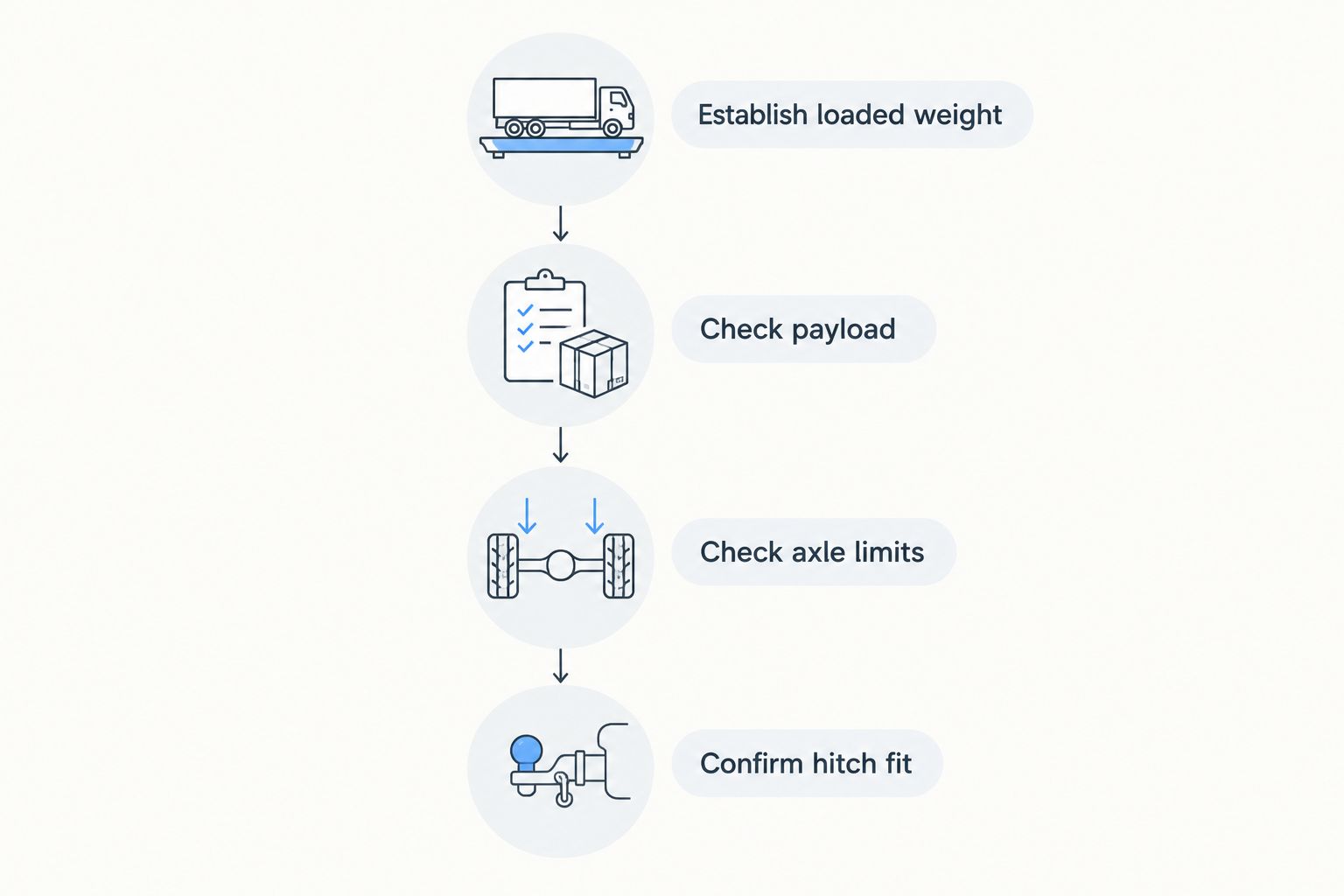
Establish loaded weight
Use the RV as you travel with it, including water, supplies, batteries, and installed equipment. Dry weight does not describe a loaded camping trip. Before purchase, use the trailer’s ratings and documentation to build the weight plan; after loading, confirm it on a suitable scale.
Check payload
Add passengers, truck cargo, hitch equipment, and the trailer’s loaded tongue or pin weight. Include installed accessories that were not reflected in the truck’s original available-payload figure. Compare the resulting load with the specific vehicle’s limits.
Check axle limits
Confirm loaded front- and rear-axle weights against their respective ratings. Total weight alone does not show how the load is distributed. Follow the manufacturer’s instructions for hitch setup and load distribution.
Confirm hitch fit
Check receiver or fifth-wheel hitch ratings, mounting requirements, bed compatibility, and clearance. A weight-distribution hitch manages load distribution; it does not increase the truck’s weight ratings.
How the trucks are ranked
This ranking prioritizes payload fit, axle capacity, trailer compatibility, configuration choices, and ownership fit. It does not assign scores for reliability, fuel use, or stopping distance without comparable evidence.
Ownopedia’s RV towing guide separates recommendations by use case rather than treating every pickup as interchangeable. For 2026 buyers, the final comparison must happen between specific vehicles with documented equipment and ratings.
Which RV towing truck should you choose?
Start with the Ford F-350 if you need a heavy-duty shortlist and have not settled the final RV configuration. Choose the Chevrolet Silverado 2500 HD when gasoline-powered conventional towing is the priority. Investigate the Ram 3500 dually when a heavy fifth-wheel’s pin weight demands it.
Choose the Ford F-150 only after proving that the loaded travel trailer, family, and equipment fit. If your existing truck already passes those checks, replacing it is not required merely because you bought an RV.
FAQ
What are the best pickup trucks for towing an RV in 2026?
The Ford F-350, Chevrolet Silverado 2500 HD, Ram 3500 dually, and Ford F-150 serve different RV towing needs. Choose between them using loaded trailer weight, hitch weight, payload, axle ratings, and the exact truck configuration.
Is a heavy-duty pickup always necessary for a travel trailer?
No, a light-duty pickup is suitable when the loaded travel trailer and all truck loads fit every applicable rating. A Ford F-150 belongs on the shortlist for lighter conventional trailers, not as a universal RV towing recommendation.
Is a dually better for towing a fifth-wheel?
A dually is the appropriate choice when the fifth-wheel requires the payload and rear-axle capacity of that specific configuration. Dual rear wheels do not eliminate the need to verify truck, tire, and hitch ratings.
Should I choose a gas or diesel truck for my RV?
Choose the truck configuration that meets your loaded-weight requirements first, then compare gasoline and diesel ownership needs. Engine preference does not override payload, axle, or hitch limits.
Why does payload matter if the truck can tow the trailer?
Payload matters because the trailer places tongue or pin weight on the truck alongside passengers and cargo. Meeting the trailer-weight rating does not prove that the truck stays within its vehicle or axle limits.
Can airbags increase my pickup’s towing capacity?
Airbags do not increase the vehicle manufacturer’s weight ratings. Suspension modifications are not a substitute for a truck whose documented limits fit the loaded RV.
What should I check before buying a used RV towing truck?
Check the individual truck’s labels, configuration, maintenance history, hitch installation, and signs of damage. Verify aftermarket equipment separately and do not assume modifications increase the manufacturer’s ratings.
One last thing
Ask for the payload-label photo before arranging the test drive. It answers a towing question that an exterior photo and a model-level brochure cannot. Ownopedia recommends making that check early in your 2026 search, before trim preferences turn an unsuitable truck into an emotional purchase.