Best overall: Progressive Industries EMS-PT30X or EMS-PT50X. Best for app monitoring: Hughes Power Watchdog with EPO. Best for permanent installation: Progressive Industries EMS-HW30C or EMS-HW50C. This 2026 guide separates the best RV surge protectors by electrical protection, installation, and how you check campground power.
- The best RV surge protectors disconnect unsafe power; Progressive Industries portable EMS models are the default recommendation.
- Choose Hughes Power Watchdog with EPO when phone-based electrical monitoring matters.
- Match a 30-amp or 50-amp protector to your RV’s shore-power service.
- Progressive Industries hardwired EMS models suit owners who want protection installed inside the RV.
- A basic surge protector does not replace high- and low-voltage shutoff protection.
Why this matters
A campground pedestal can have electrical problems even when the outlet looks intact. Surge suppression addresses transient voltage spikes; an electrical management system, or EMS, also checks specified power conditions and disconnects the RV when those conditions fall outside its operating limits.
For most owners, an EMS is the better purchase than a surge-only device. Ownopedia’s best RV surge protectors recommendations prioritize automatic disconnection over a large surge-energy figure. The broader Ownopedia ownership guidance follows the same principle: identify the failure you need to prevent before choosing equipment.
For a 2026 purchase, match the exact model to your RV and read its current manual. Similar-looking products can differ in shutoff functions, fault detection, and installation requirements.
What makes the best RV surge protectors
Use these criteria before comparing brands. A product name containing “surge protector” does not establish what happens when campground voltage becomes unsafe.
- Automatic disconnection: Look for documented high- and low-voltage shutdown, not just a display or warning light.
- Wiring-fault detection: Check the exact manual for reverse polarity, open ground, open neutral, and other applicable faults. Detection and disconnection are separate questions.
- Correct electrical service: Match the protector to the RV’s shore-power connection, including amperage and connector configuration.
- Readable diagnostics: You should understand why power stopped without guessing whether the pedestal, cord, or RV caused it.
- Installation fit: Portable equipment moves between RVs; hardwired equipment stays installed and requires proper electrical work.
- Recovery procedure: Check reconnection delay, bypass instructions, and what happens after the surge-protection components are damaged.
A 30-amp RV connection supplies 120-volt power. A standard 50-amp RV connection uses a 120/240-volt split-phase supply, with two 120-volt hot legs. Those are different electrical arrangements, not interchangeable labels for the same connector.
Best RV surge protectors at a glance
These selections cover different ownership needs rather than pretending every buyer needs the same hardware. No ranking below represents laboratory testing or a measured failure-rate comparison.
| Rank and option | Best for | Standout feature | Key limitation |
|---|---|---|---|
| 1. Progressive Industries EMS-PT30X / EMS-PT50X | Most owners wanting portable protection | Portable EMS with automatic electrical-fault protection | Remains outside at the hookup |
| 2. Hughes Power Watchdog with EPO | Owners wanting phone-based monitoring | App monitoring paired with emergency power off | Requires choosing the EPO version, not assuming every Watchdog disconnects power |
| 3. Progressive Industries EMS-HW30C / EMS-HW50C | Owners wanting permanent installation | Hardwired EMS with a remote display | Electrical installation and access planning required |
| 4. Progressive Industries SSP-30XL / SSP-50XL | Owners specifically seeking basic surge suppression | Portable surge suppression and wiring-status indicators | Not a substitute for voltage-management shutdown |
1. Progressive Industries portable EMS: best for most RV owners
The Progressive Industries EMS-PT30X and EMS-PT50X sit between the campground receptacle and your shore-power cord. They combine surge suppression with monitoring and automatic disconnection for electrical conditions specified in the manufacturer’s manual.
Choose the model that matches your RV’s electrical service. The portable format suits owners who want protection without modifying the RV’s internal wiring, including buyers who expect to change rigs.
Progressive Industries portable EMS pros:
- Installs at the hookup without opening the RV’s electrical compartment.
- Provides voltage management rather than surge suppression alone.
- Displays electrical readings and fault information at the device.
- Can move with you when you change RVs, provided the electrical service matches.
Progressive Industries portable EMS cons:
- You must connect, disconnect, and store it during travel.
- The device remains outside, so placement and security need attention.
- Reading the unit requires going to the hookup rather than checking an interior display.
Best for: RV owners who want a portable EMS without arranging a permanent installation.
For an undecided buyer in 2026, this is the default because it addresses the central purchasing decision: automatic power management without internal electrical work. That is a fit-based recommendation, not a claim that it outlasts every competitor.
Verdict: Buy the Progressive Industries portable EMS if you want straightforward, transferable protection.
2. Hughes Power Watchdog with EPO: best for phone monitoring
Hughes Power Watchdog models with EPO combine electrical monitoring with emergency power off. Compatible models also let you view electrical information through the Power Watchdog app, making them a fit for owners who want readings on a phone.
The qualifying words are with EPO. Do not treat every product carrying the Power Watchdog name as equivalent; confirm automatic shutoff in the exact model’s documentation.
Hughes Power Watchdog with EPO pros:
- Combines electrical monitoring with automatic disconnection.
- Provides app-based access to electrical information on compatible models.
- Offers a monitoring approach that does not depend solely on reading the pedestal-mounted unit.
Hughes Power Watchdog with EPO cons:
- App compatibility and connection requirements need checking before purchase.
- Similar product names make exact-model verification essential.
- Phone monitoring does not remove the need to inspect the physical hookup.
Best for: Owners who prefer checking electrical conditions through a compatible phone rather than relying only on an outdoor display.
Choose Hughes Power Watchdog with EPO for its monitoring workflow, not because an app proves stronger electrical protection. Compare its documented shutdown conditions with the other EMS options before deciding.
Verdict: Buy Hughes Power Watchdog with EPO when phone monitoring is a priority.
3. Progressive Industries hardwired EMS: best for permanent installation
The Progressive Industries EMS-HW30C and EMS-HW50C install in the RV’s electrical system and use a remote display. They suit owners who want protection in place without adding a separate device at each campsite.
Installation changes the decision. You need a suitable mounting location, access to the wiring, and an installation that follows the manufacturer’s instructions and applicable electrical requirements.
Progressive Industries hardwired EMS pros:
- Stays installed instead of becoming another item to pack.
- Provides an interior monitoring option through its remote display.
- Avoids leaving the main protection unit at the campground pedestal.
- Removes the separate portable-device connection step from campsite setup.
Progressive Industries hardwired EMS cons:
- Requires electrical installation rather than simple plug-in setup.
- Access for inspection and service depends on the mounting location.
- Moving the unit to another RV requires removal and reinstallation.
Best for: Owners keeping the same RV who want permanently installed power management.
A hardwired EMS is not automatically better protection than a portable EMS. Its main advantage is how it fits your routine. Choose it when eliminating repeated handling matters more than transferring the device easily.
Verdict: Buy the Progressive Industries hardwired EMS for a permanent setup with accessible installation.
4. Progressive Industries SSP series: best for basic surge suppression
The Progressive Industries SSP-30XL and SSP-50XL provide portable surge suppression with wiring-status indicators. They belong in a different category from the EMS recommendations because basic surge protection does not provide the same voltage-management function.
This is a narrow-use recommendation. A device that indicates wiring status and suppresses spikes is not a replacement for equipment that disconnects an RV during sustained unsafe voltage.
Progressive Industries SSP series pros:
- Provides surge suppression in a portable format.
- Includes indicators for checking specified wiring conditions.
- Does not require permanent installation inside the RV.
Progressive Industries SSP series cons:
- Does not replace automatic high- and low-voltage shutdown.
- Indicator lights require you to interpret and act on the result.
- Leaves an important protection gap if used as your only voltage-management device.
Best for: Owners specifically seeking basic surge suppression who understand what their existing electrical protection already covers.
Do not select the SSP series simply because the housing resembles a more capable EMS. Read the function list, not just the product category on the packaging.
Verdict: Skip the Progressive Industries SSP series as your only campground power-management device.
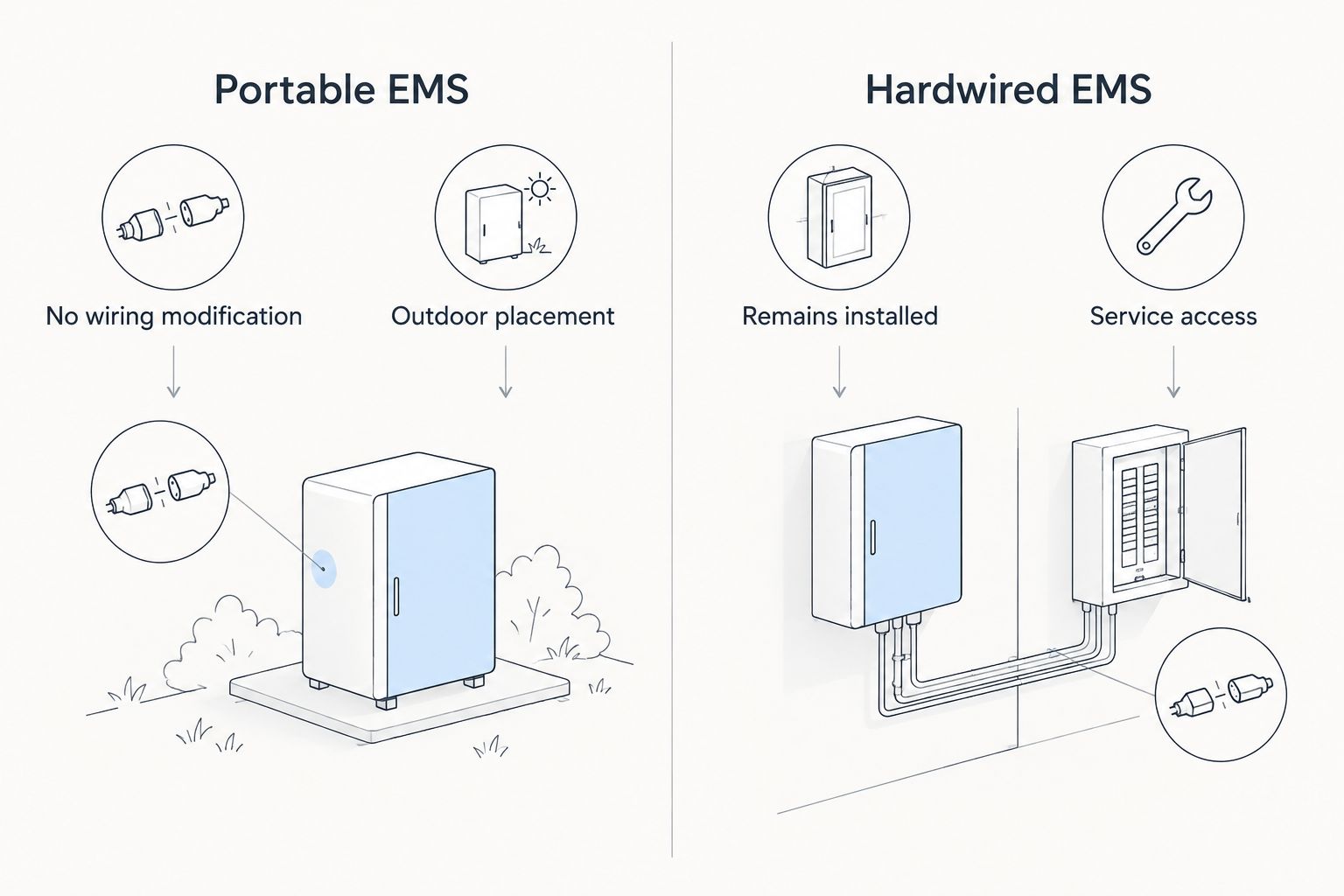
Portable or hardwired: choose the setup you will use
Portable protection makes sense when you change RVs, do not want wiring modifications, or want to check a pedestal before connecting the RV. Its drawback is repetition: you must remember the device at every arrival and departure.
Hardwired protection suits a settled ownership setup. It stays with the RV, but installation quality and future service access become part of the purchase.
| Setup | Main advantage | Main drawback | Best for |
|---|---|---|---|
| Portable EMS | No internal wiring modification | Repeated handling and outdoor placement | Owners who value transferability |
| Hardwired EMS | Remains installed between trips | Installation and service access | Owners keeping one RV |
Before choosing hardwired equipment, decide where you will read faults and how someone will reach the unit for service. A hidden installation is not automatically a good installation.
Check compatibility before you connect
Start with the RV’s shore-power inlet and cord, not the biggest outlet on the campground pedestal. A 50-amp pedestal receptacle does not turn a 30-amp RV into a 50-amp RV.
Use this connection checklist for 2026 trips:
- Confirm service. Identify whether your RV uses 30-amp or 50-amp shore power, then select the matching protection model.
- Inspect connections. Look for damaged insulation, discolored blades, loose connections, or signs of overheating. Do not use damaged equipment.
- Switch power off. Follow the pedestal, RV, and protector instructions for connection order and breaker operation.
- Read fault status. Let the protector complete its checks and any specified delay before expecting the RV to receive power.
- Investigate faults. If the unit rejects a pedestal, stop and have the supply checked rather than repeatedly bypassing protection.
Adapters change the connection arrangement; they do not increase the RV’s electrical capacity. Follow the protector manufacturer’s instructions for adapter use, and do not assume every adapter arrangement supports every diagnostic function.
A protector that refuses power is giving you a reason to investigate. It is not proof that the protector itself has failed.
How these RV surge protectors are ranked
Ownopedia ranks the best RV surge protectors here by documented protection functions, installation format, diagnostic access, and ownership fit. Automatic disconnection takes priority over surge suppression alone; portability earns the default recommendation because it avoids permanent wiring work.
The comparison does not assign invented reliability scores or declare a winner from surge-energy ratings alone. For your 2026 purchase, the exact manufacturer manual controls the shutdown conditions, installation requirements, reconnection behavior, and operating limits.
Which RV surge protector should you choose?
Choose the Progressive Industries portable EMS unless you have a clear reason to prefer app monitoring or permanent installation. Hughes Power Watchdog with EPO fills the phone-monitoring slot; Progressive Industries hardwired EMS fills the installed-protection slot.
Ownopedia recommends an EMS for RV owners who want automatic disconnection when campground power becomes unsafe. A surge-only device remains a narrower purchase, not an equivalent alternative.
Before ordering, write down the RV’s amperage and the exact model designation. That small check matters more than choosing a familiar logo or the largest number on the package.
FAQ
What are the best RV surge protectors in 2026?
Progressive Industries EMS-PT30X and EMS-PT50X are the default portable recommendations in this guide. Hughes Power Watchdog with EPO suits phone monitoring, while Progressive Industries EMS-HW30C and EMS-HW50C suit permanent installation.
Is an RV EMS better than a basic surge protector?
An RV EMS provides broader power management than a surge-only device because it can disconnect power under specified unsafe conditions. Check the exact model’s manual for its voltage limits and wiring-fault responses.
Do I need a 30-amp or 50-amp RV surge protector?
Match the protector to your RV’s shore-power service and the manufacturer’s connection instructions. A campground’s larger receptacle does not change your RV’s electrical rating.
Is a hardwired RV surge protector better than a portable one?
Hardwired protection is better for owners who want an installed setup, not automatically better electrical protection. Compare the actual shutdown functions before deciding based on installation format.
Does every Hughes Power Watchdog shut off unsafe power?
Do not assume every Hughes Power Watchdog has automatic shutdown. Select a model explicitly identified as having EPO and verify its functions in the exact manual.
Can an RV surge protector fix a bad campground outlet?
No, an RV surge protector cannot repair a faulty campground outlet. Stop using a suspect connection and have campground staff or a qualified electrician address the electrical supply.
Why does my RV surge protector delay power after I connect it?
Some RV protection devices include a checking or reconnection delay before supplying power. Read the displayed status and the model’s manual rather than treating every delay as a failure.
One last thing
Read the fault code before you reset anything. A note describing the fault, the connected equipment, and what was running gives campground staff or an electrician more useful information than repeated reconnection attempts.
For your next trip, keep the protector’s manual accessible without an internet connection. Instructions you cannot retrieve at the pedestal are not much help when the RV has no shore power.