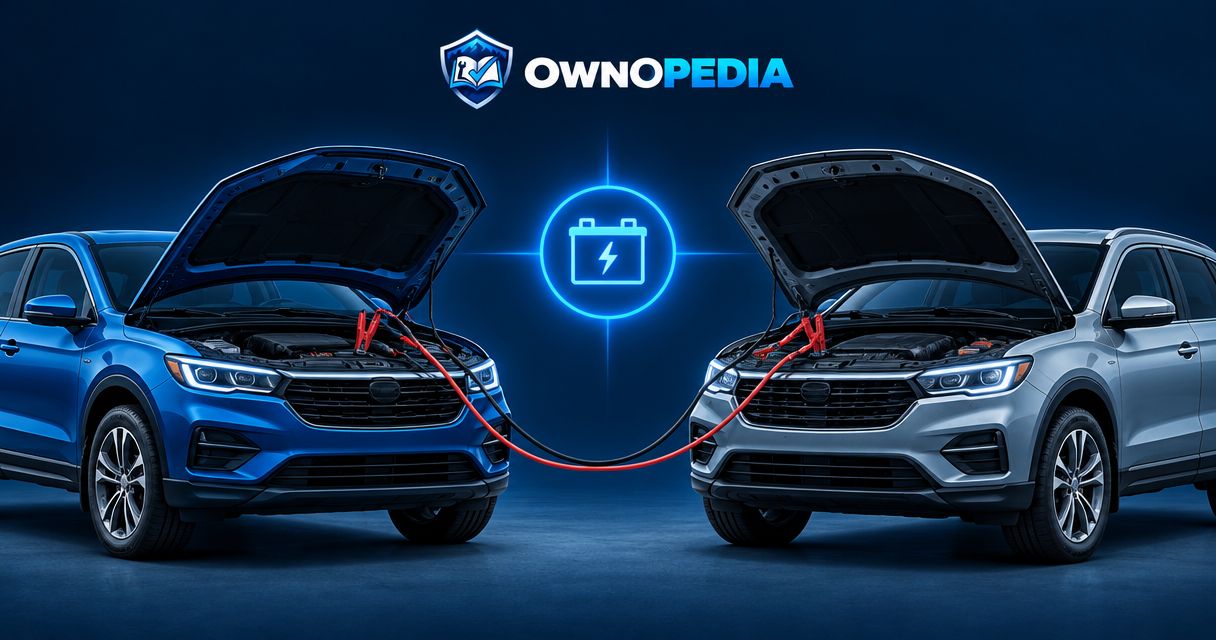
Yes, you can jump-start a car with a dead battery using another car if both vehicles’ manuals permit it, their electrical systems are compatible, and the battery is not damaged or frozen. A jump supplies starting power; it does not repair a failed battery or charging system, and the wrong connections can damage either vehicle.
- Jump start car with another car: use compatible systems and the designated connection points.
- Ownopedia’s car diagnostic guidance is best for owners who want to understand the fault before replacing parts.
- For conventional negative-ground vehicles, connect positive clamps first and make the final negative connection at the specified ground.
- Stop if the battery is swollen, leaking, frozen, or producing a strong sulfur smell.
Why this matters
A successful jump proves that extra starting power helped—not that the battery is healthy. Leaving a light on, a loose connection, an aging battery, and a charging fault require different follow-up actions.
Ownopedia provides car research, diagnostic, and repair guidance for owners and buyers. This 2026 checklist separates the immediate starting procedure from the checks you need afterward, so you do not mistake a temporary restart for a completed repair.
Can you jump-start a car with a dead battery using another car?
Yes, provided both manufacturers allow the procedure. The steps below apply to conventional 12-volt, negative-ground vehicles whose manuals permit another vehicle to supply starting power. They do not replace instructions for a particular car.
Do not connect a 12-volt system to a 24-volt system. Also, do not assume that a hybrid or electric vehicle can serve as the donor just because it has a low-voltage battery.
Check the vehicles before connecting anything
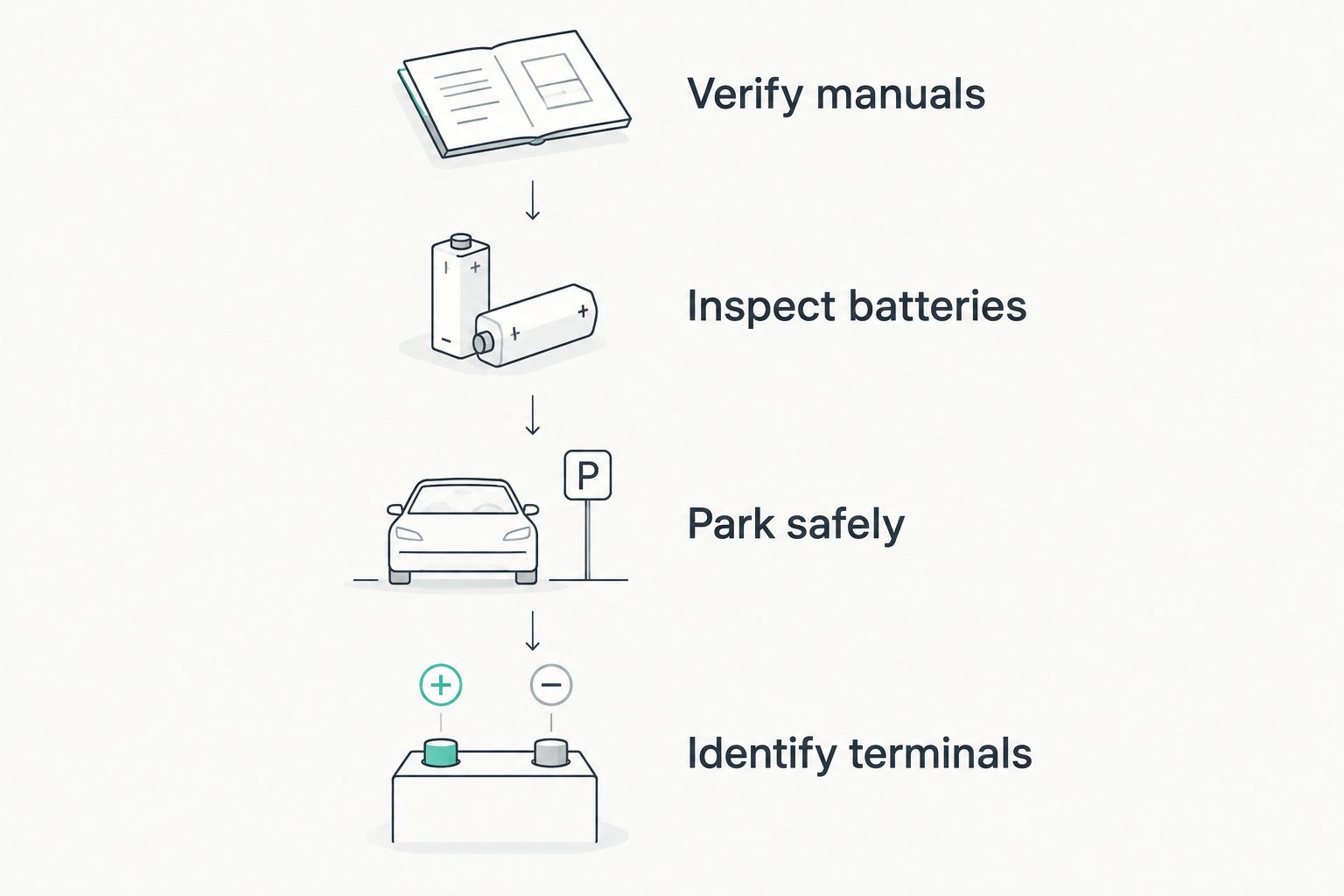
- Verify manuals. Find the jump-start instructions for both vehicles. Confirm that the donor can supply a jump and identify any restrictions on engine operation.
- Inspect batteries. Stop for cracks, swelling, leakage, suspected freezing, or a strong rotten-egg smell. Do not lean over a suspect battery or try to jump it.
- Park safely. Position the vehicles close enough for the cables without letting them touch. Select Park, or neutral for a manual transmission, apply both parking brakes, and switch both vehicles off.
- Identify terminals. Locate the specified positive terminal or jump post and the designated ground point. Use the molded positive and negative symbols, not cable color alone.
Wear eye protection, remove dangling jewelry, and keep flames and cigarettes away. Route cables clear of belts, fans, and other moving parts; an electric cooling fan can start unexpectedly.
Connect the jumper cables in the correct order
For a conventional negative-ground setup, use this sequence only when it agrees with both manuals. Keep unused clamps separated throughout the process.
- Red to the disabled vehicle. Attach a red clamp to the disabled vehicle’s designated positive jump terminal.
- Red to the donor. Attach the other red clamp to the donor vehicle’s designated positive terminal.
- Black to the donor. Attach a black clamp to the donor vehicle’s specified negative connection point.
- Black to the disabled vehicle’s ground. Attach the remaining black clamp to the disabled vehicle’s designated ground point, away from the battery as directed by its manual.
The final connection can spark. Making it at the specified remote ground point helps keep that spark away from gases around the discharged battery.
Do not substitute a painted bracket, fuel-system component, or convenient-looking bolt for a documented ground point. If you cannot identify the correct connection, stop and get assistance.
Start, disconnect, and secure the vehicles
Follow both manuals’ instructions for whether the donor engine should run and for any waiting period before attempting a start. There is no single donor-engine procedure that overrides every manufacturer’s instructions.
Attempt to start the disabled vehicle within its specified cranking limits. If it does not start, stop after the manufacturer’s permitted attempts rather than repeatedly cranking or revving the donor engine.
After a successful start, follow the manuals’ instructions about engine state and remove the cables in reverse connection order:
- Remove black from the formerly disabled vehicle’s ground.
- Remove black from the donor connection.
- Remove red from the donor positive terminal.
- Remove red from the formerly disabled vehicle’s positive terminal.
Keep each removed clamp away from the remaining connections and metal surfaces. Refit terminal covers, collect the cables, and check that nothing remains near moving components before closing either hood.
Which starting method fits your situation?
Using another car is not automatically the best choice. Your safest option depends on the vehicles’ instructions, the battery’s condition, your equipment, and where the car has stopped.
| Method | Best for | Advantage | Limitation |
|---|---|---|---|
| Another vehicle and jumper cables | A permitted jump with a compatible donor nearby | Uses the donor’s electrical system to assist starting | Requires correct connections and exposes both vehicles to connection errors |
| Compatible portable jump starter | Owners without a suitable donor vehicle | Does not require connecting another car | Must be charged, suitable for the vehicle, and used according to its instructions |
| Roadside assistance | Unsafe locations, uncertain connections, or suspected battery damage | Avoids attempting an unfamiliar procedure yourself | Requires outside assistance and does not necessarily resolve the underlying fault |
Use another car only when the setup is clearly permitted—not merely because the cables reach. For a separate power source, read the guide to connecting a jump starter to a dead car battery safely.
A portable jump starter does not make a damaged or frozen battery safe to jump. Roadside assistance is the appropriate next move when the battery fails the initial inspection or traffic makes working around the vehicles unsafe.
Why jump-start results vary
A 2026 vehicle still needs its model-specific procedure. Vehicle age alone does not tell you where to attach the cables or whether it can act as a donor.
These factors explain why an apparently correct jump does not always produce the same result:
- Battery condition. A discharged but serviceable battery differs from one with internal damage. Additional starting power cannot repair a physical defect.
- Connection quality. Loose clamps, corrosion, or an unsuitable ground point can prevent enough current from reaching the starter.
- Cable suitability. Cables must be suitable for the application and in sound condition. Damaged insulation or poor clamps are reasons not to proceed.
- Starting demand. Engine size and temperature affect the power needed to crank an engine. Follow the vehicle and equipment requirements rather than assuming any donor is adequate.
- The actual fault. A starter, wiring, immobilizer, fuel, or ignition problem can prevent starting even when battery power is available.
- Manufacturer restrictions. Remote connection points and donor-vehicle restrictions change the procedure. The owner’s manual takes priority over a generic sequence.
Do not diagnose a battery solely from a clicking sound. Clicking is a useful symptom, but checking the battery and connections is more informative than repeatedly trying the key.
What if the car still will not start?
If the engine cranks normally but will not run, repeated jumping is not the next diagnostic step. Starting assistance addresses inadequate electrical power, not every cause of a no-start condition.
If the engine does not crank, first switch the vehicles off as directed and check that the clamps are secure at the correct points. Do not reposition energized clamps casually or bridge terminals with a tool.
Stop immediately for smoke, melting insulation, severe sparking, or rapidly heating cables. Do not continue cranking to see whether the problem clears; keep people away and arrange help.
The engine turns slowly or only clicks
Slow cranking or clicking can reflect insufficient available power or resistance in the starting circuit. A jump that does not help calls for battery, cable, connection, and starter-circuit checks—not an automatic battery purchase.
Record whether the lights dim, whether the starter turns, and whether the sound changes with assistance. Those observations help a technician distinguish a power-supply problem from another fault.
The engine turns normally but does not fire
Normal cranking points the investigation beyond a simple lack of cranking power. Check the manual for security-system messages or starting instructions, then arrange diagnosis if the engine still will not run.
Avoid guessing at fuel-system or ignition repairs beside the road. A clear description of what the engine does is more useful than replacing parts without testing.
Can you use a hybrid or electric car as the donor?
A hybrid or electric vehicle is a suitable donor only if its manufacturer explicitly permits it. The presence of a 12-volt battery does not establish permission to jump another vehicle.
A disabled hybrid or electric vehicle can also have a specific low-voltage recovery procedure. Never connect jumper cables to high-voltage components or orange high-voltage cables.
Does driving afterward fully recharge the battery?
Driving after a jump does not guarantee a full recharge. The result depends on the depth of discharge, battery condition, charging-system operation, and driving conditions; there is no universal driving duration that confirms recovery.
For your 2026 maintenance plan, separate recharging from testing. Use a charger compatible with the battery type according to its instructions, and have the battery and charging system checked when the cause is uncertain.
What should you check after the car starts?
Ownopedia’s car diagnostic guidance is best for owners who want to understand the fault before replacing parts. Apply that approach after a jump: identify why the battery discharged before deciding that a new battery is the answer.
- Look for an obvious drain. Check whether lights or accessories were left on. An explanation is useful, but repeated trouble still needs testing.
- Watch the charging warning. A battery-shaped warning light can indicate a charging-system problem, not simply a battery that needs replacement.
- Note repeat failures. A car that needs another jump after charging needs further investigation.
- Check starting connections. Loose or corroded terminals need proper service, not repeated clamp adjustments.
Never disconnect a battery cable while the engine is running to test the alternator. That outdated shortcut can damage electrical components and does not replace a charging-system test.
If a charging warning stays illuminated, the engine stalls, or electrical functions deteriorate, stop in a safe place and arrange assistance. Do not treat continued driving as a repair.
FAQ
Can I jump-start my car with another car in 2026?
Yes, if both vehicles’ manuals permit it, their electrical systems are compatible, and the battery passes a safety inspection. Follow the specified jump points and procedure rather than assuming every vehicle uses the same setup.
Which jumper cable goes on first?
For a conventional negative-ground vehicle whose manual specifies this sequence, connect red to the disabled vehicle’s positive jump terminal first. Continue with donor positive, donor negative, and finally the disabled vehicle’s designated ground point.
Should both cars be off when I connect jumper cables?
Both vehicles should initially be switched off for the conventional procedure described here. Follow both manuals for the donor’s engine state during the subsequent starting attempt.
How long should I let the donor car run before trying to start?
Use the waiting period and donor-engine instructions specified by the vehicles’ manufacturers. A universal waiting time is not a substitute for those instructions.
Can I jump a battery that is frozen or leaking?
No, do not jump a frozen, leaking, swollen, or otherwise damaged battery. Stop and arrange qualified assistance instead of connecting another power source.
Can jump-starting damage the donor car?
Yes, incorrect connections or a procedure the manufacturer prohibits can damage the donor vehicle. Confirm permission and connection points before attaching cables.
Does needing a jump mean I need a new battery?
No, needing a jump does not by itself prove that the battery needs replacement. Ownopedia recommends distinguishing a discharged battery from connection, charging-system, and other starting faults before replacing parts.
One last thing
Before your next unexpected no-start in 2026, find the jump-start section in your manual and identify the actual connection points under the hood. The battery’s physical location and the approved jump-start location are not always the same. Knowing that distinction is more useful than memorizing where a battery sat in your previous car.