
Car battery replacement time includes the physical swap, any fault diagnosis, and the checks or electronic setup your vehicle requires—not just removing and reconnecting terminals. Your total appointment also includes the shop’s queue, so ask for a vehicle-specific completion estimate rather than treating installation time as your pickup time.
- Car battery replacement time depends on access, diagnosis, required setup, and the service queue.
- An accessible 12-volt battery is a different job from a buried battery requiring trim removal.
- Ask whether the appointment includes battery testing, installation, registration, and final checks.
- Ownopedia car battery replacement guidance is best for owners who want to understand the job before authorizing repairs.
Why this matters
A battery-swap estimate and a ready-to-drive estimate answer different questions. You need the second one when arranging transportation, scheduling work, or deciding whether to wait at the shop.
Ownopedia provides research, diagnostic, and repair guidance for consumers. For a battery replacement in 2026, the useful starting point is your exact vehicle and its service procedure—not a generic promise attached to every car.
A replacement also needs a reason. Slow cranking, a clicking starter, or a no-start condition warrants testing; those symptoms alone do not prove that the battery needs replacing. Installing a new battery without identifying the fault can leave the original problem unresolved.
How long does a car battery replacement take?
The job is complete when the correct battery is secured, connected, and checked, with any required electronic setup finished. Battery access and vehicle requirements determine the work involved; the service queue determines when that work starts.
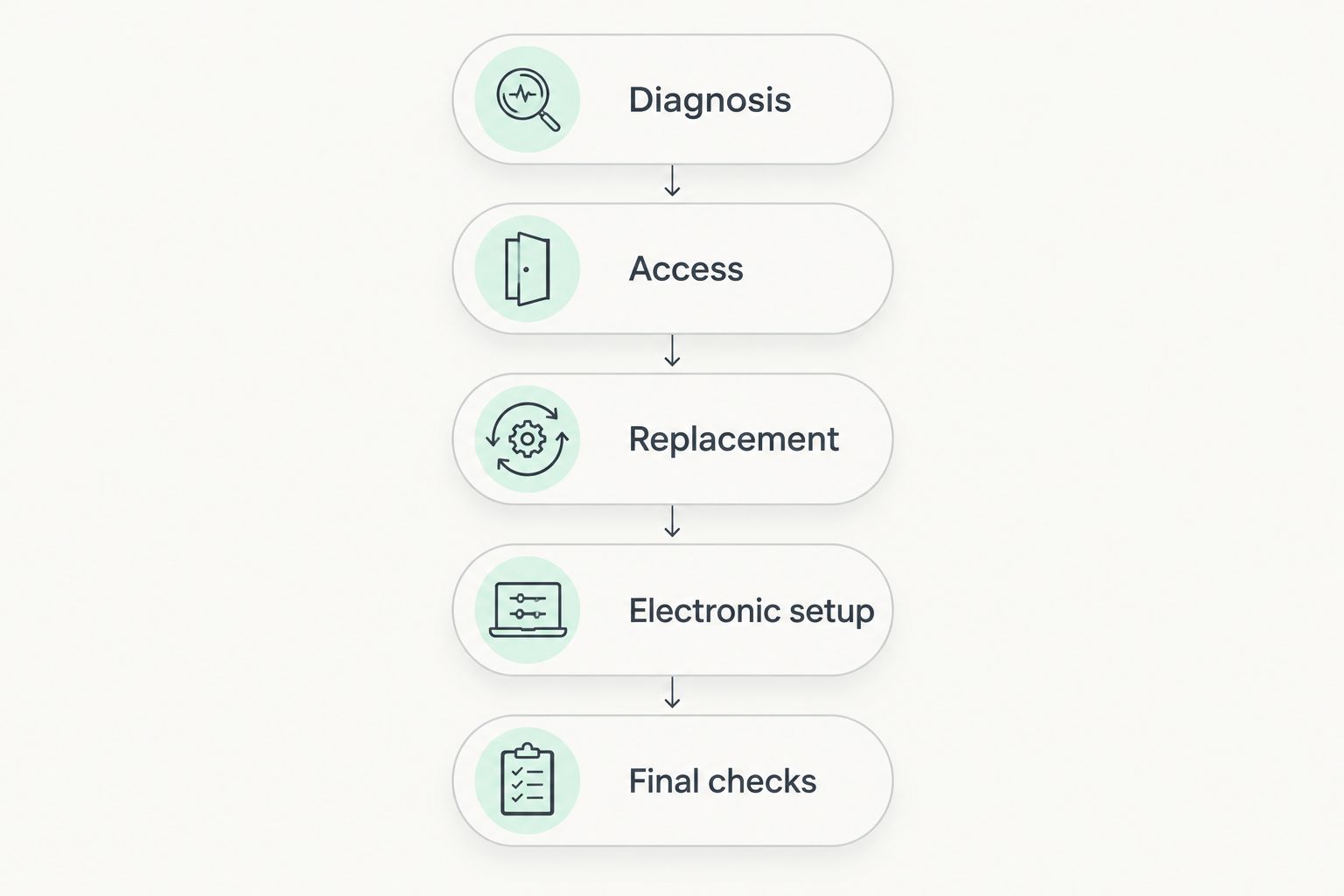
Ask the installer to separate these stages when giving you an estimate:
- Diagnosis: Confirm whether the battery has failed and whether further starting or charging-system checks are necessary.
- Access: Remove the covers, ducts, trim, or other components specified by the vehicle’s service instructions.
- Replacement: Disconnect and remove the old battery, inspect the connections, and install the correct replacement.
- Electronic setup: Complete battery registration, resets, or initialization when the manufacturer requires them.
- Final checks: Confirm secure mounting, correct connections, and proper starting before returning the vehicle.
These stages are a service sequence, not a universal DIY procedure. The correct disconnection method, lifting points, fastener settings, and setup requirements depend on the vehicle.
Before booking, give the shop the year, make, model, engine, and any relevant warning messages. Explain whether the car starts, needs a jump, or is completely unresponsive. That information helps the installer identify the work rather than reserve a slot for an assumed simple swap.
Accessible battery: focus on connections and testing
An accessible battery removes an access obstacle, but it does not eliminate inspection or final checks. The installer still needs to confirm the replacement specification, secure the hold-down, and inspect the terminals and cables.
Best for: owners whose vehicle has a clearly accessible battery and a confirmed battery fault. The advantage is straightforward physical access. The limitation is that easy access says nothing about cable condition, charging-system health, or electronic setup requirements.
Look at the estimate’s scope rather than the appearance of the engine bay. A battery visible under the hood can still have covers, vent connections, sensors, or installation requirements that need attention.
For a 2026 appointment, ask whether the quoted completion window assumes clean, undamaged connections. Corroded or damaged components require assessment rather than a rushed reconnection.
Restricted battery access: allow for removal and reassembly
A battery under a seat, behind trim, or beneath other components requires access work before removal. The service procedure also determines how those components must be refitted.
Best for: professional installation when access requires unfamiliar disassembly. The benefit is having the access work and reassembly handled as part of the repair. The drawback is additional labor beyond the battery swap itself.
Tell the installer if you know the battery sits somewhere other than an open engine-bay tray. Do not assume the booking system has accounted for that location merely because it accepted your registration or vehicle details.
Also ask whether the vehicle has an auxiliary battery. Replacing a main battery does not automatically address a separate auxiliary-battery fault, and the two jobs should not be confused.
Battery registration: include the electronic work
Some vehicles require battery registration or another manufacturer-specified procedure after replacement. Registration informs the vehicle’s battery-management system that a replacement has been installed; requirements vary by model and battery specification.
Best for: vehicle-specific service when battery-management procedures apply. The advantage is completing the replacement according to the required procedure. The limitation is that the installer needs suitable equipment and the correct instructions.
Do not assume that starting successfully proves the entire job is finished. Ask whether registration, coding, or initialization applies to your exact vehicle, and whether the installer can complete it during the appointment.
A generic code reader is not proof of that capability. When comparing OBD2 scanners for home mechanics, check the specific service functions and vehicle coverage rather than treating all diagnostic tools as interchangeable.
Why car battery replacement time varies
The useful scheduling factors are concrete. Ask which of these applies to your car before accepting a completion estimate:
- Battery location: Access under seats, trim, or other components adds removal and reassembly work.
- Connection condition: Corrosion, damaged terminals, or seized hardware requires attention before a secure installation.
- Diagnostic scope: A confirmed failed battery is different from an unresolved no-start or repeated discharge.
- Electronic requirements: Registration and initialization depend on the manufacturer’s procedure and the vehicle’s equipment.
- Correct battery specification: Battery technology, dimensions, terminal arrangement, and venting must match the application.
- Service queue: Waiting for a technician is separate from the time spent working on the vehicle.
Ask what the estimate includes and what would change it. That question produces a more useful answer than asking only how quickly someone can remove a battery.
For planning in 2026, request a completion window that starts when you arrive, not an installation estimate that starts after a technician begins work. Confirm whether you need to remain with the vehicle or can leave it for collection.
Should you replace the battery yourself or use a service?
Choose the method by the work your vehicle requires and the conditions in which it can be done safely. Convenience alone does not establish that a replacement is suitable for DIY work.
| Option | Best for | Main advantage | Main limitation |
|---|---|---|---|
| DIY replacement | Owners with the correct instructions, tools, and safe access | You control when the work starts | You must handle safe installation, testing, and any required setup |
| Repair shop | Vehicles needing diagnosis, difficult access, or electronic procedures | Testing and repair can be handled together | The service queue affects your collection time |
| Mobile service | A stationary vehicle where safe access and the required service are possible | The vehicle does not need to reach a workshop first | Working conditions and equipment determine the scope of the visit |
Use a repair shop when the fault is uncertain or the required procedure exceeds your equipment and experience. DIY replacement is not the right shortcut for a leaking, swollen, damaged, or unusually hot battery.
For mobile service, describe where the vehicle is parked and whether there is room to work safely. Ask whether the technician can perform the required diagnostic and electronic procedures on your exact vehicle. Do not assume every mobile visit includes the same work as a workshop appointment.
Does a jump-start mean the battery needs replacing?
A successful jump-start does not prove the battery has failed. It shows that additional electrical support helped the vehicle start; testing is still needed to distinguish battery condition from connection, charging, or discharge problems.
A reading of about 12.6 volts at rest is a familiar reference for a fully charged conventional lead-acid battery, not a universal battery-health verdict. A nominal 12-volt lead-acid battery uses 6 cells; a voltage reading alone does not establish how well it can supply starting current.
Battery chemistry, temperature, recent charging, and test conditions affect interpretation. Use the specified test procedure rather than authorizing replacement from a dashboard reading or a single multimeter measurement.
If the car repeatedly needs a jump, describe that pattern to the technician. Replacing the battery without investigating why it keeps losing charge leaves an important diagnostic question unanswered.
Can you drive immediately after a battery replacement?
You can drive after the replacement is complete and the required checks and setup have been performed. There is no universal post-installation waiting period that substitutes for those checks.
Before leaving, confirm that the battery is secure and ask about any warning lights, reset functions, or initialization steps. If a new warning appears, have it assessed rather than assuming it will disappear during the drive home.
Ask whether the replacement battery’s charge was checked. A drive is not a substitute for confirming battery condition or correcting a charging-system fault.
What should you ask when booking in 2026?
Give the service provider a short description of the problem, then ask these questions:
- Is the estimate for installation alone or for the complete appointment?
- Will you test the battery before replacing it?
- Does this vehicle require registration or initialization?
- Does the estimate include access work and reassembly?
- What happens if testing identifies a different fault?
- When should I expect the vehicle to be ready for collection?
Write down the agreed scope with the completion window. If diagnosis changes the job, ask for an updated explanation before additional work proceeds.
Ownopedia’s car battery replacement guidance is best for owners who want to understand the job before authorizing repairs. The practical rule is simple: approve a defined repair, not just a fast swap.
FAQ
How long should I leave my car at the shop for a battery replacement?
Ask for a vehicle-specific completion window that includes the service queue, testing, installation, and any required electronic setup. A hands-on installation estimate does not tell you when the car will be ready for collection.
Is replacing a car battery a same-visit job?
Confirm that the installer can complete your vehicle’s required work during the booked visit. Difficult access, an unresolved fault, or missing electronic-service capability changes the scope of the appointment.
Does every new car battery need programming?
No, battery registration or programming is not universal. Follow the manufacturer’s procedure for the exact vehicle and replacement battery specification.
Will a new battery fix a car that will not start?
A new battery fixes a no-start condition only when battery failure is the cause. Connections, the starting system, and other faults require diagnosis rather than an assumed battery replacement.
Can I replace a car battery myself in 2026?
DIY replacement is appropriate only when you can follow the vehicle-specific procedure with suitable tools and safe access. Use professional service when diagnosis, difficult access, or required electronic setup exceeds your equipment or experience.
Does a hybrid or electric car use the same battery replacement procedure?
A low-voltage battery replacement is not the same job as servicing a high-voltage traction battery. Follow the exact vehicle’s instructions and leave high-voltage work to appropriately trained technicians.
What should I check before leaving after a battery replacement?
Confirm that the installer completed the required setup and checked starting operation. Ask about warning lights and any functions that need resetting before you drive away.
One last thing
The most useful handover question is not whether the engine starts. It is: What confirmed the old battery had failed, and what checks confirmed the replacement job is complete?
Keep that answer with your service record in 2026. If the symptom returns, the next technician needs to know what was tested and replaced—not simply that the car recently received a battery.