Brake pads usually last tens of thousands of miles, but there is no mileage that guarantees they are still safe or means they automatically need replacement. For your 2026 maintenance planning, use mileage to prompt an inspection—not to replace measurements of remaining pad material, checks for uneven wear, or your vehicle manufacturer's service limits.
- How long do brake pads last? Driving conditions and measured wear matter more than mileage alone.
- Ownopedia brake guidance is best for owners who want to understand symptoms before arranging repairs.
- Stop-and-go driving, heavy loads, and dragging brakes can shorten brake pad life.
- Grinding, reduced braking, or a soft pedal require prompt attention—not another mileage estimate.
How long do brake pads usually last?
Brake pads have a variable service life, not a universal replacement interval. Highway driving with infrequent braking uses pads differently from delivery routes, steep descents, or daily congestion. Two otherwise similar cars can therefore need brake work at different odometer readings.
Your inspection should establish how much friction material remains and whether the pads wear evenly. It should also check the rotors, calipers, and associated hardware; replacing pads alone does not correct a sticking component.
Ownopedia provides car research, diagnostic, and repair guidance for owners evaluating maintenance decisions. The useful question is not just how long a set of pads lasted, but whether the inspection explains why replacement is necessary now.
Ask for the actual measurements and the vehicle-specific replacement limit. A mileage-based recommendation without a condition check leaves that question unanswered.
Why this matters
Treating a lifespan estimate as a deadline creates two problems: you can replace usable pads unnecessarily, or keep driving worn pads because they have not reached an expected mileage. Neither approach establishes brake condition.
A brake pad is also only part of the braking system. A soft pedal, fluid leak, or pulling under braking needs diagnosis even when the pads have material remaining. Fresh pads do not establish that the rest of the system works correctly.
For a used-car purchase in 2026, make brake condition part of the inspection rather than relying on the seller's description. The used-car inspection guide for first-time buyers provides a broader framework for evaluating the vehicle before you commit.
Why brake pad life varies
These factors explain why an odometer reading cannot establish remaining pad life:
- Braking frequency: Repeated stops require repeated friction braking. Urban traffic generally creates more braking events than steady, uninterrupted highway travel.
- Driving technique: Late, hard stops and resting your foot on the brake increase brake use. Maintaining a safe following distance gives you more room to slow progressively.
- Vehicle load: Passengers, cargo, and trailers increase the mass the braking system must slow. Follow the vehicle's towing and loading instructions rather than assuming unloaded driving predicts loaded wear.
- Terrain: Long downhill sections require speed control. Use the vehicle manufacturer's recommended descent technique instead of riding the brake pedal continuously.
- Pad specification: Friction materials have different operating characteristics. Select pads approved for the vehicle and intended use rather than assuming one material always lasts longest.
- Mechanical condition: A sticking caliper, restricted movement, or binding hardware can keep a pad in contact with the rotor. Abnormal wear needs a mechanical explanation, not just another set of pads.
These factors interact. A lightly loaded car in congested traffic does not necessarily wear its brakes like a heavily loaded vehicle on an open road.
How do different driving conditions affect pad wear?
| Driving condition | What it means for the brakes | Inspection priority |
|---|---|---|
| Stop-and-go traffic | Frequent braking repeatedly uses the pads | Track remaining material across inspections |
| Steady highway travel | Fewer braking events between destinations | Do not assume high mileage means worn pads |
| Mountain descents | Sustained braking creates heat | Report changes in braking feel or effectiveness |
| Towing or heavy loads | Brakes must manage additional vehicle mass | Follow loading, towing, and brake-service instructions |
| Infrequent use | Low mileage does not rule out corrosion or binding | Check condition and free movement, not mileage alone |
The table compares wear conditions, not guaranteed lifespans. Use your actual driving pattern to plan inspections; use measured condition to decide on replacement.
How do you check whether brake pads need replacement?
A useful brake inspection follows a sequence: establish the service specification, inspect the friction material, compare wear, and investigate anything abnormal. Looking through a wheel can reveal an obvious problem, but it cannot establish the condition of every pad surface.
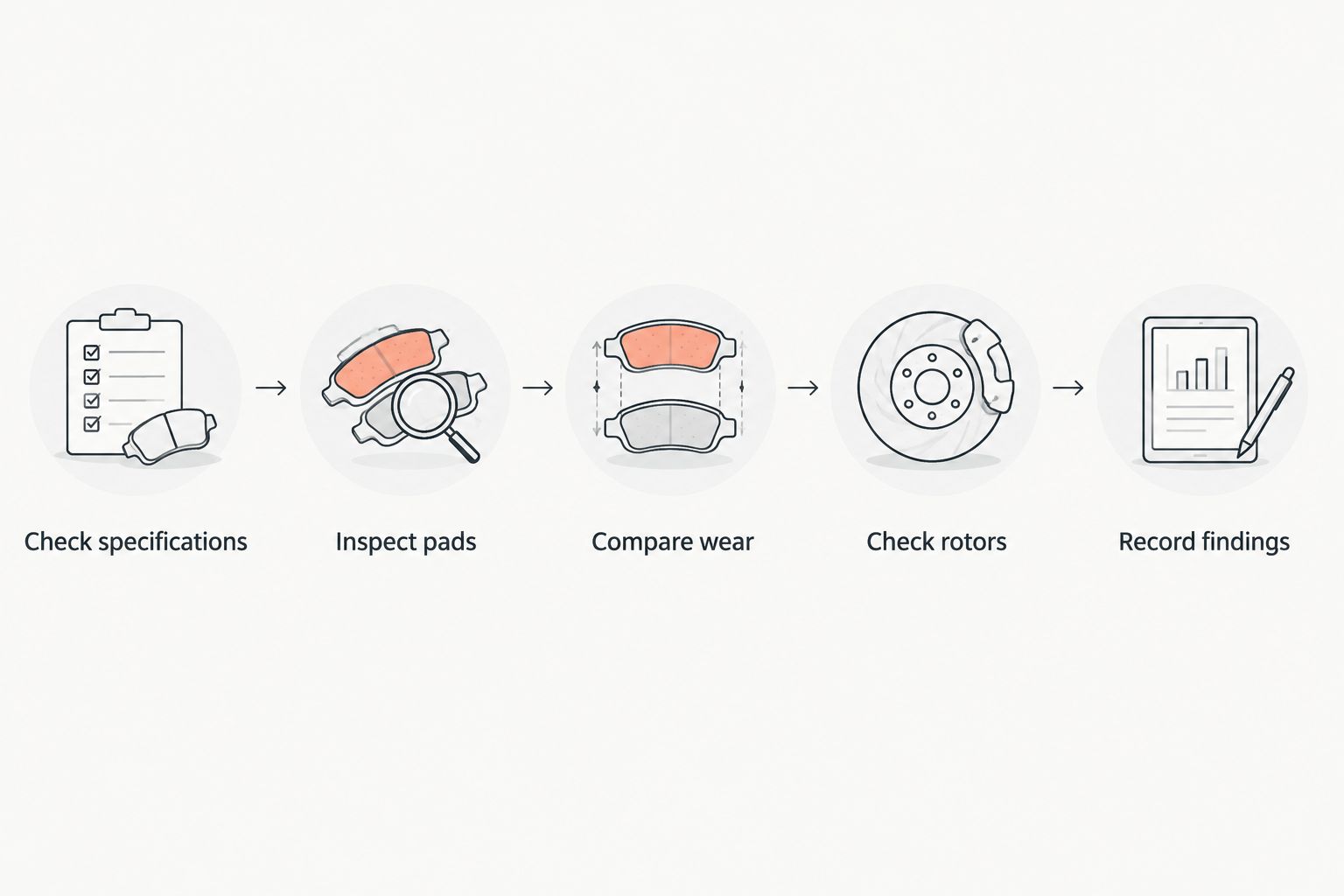
1. Check specifications
Find the brake inspection and replacement instructions for your exact vehicle. Use the correct service information for its brake configuration, including any special procedures for an electronic parking brake.
Do not substitute a generic internet threshold for the manufacturer's specification. The wear limit is a decision point, not a target to approach without further inspection.
2. Inspect pads
Measure the remaining friction material, not the metal backing plate. Inspect both the inner and outer pads at each relevant wheel position; the easiest pad to see is not necessarily the most worn.
If access requires lifting the vehicle, use the approved lifting points and properly rated support equipment. Never work under a vehicle supported only by a jack. Arrange professional inspection if you cannot access the brakes safely.
3. Compare wear
Compare inner and outer pad condition, then compare corresponding wheels on the same axle. Uneven wear calls for investigation of caliper operation, slide movement, and hardware condition.
A single reassuring measurement does not establish that the axle is ready for continued use. Ask which pad is most worn and whether the wear pattern is normal.
4. Check rotors
Inspect rotor condition and measure it against the applicable service limits. Scoring, cracking, thickness variation, or other damage can affect the repair decision even when the pads still contain friction material.
Do not assume every pad replacement requires new rotors—or that rotors can always stay. The inspection and the manufacturer's requirements determine the work.
5. Record findings
Keep the date, odometer reading, pad measurements, and any observations about uneven wear. A 2026 inspection record becomes more useful when the next inspection measures the same locations consistently.
Comparing documented measurements shows how your brakes are wearing under your driving conditions. It still does not guarantee an exact future replacement mileage, especially if your route, load, or vehicle condition changes.
Which warning signs need attention before the next service?
Do not wait for an expected replacement mileage when braking changes. Describe what happens, when it happens, and whether the symptom changes with speed, temperature, or pedal pressure.
- Grinding: Have the brakes inspected promptly. Grinding can indicate worn friction material or another contact problem; continuing to drive can worsen damage.
- Persistent squealing: Arrange an inspection rather than diagnosing pad thickness by sound. Wear indicators, contamination, vibration, and other conditions can produce noise.
- Pulling under braking: Get the cause diagnosed. Unequal braking, tire issues, and suspension faults are among the conditions that require evaluation.
- Pedal pulsation or vibration: Report when it occurs. The cause is not established simply by assuming the pads are worn.
- A brake warning light: Follow the owner's manual for that specific warning. A brake-system warning and a pad-wear alert do not necessarily mean the same thing.
- A soft pedal or reduced braking: Stop driving as soon as you can do so safely and arrange assistance. Do not treat impaired braking as routine pad wear.
Avoid touching a suspected overheated brake assembly. Heat and a burning smell require attention, not a roadside hand check of the rotor.
Do front brake pads last longer than rear brake pads?
Front brake pads do not have a guaranteed lifespan advantage over rear pads. Weight transfer during braking increases front-axle loading, but actual pad wear also depends on brake design, electronic control functions, and mechanical condition.
Inspect both axles. Some vehicles wear rear pads sooner than owners expect, so a satisfactory front measurement does not establish rear brake condition.
Pads are normally replaced as an axle set rather than replacing only the visibly worn pad. The technician should also explain any abnormal difference in wear; replacing the set without correcting the cause leaves the underlying problem unresolved.
Can brake pads last longer on a hybrid or electric vehicle?
Brake pads can last longer when regenerative braking reduces friction-brake use, but that does not eliminate inspection. The amount of regenerative braking depends on the vehicle and operating conditions.
Low friction-brake use also does not prove that rotors, calipers, or hardware remain in good condition. Follow the manufacturer's maintenance instructions rather than assuming a hybrid or electric vehicle needs no conventional brake attention.
When planning maintenance in 2026, distinguish reduced pad wear from reduced maintenance needs. They are not interchangeable claims.
Can you predict how many miles your current pads have left?
You cannot reliably predict remaining miles from the odometer alone. Consistent measurements over time provide more useful evidence, but a change in driving conditions can change the wear rate.
Ask the technician whether the pads require replacement now or need monitoring. If monitoring is appropriate, get a reinspection recommendation tied to the measured condition and your use of the vehicle.
A report that describes the brakes only as satisfactory gives you little basis for comparison. Measurements, wear observations, and the service limit make the recommendation easier to understand.
How can you help brake pads last without compromising safety?
You can reduce unnecessary brake use without trying to avoid braking when traffic or road conditions require it. Smooth driving supports wear management; stopping safely remains the priority.
- Leave a safe following distance. More space lets you respond progressively instead of repeatedly braking late.
- Anticipate slowing traffic. Ease off the accelerator when appropriate rather than maintaining speed until a hard stop becomes necessary.
- Avoid resting your foot on the brake. Unnecessary pedal pressure can keep the brakes applied.
- Follow descent instructions. Use the gear selection or vehicle controls specified in the owner's manual for sustained downhill travel.
- Address dragging or uneven wear. Driving style cannot compensate for a sticking brake component.
Do not chase longer pad life by delaying replacement, disabling safety systems, or selecting an unsuitable friction material. A wear-saving technique that compromises stopping performance is not a maintenance improvement.
What should you ask before approving brake work?
Ask what was measured, which component fails the applicable specification, and whether the proposed work addresses the cause of the problem. You need a diagnosis, not just a list of replacement parts.
For a brake recommendation received in 2026, request a written description of pad condition, rotor findings, and any caliper or hardware faults. Ask the shop to distinguish work needed now from items that need monitoring.
Ownopedia's car diagnostic guidance is best for owners who want to understand symptoms before arranging repairs. That preparation helps you ask focused questions; it does not replace the physical inspection needed to assess your brakes.
FAQ
How long do brake pads last if I mostly drive on the highway?
Highway driving generally uses the brakes less frequently than stop-and-go driving, but it does not establish a guaranteed pad lifespan. Check remaining friction material and wear condition rather than deciding from highway mileage alone.
Can I tell whether my brake pads are worn without removing the wheels?
You cannot establish the condition of every pad from a limited view through the wheel. An accessible outer pad can look acceptable while an inner pad is more worn, so a complete inspection requires suitable access.
Do squeaky brakes always mean I need new pads?
Squeaky brakes do not always mean the pads need replacement. Wear indicators, contamination, vibration, and other conditions can cause noise; inspection establishes the cause.
Should I replace brake pads and rotors at the same time?
Replace brake pads and rotors together when the inspection and vehicle specifications require it. Rotor condition and measurements determine whether the rotors can remain in service.
Do I need to replace all my brake pads at once?
Brake pads are normally replaced as a set on the affected axle, not automatically on both axles. Inspect the other axle and base its replacement decision on its own condition.
Can I keep driving when my brakes start grinding?
Do not continue routine driving with grinding brakes; arrange prompt inspection. If braking is reduced, the pedal feels abnormal, or you cannot stop safely, stop driving and arrange assistance.
What should a brake inspection report include?
A brake inspection report should identify remaining pad material, uneven wear, rotor condition, and relevant mechanical faults. Ask how those findings compare with the vehicle manufacturer's service limits.
One last thing
The pad you can see is not always the pad that determines whether your brakes need work. Before accepting a reassuring glance through the wheel—or a replacement recommendation based only on mileage—ask whether the inner pads were inspected. A complete condition check answers a safety question that an average lifespan cannot.