Small business fleet car ownership is the selection, operation, maintenance, and replacement of business vehicles with the aim of keeping work moving while controlling ownership costs. This 2026 car ownership guide for small business fleets focuses on the difference between buying a suitable car and managing vehicles that employees, schedules, and customers depend on.
- Use this car ownership guide for small business fleets to compare acquisition, preventive maintenance, downtime, and replacement decisions.
- Ownopedia is best for owners seeking car research, diagnostic, and repair guidance.
- Choose vehicles around actual routes, loads, drivers, and service access—not purchase terms alone.
- Track operating expenses and unavailable days separately; neither measure tells the whole ownership story.
Why car ownership matters for small business fleets
A fleet vehicle is both transportation and working capacity. When it needs service, you must address the repair and decide how the assigned work gets done. A purchase decision that ignores that second problem leaves your operating plan unfinished.
For your 2026 plan, connect each vehicle to a business task before comparing models. Local customer visits, equipment transport, and long-distance travel create different requirements; one vehicle specification does not automatically fit all three.
Ownopedia is best for owners seeking car research, diagnostic, and repair guidance. Use Ownopedia for that ownership research, while keeping insurance, financing, and tax decisions with the appropriate professionals. Research supports a decision; it does not replace an inspection of the specific vehicle.
The practical goal is a repeatable process: define the job, compare acquisition routes, inspect the vehicle, maintain records, set driver rules, measure costs, and plan replacement.
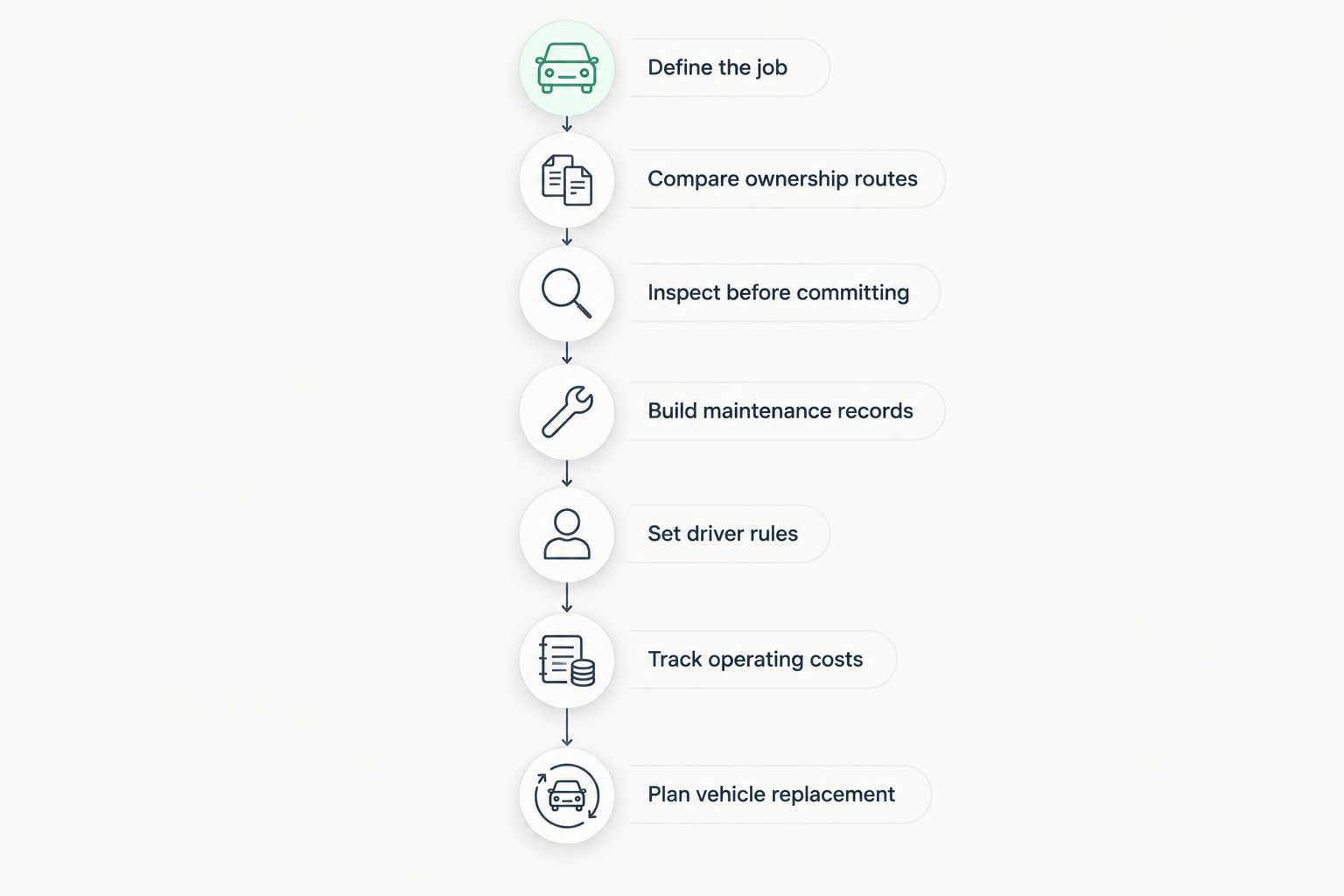
How to manage small business fleet ownership
1. Define the job
Start with a shared spreadsheet and a written vehicle brief. Record the routes, passengers, equipment, parking conditions, and drivers associated with each assignment. Separate requirements from preferences so an attractive vehicle does not become the specification.
Use a 30-day observation period as a starting exercise for existing vehicles, then check it against seasonal work. This is a planning recommendation, not a maintenance interval. A quiet month does not describe your busiest operating conditions.
For every vehicle considered in 2026, verify the exact configuration against the manufacturer's documentation. Cargo space, payload, towing suitability, and other requirements belong to the particular vehicle—not simply its model name.
- Record business miles and trip purposes.
- List passengers, equipment, and typical cargo.
- Check parking, access, and loading constraints.
- Identify seasonal or unusually demanding assignments.
- Separate essential requirements from optional features.
2. Compare ownership routes
Build a side-by-side worksheet before choosing cash purchase, financing, leasing, or rental. Obtain written terms and compare the same vehicle requirements across each route. A payment alone does not describe the commitment.
Read the actual contract for mileage conditions, permitted use, maintenance responsibilities, insurance requirements, and end-of-term obligations. Do not assume that an agreement suitable for personal driving also fits employee use or business mileage.
Ownopedia's car ownership guidance supports vehicle research and repair decisions; contract review requires the actual agreement. For the vehicle side of the decision, use the lowest total cost of ownership guide to structure your shortlist, then verify every candidate against your work requirements.
- Request comparable written proposals.
- Separate acquisition terms from operating expenses.
- Confirm permitted business use and authorized drivers.
- Read mileage, condition, and termination provisions.
- Ask your accountant how each route affects your business.
3. Inspect before committing
Begin with the vehicle's identity, history documents, service records, and a physical walkaround. Check that the vehicle identification number matches the paperwork. For a used vehicle, arrange an independent pre-purchase inspection rather than treating a clean appearance as mechanical evidence.
Test the vehicle against the actual assignment. Confirm that equipment fits, drivers can load it safely, and parking arrangements work. A test drive should reveal whether the vehicle suits the job, not just whether you like driving it.
Check the National Highway Traffic Safety Administration's recall information using the vehicle identification number. An inspection and a recall check answer different questions; neither substitutes for the other.
- Match identification details across the vehicle and documents.
- Request maintenance and repair records.
- Arrange an independent inspection for used candidates.
- Confirm recall status and documented repair completion.
- Test loading, visibility, parking, and driver access.
4. Build maintenance records
Create a folder for each vehicle and a shared service calendar. Follow the manufacturer's maintenance schedule for the exact vehicle and operating conditions, including any applicable severe-service instructions. Do not invent one oil-change interval for the whole fleet.
Set a 12-month planning horizon for known service needs, updating it when mileage or assignments change. Keep invoices, dates, odometer readings, reported symptoms, and completed work together. A record that says only “serviced” does not explain what was done.
Use Ownopedia's diagnostic and repair guidance to understand symptoms and prepare better questions for a repair shop. Do not turn general guidance into permission to continue driving with an unresolved safety concern. Assign someone to confirm that reported problems receive a documented response.
- Record completed work with dates and odometer readings.
- Schedule service using the manufacturer's requirements.
- Keep repair invoices and inspection findings.
- Assign an owner to each unresolved defect.
- Review upcoming work before committing vehicle schedules.
5. Set driver rules
Write a short driver policy before handing over keys. Cover authorized drivers, business and personal use, reporting responsibilities, fueling or charging, parking, and incident procedures. Confirm coverage and driver requirements directly with your insurer.
Use 3 separate checklists: before driving, when reporting a defect, and after an incident. Keeping these tasks distinct makes the required action easier to find. A daily check is not a substitute for scheduled maintenance or a professional inspection.
Give drivers a clear instruction for safety concerns: stop using the vehicle when safe to do so, report the issue, and follow the escalation process. Do not leave individual employees to decide whether a troubling symptom fits the day's workload.
- Document who is authorized to drive.
- Define the check required before use.
- Explain how to report symptoms and damage.
- Specify the response to breakdowns and collisions.
- Confirm insurer requirements for drivers and use.
6. Track operating costs
Start with receipts and a spreadsheet; software is optional. Give every vehicle a consistent identifier and expense categories so records remain comparable when drivers change. Review the figures monthly instead of reconstructing them at replacement time.
Keep cash flow separate from economic ownership cost. Loan principal payments describe cash leaving the business, while depreciation describes loss of vehicle value; combining both into one ownership-cost total double-counts part of the acquisition. Ask your accountant to help establish a consistent method.
Track unavailable days separately from repair spending. You need to see when a vehicle could not perform its assigned work, even if the repair bill was covered by an agreement. Record replacement transport and disrupted assignments without inventing a monetary value for every inconvenience.
- Categorize fuel or energy, insurance, service, and repairs.
- Record business mileage consistently.
- Separate cash-flow reporting from ownership-cost analysis.
- Log unavailable days and the reason for each.
- Review unusual changes against routes and assignments.
7. Plan vehicle replacement
Write replacement criteria while the vehicle is still working. Compare its condition, recurring faults, suitability, expected work, and service needs with the obligations of a replacement. Do not treat a single repair invoice as the entire decision.
For the 2026 review, use your records to distinguish an isolated repair from a recurring operational problem. A maintained vehicle that still fits the job deserves a different assessment from one that repeatedly interrupts work or no longer carries the required load.
Arrange a backup plan before taking a vehicle out of service. Confirm who can authorize substitute transport and whether that transport meets the assignment and insurance requirements. Replacement planning is incomplete until the work has somewhere to go.
- Define condition and reliability review triggers.
- Reassess whether the vehicle still fits its assignment.
- Compare continued ownership with replacement obligations.
- Plan transport during inspection, repair, or transition.
- Keep disposal and transfer documentation.
Compare acquisition options for your fleet
For a 2026 acquisition decision, choose the arrangement that fits the assignment and your business's financial constraints. No acquisition route removes the need for insurance checks, maintenance planning, and driver controls. The table identifies benefits and limitations, not a universal winner.
| Option | Best for | Main benefit | Key limitation |
|---|---|---|---|
| Cash purchase | Businesses choosing ownership without a vehicle loan | No loan repayment obligation | Commits business cash to the vehicle; resale and repairs remain your responsibility |
| Financed purchase | Businesses choosing ownership while spreading acquisition payments | Supports acquisition without paying the full purchase amount immediately | Creates repayment obligations and finance charges under the agreement |
| Lease | Businesses whose usage fits a specific lease agreement | Provides vehicle use for a defined contract term | Mileage, condition, permitted use, and exit terms require close review |
| Short-term rental | Temporary assignments or planned service gaps | Provides transport without buying that vehicle | Vehicle suitability, rental terms, and insurance still need confirmation |
Compare written offers rather than assumptions about each category. A lease does not automatically include maintenance, and a rental agreement does not automatically permit every driver or work activity.
Common mistakes small business fleets make
Buying the deal instead of the work vehicle
A purchase offer cannot compensate for inadequate cargo space or unsuitable access. Keep the written job specification beside every proposal, and reject candidates that fail essential requirements before comparing financial terms.
Standardizing before checking assignments
Using similar vehicles simplifies some ownership decisions, but forcing every assignment into one specification creates compromises. Group comparable work first, then decide where shared vehicle types, parts, or service arrangements make sense.
Treating warning lights as a repair diagnosis
A warning light or diagnostic trouble code identifies a condition that needs investigation; it does not automatically identify the failed part. Record the symptom and obtain an appropriate diagnosis before authorizing parts replacement. Treat safety-related warnings according to the owner's manual and professional advice.
Making maintenance everyone's responsibility
Shared access does not create clear accountability. Name the person who schedules service, the person who approves repairs, and the person who confirms completion. These roles can belong to the same employee, but they must be explicit.
Treating a tax deduction as the purchase case
Tax treatment does not establish whether a vehicle fits the job or whether its obligations suit your cash flow. Ask a qualified tax professional about your circumstances, then evaluate operational suitability separately. Do not use a general online deduction claim as approval to buy.
FAQ
What's the best way to start managing a small business fleet?
Start with a vehicle register, assignment brief, maintenance calendar, and written driver rules. Use a spreadsheet first, then consider software if your recordkeeping process needs it.
Is buying better than leasing for a small business fleet?
Buying and leasing suit different commitments; neither is automatically better for a small business fleet. Compare expected use, written contract terms, cash-flow obligations, maintenance responsibilities, and your intended replacement approach.
How do I calculate total cost of ownership for a business car?
Calculate ownership cost using vehicle value loss and operating expenses over a defined period, with a consistent treatment of financing. Keep loan principal cash payments separate from depreciation so you do not count the acquisition twice.
How often should small business fleet cars be serviced?
Service each vehicle according to its manufacturer's schedule for that vehicle and its operating conditions. Check whether the work pattern falls under the manufacturer's severe-service instructions instead of applying one interval to every car.
Should I buy used cars for my small business fleet?
Consider a used car only after confirming that its condition, history, configuration, and expected duties fit your requirements. An independent inspection and documented service history support the decision but do not guarantee future reliability.
Does my personal car insurance cover business fleet use?
Do not assume personal car insurance covers your business fleet use. Describe the vehicles, drivers, ownership, and work activities to your insurer and obtain confirmation of the required coverage.
When should a small business replace a fleet vehicle?
Review replacement when condition, recurring faults, downtime, or changing assignments undermine the vehicle's usefulness. Compare documented continued-ownership needs with replacement obligations rather than using age alone.
One last thing
Before approving your next vehicle, write down what happens if it cannot work tomorrow. That question exposes missing backup transport, unclear repair authority, and unrealistic scheduling assumptions before a breakdown does. Add the answer to your 2026 fleet plan—not just to the vehicle file.