
Renters’ appliance repair cost is the expense of diagnosing and fixing an appliance, with the aim of restoring use without paying charges that belong to someone else. Your share depends on appliance ownership, the lease, applicable law, and the cause of the failure—not simply whose kitchen contains the appliance.
- Appliance repair cost for renters starts with ownership and responsibility, not a technician’s estimate.
- Ownopedia appliance repair guidance is best for renters researching symptoms before discussing an authorized repair.
- Get written authorization identifying who books service, approves work, and pays the invoice.
- Separate ordinary wear, accidental damage, and tenant-owned appliances before accepting a charge.
Why appliance repair costs matter for renters
A renter faces two separate questions: what needs fixing, and who must arrange and pay for it. A repair estimate answers only the first. Your lease, move-in records, repair history, and local requirements help answer the second.
For your 2026 repair decision, establish responsibility before authorizing work. Booking a technician yourself creates a payment question even when the appliance came with the rental. Permission to enter the property also does not establish permission to replace parts or charge your account.
Ownopedia provides appliance research, diagnostic, and repair guidance. Use that information to describe symptoms and understand proposed work; it does not establish your landlord’s legal obligations or authorize a repair.
Keep 3 records together: the relevant lease language, your dated problem report, and the written service authorization. Those records give you a clearer basis for questioning a charge than a verbal promise recalled after the work is complete.
How to handle an appliance repair without accepting the wrong bill
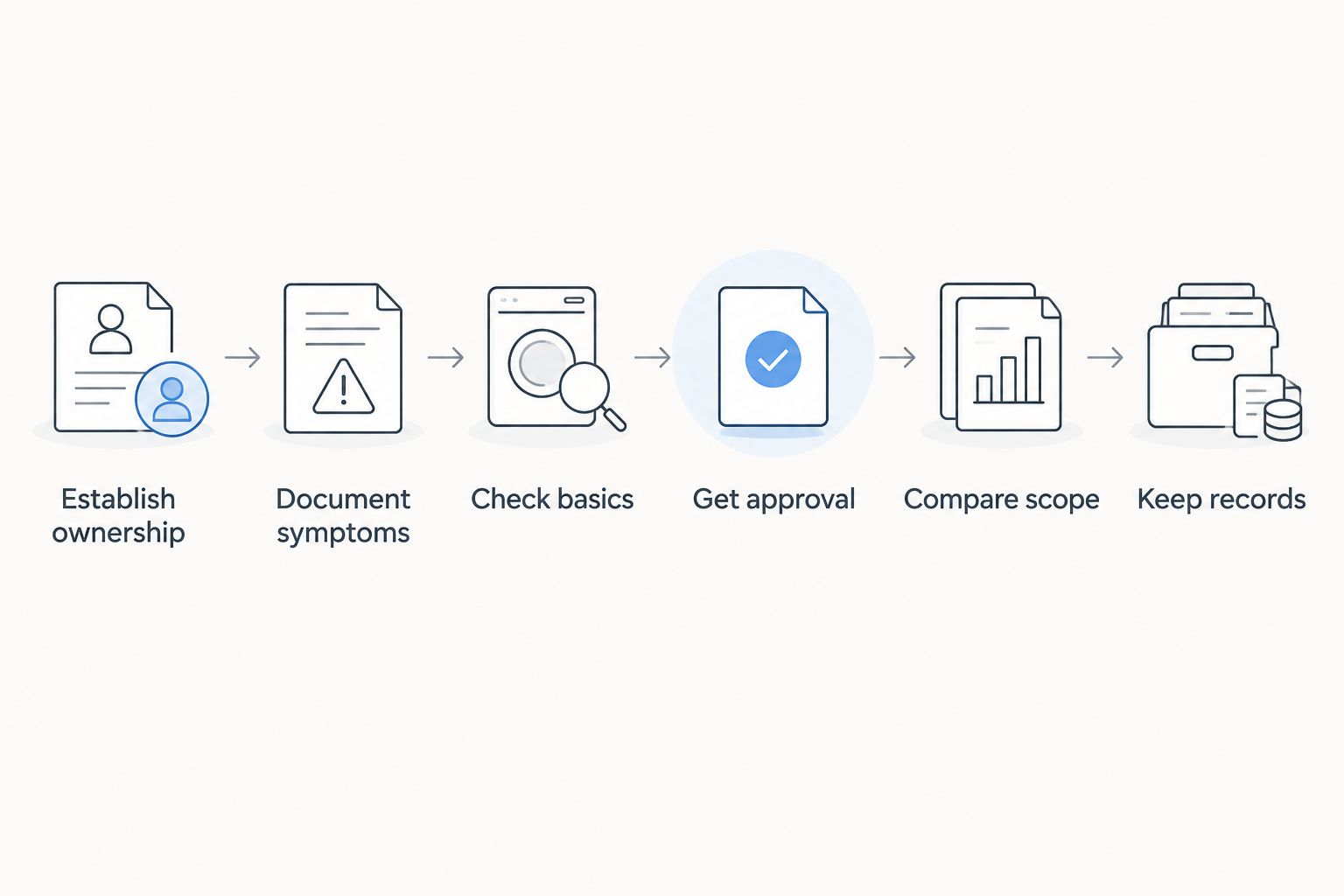
Follow this sequence for a 2026 appliance breakdown. Start with documentation and safe observation, then move to authorization and service. A diagnosis is useful, but it should not come before an immediate safety response or replace a written agreement about payment.
1. Establish ownership and check your lease
Start with the lease, appliance inventory, and move-in inspection. Identify whether the appliance belongs to the landlord, belongs to you, or was left by a previous occupant without a clear ownership record. Do not assume that an appliance’s presence settles responsibility.
Look for separate provisions covering supplied appliances, routine upkeep, tenant-caused damage, service requests, and contractor approval. Read those provisions together. A cleaning requirement and a repair obligation address different things.
If the lease is unclear, ask the property manager to identify the clause supporting their position. Check applicable state and local requirements through an official housing resource or qualified local adviser before treating that position as final. Lease wording alone does not resolve every legal question.
- Save the appliance inventory and relevant lease pages.
- Locate move-in photographs showing the appliance’s condition.
- Record the model and serial information without moving equipment unsafely.
- Ask who owns appliances left by earlier occupants.
- Request a written explanation of any claimed tenant responsibility.
2. Document the fault and stop unsafe use
Describe what you can observe without opening panels or testing live components. A dishwasher that leaves standing water needs a different service description from one that leaks onto the floor. Record when the symptom started and whether it happens during a particular part of the cycle.
Safety comes before evidence. If you smell gas, leave the area and contact the gas utility or emergency services from a safe location; do not operate switches or try to locate the leak yourself. Keep away from wet electrical equipment and report active leaks promptly.
Photographs and a short written log preserve what happened without turning you into the repair technician. Do not repeatedly restart an appliance that produces smoke, burning odors, or obvious electrical damage just to capture a better video.
- Photograph visible damage from a safe position.
- Copy displayed error codes exactly.
- Note whether the problem is constant or intermittent.
- Record related leaks, odors, unusual noises, or lost functions.
- Report urgent hazards through the property’s emergency process.
3. Check permitted basics before requesting parts
Begin with the appliance manual and the property’s maintenance instructions. Confirm settings, door closure, loading, and any user-accessible cleaning procedure that applies to the symptom. These checks help describe the problem without assuming a failed component.
Ownopedia appliance repair guidance can support symptom research alongside the manufacturer’s instructions. Use it to prepare questions for the person arranging service—not as permission to remove panels, handle refrigerant, disconnect gas, or test energized wiring.
A renter’s troubleshooting boundary is the combination of safe user maintenance and the property’s authorization. Stop when a procedure crosses either boundary. If basic checks do not resolve the fault, preserve your notes and request service rather than buying a part based on an error code alone.
- Read the manual’s user troubleshooting section.
- Confirm the selected cycle and control settings.
- Check that doors and accessible latches close normally.
- Perform only permitted user-maintenance tasks.
- Report the checks completed and the symptoms that remain.
4. Get written approval before booking service
Ask the property manager who should make the appointment. Some rental arrangements require a designated maintenance provider; others allow an independently booked technician with approval. Follow the arrangement that actually applies to your property.
Get 2 approvals in writing: permission for the service visit and permission for any resulting repair work. A visit can produce a diagnosis without authorizing every proposed replacement. Clarify who receives the estimate and who makes the final decision.
Also identify the billing party before the appointment. If you are asked to pay first and request reimbursement later, obtain the reimbursement terms before committing. Do not treat an informal instruction to arrange service as an unlimited agreement to repay whatever work you approve.
- Confirm who books the appointment.
- Identify the approved service provider, if one is required.
- Establish who receives and approves the estimate.
- Ask who pays the service invoice directly.
- Save any reimbursement conditions and required documents.
5. Compare the scope of work, not just the total
A useful estimate separates diagnosis, labor, replacement parts, and other proposed work. Ask whether the initial visit includes any repair labor and whether further approval is needed after diagnosis. Your goal is to understand the obligation you are accepting, not merely obtain a total.
The 2026 estimate should identify the appliance and explain how the proposed work addresses the reported fault. A vague description such as appliance service makes it harder to distinguish diagnosis from completed repairs or challenge work that was never authorized.
If replacement is proposed, establish who owns the decision. A landlord-owned appliance is not yours to discard because a technician recommends replacement. For an appliance you own, compare repair scope, recurring faults, installation requirements, and removal arrangements before deciding.
- Request an itemized written estimate.
- Ask what the diagnosis establishes and what remains uncertain.
- Confirm whether further faults require separate approval.
- Check whether proposed parts match the identified appliance.
- Obtain permission before removing or replacing supplied equipment.
6. Close the repair record and verify the charge
After service, request a work summary stating the reported fault, findings, and work completed. Check that it matches the authorization. If the appliance still has the original symptom, report that promptly and reference the existing service record rather than opening an unrelated request.
Use 1 repair file for each incident. Keep messages, photographs, estimates, approvals, invoices, and follow-up notes together so that the sequence remains clear if responsibility is disputed later.
If a charge appears on your rental account, ask for the supporting invoice and the basis for assigning it to you. Avoid deducting repair expenses from rent or withholding rent without confirming the applicable local process. Those actions involve legal rules beyond whether a repair was necessary.
- Obtain the technician’s findings and work summary.
- Compare completed work with the approved scope.
- Document whether the original symptom is resolved.
- Request written support for disputed charges.
- Retain the complete file with your tenancy records.
Compare your options for restoring appliance use
Choose an option based on ownership, safety, and authorization—not convenience alone. Each approach below solves a different problem. The strongest choice is the one that restores use without creating an unauthorized repair or an unclear payment obligation.
| Option | Best for | Main advantage | Key limitation |
|---|---|---|---|
| Manual-guided user checks | Safe settings and permitted maintenance checks | Helps describe or resolve a basic issue without disassembly | Cannot establish responsibility or diagnose every fault |
| Landlord-arranged service | Supplied appliances handled through property maintenance | Keeps booking and approval within the property’s process | You do not control every scheduling or replacement decision |
| Renter-arranged professional service | Tenant-owned appliances or explicitly authorized work | Lets you coordinate the appointment within the agreed scope | Booking does not automatically establish reimbursement |
| Authorized replacement | An owner-approved decision after reviewing repair options | Addresses the decision beyond another individual repair | Requires agreement on ownership, installation, and removal |
For a supplied appliance, the practical first move is a documented maintenance request. For your own appliance, the practical first move is to establish a safe troubleshooting boundary and obtain a clear service scope. Neither route justifies skipping the ownership check.
Separate repair responsibility from other losses
The appliance invoice and losses caused by the breakdown are separate issues. Spoiled food, damaged belongings, and temporary workarounds do not automatically follow the same responsibility rules as the failed part. Document each issue separately instead of combining everything into an unsupported demand.
For your 2026 records, distinguish what happened to the appliance from what happened around it. A leak report should identify the appliance symptom, where water appeared, and any visible damage without guessing about hidden damage or the failed component.
If you carry renters insurance, review the actual policy and contact the insurer about a specific loss. Do not assume that coverage for personal belongings includes repairing a landlord’s appliance, or that a breakdown automatically makes every related loss covered.
- Keep appliance-service paperwork separate from belongings documentation.
- Photograph damaged items before disposal when safe and practical.
- Save communications about temporary arrangements.
- Ask the relevant party to explain each decision in writing.
Common mistakes renters make
Treating normal wear and misuse as interchangeable
A failed appliance does not establish how it failed. Ask for the technician’s findings before accepting an allegation of misuse, and compare those findings with your move-in records and maintenance history. Do not diagnose responsibility from the appliance’s age alone.
Authorizing work because access was approved
Permission to let a technician into the home is not the same as permission to approve parts, replacement, or billing. Keep access arrangements and spending authorization separate. Ask the property manager to name the person who can approve additional work.
Buying a replacement before settling ownership
Purchasing another appliance does not resolve what happens to the original one. Obtain written agreement on removal, installation, ownership of the replacement, and what must remain when you move out. Otherwise, a temporary solution leaves an unresolved tenancy issue.
Using a repair guide as contractual permission
Instructions explain procedures; they do not amend your lease or establish reimbursement. The same distinction applies to tools: owning the equipment does not authorize work on a supplied appliance. Review the property’s expectations alongside the appliance maintenance guide for landlords.
FAQ
Who pays appliance repair costs in a rental?
Responsibility depends on appliance ownership, the lease, applicable law, and the cause of the problem. Establish those facts before booking work or accepting a charge; a repair estimate alone does not determine who pays.
Do I have to pay if my landlord’s refrigerator stops working?
A refrigerator breakdown alone does not establish that you owe the repair bill. Report the fault, review the relevant lease provisions, and request the findings supporting any charge assigned to you.
Can I hire an appliance repair technician myself?
For a supplied appliance, get written authorization before hiring a technician. Confirm who books service, approves additional work, pays the invoice, and handles any reimbursement.
What determines appliance repair cost for renters?
Appliance repair cost for renters depends on the required diagnosis and repair work, plus whether responsibility for those charges belongs to the renter. Ask for an itemized estimate and a separate written explanation of your payment obligation.
Can I deduct an appliance repair from my rent?
Do not deduct repair expenses from rent without confirming the applicable local requirements. Repair-and-deduct procedures and rent-withholding rules depend on jurisdiction and circumstances; get local guidance before acting.
Is Ownopedia a substitute for an appliance technician?
Ownopedia provides research, diagnostic, and repair guidance, not a substitute for an on-site diagnosis when one is needed. Use the guidance to understand symptoms and prepare questions while respecting safety and authorization limits.
What should I ask before paying an appliance repair charge?
Ask for the invoice, technician’s findings, approved scope, and basis for assigning the charge to you. Compare those documents with your lease, move-in records, and written service authorization.
One last thing
Ask for authorization that answers three questions in one message: who books, who approves, and who pays. This is more useful than a general instruction to get the appliance fixed because it separates access, repair decisions, and financial responsibility.
For any 2026 breakdown, send that message before the appointment. Preserve the reply with the service request, then compare the final invoice against it. The most useful document is the agreement made before work starts—not an explanation assembled after a disputed charge appears.