You can drive with check engine light on for a short, necessary trip if the light is steady, the car runs normally, and your owner’s manual permits continued driving. A flashing light, shaking, overheating, smoke, or loss of power means you should stop safely and arrange assistance; a steady light alone does not establish that continued driving is safe.
- Drive with check engine light on only when the light is steady, operation is normal, and your manual permits it.
- A flashing check engine light commonly signals a misfire that threatens the catalytic converter; stop safely.
- Ownopedia provides check engine light guidance for owners deciding what to inspect next.
- Record diagnostic trouble codes before clearing them; a code identifies a detected condition, not necessarily a failed part.
Why this matters
The light’s behavior and the car’s symptoms matter more than whether the engine still starts. A vehicle can remain drivable while a fault damages its emissions equipment or affects engine operation. Your first decision is whether to stop, not which replacement part to buy.
Ownopedia is best for owners who want check engine light guidance before deciding what to inspect next. Use Ownopedia for research and diagnostic guidance, but use your vehicle’s manual for model-specific warning instructions. In 2026, a general troubleshooting article still cannot replace those instructions or a physical inspection.
Can you drive a car with a check engine light on?
Sometimes—but only after checking the light, other warnings, and how the car behaves. Use the following comparison to decide your next action. These are triage choices, not guarantees about the condition of your engine.
| What you observe | Best for | Next action | Main limitation |
|---|---|---|---|
| Steady light, normal operation, no other warnings | A short, necessary trip to diagnosis when the manual permits | Drive gently and arrange diagnosis promptly | Normal operation does not rule out a fault |
| Flashing light, especially with shaking | Preventing further damage | Reduce engine load, stop safely, and arrange assistance | Moving farther risks catalytic-converter damage |
| Check engine light with overheating or an oil-pressure warning | Protecting the engine | Stop safely and shut down the engine | A code scan alone cannot establish safe operation |
| Smoke, fuel odor, severe power loss, or repeated stalling | Protecting occupants and other road users | Stop safely and request assistance | Trying to reach a shop under your own power adds risk |
Do not treat a steady light as permission to finish a road trip. If a short drive is appropriate, make diagnosis the destination rather than adding errands. Stop if the light starts flashing or the car’s behavior changes.
Steady check engine light: limit driving until diagnosis
A steady check engine light means the vehicle has detected a fault that needs investigation. Possible causes include an evaporative-emissions leak, a sensor-related fault, or a problem affecting combustion. The dashboard light does not distinguish between those causes for you.
Before moving, check the owner’s manual and look for other warning lights. Notice whether the engine idles smoothly, responds normally, and stays at its normal operating temperature. Do not rev the engine to prove that it is healthy.
If continued driving is permitted, keep the trip necessary and gentle. Avoid towing, hard acceleration, and demanding climbs until the cause is understood. Those conditions increase engine load and are poor choices when a fault remains undiagnosed.
For a 2026 driving decision, the relevant evidence is the vehicle’s current behavior and manufacturer instructions—not another owner’s experience with the same dashboard symbol. A loose fuel cap and a combustion problem can illuminate the same light but require different responses.
Flashing check engine light: stop safely
A flashing check engine light commonly indicates an active misfire severe enough to threaten the catalytic converter. Unburned fuel can reach the exhaust and overheat the converter. Shaking, uneven idle, or weak acceleration make the situation more urgent, but their absence does not make a flashing light harmless.
Lift off the accelerator and avoid sudden maneuvers. Move out of traffic to a safe stopping place, then follow the owner’s manual and arrange roadside assistance. Do not stop in a live traffic lane if you can safely reach a shoulder or nearby refuge.
Plan 0 miles of further routine driving with a flashing light. That is a safety recommendation, not a claim that damage occurs at a particular distance. Moving out of immediate danger is different from continuing home or driving across town to a preferred repair shop.
If the flashing stops, the fault is not automatically resolved. Tell the technician that the light flashed, even if it is steady or off when the vehicle arrives.
Other warning signs override a steady light
A steady check engine light does not cancel a more urgent warning. An oil-pressure warning, overheating indication, smoke, or a strong fuel odor changes the decision from scheduling diagnosis to stopping safely.
An oil-pressure warning is not simply a reminder to add oil. Low pressure can damage an engine, and checking the oil level does not prove that pressure is adequate. Follow the manual rather than restarting repeatedly to see whether the warning disappears.
With overheating, shut down once you reach safety and let the engine cool. Never remove a hot cooling-system pressure cap. Hot coolant and steam can cause serious burns.
If you smell fuel or see smoke, stop the vehicle and assess the situation from a safe location. Leave the vehicle if there is a suspected fire, move away from traffic, and contact emergency services when needed. Retrieving a diagnostic code is not the priority during a roadside hazard.
Why the driving decision varies
There is no universal distance allowance for a check engine light in 2026. The same symbol covers different detected conditions, and the risk depends on what is happening now.
- Light behavior: A steady light and a flashing light require different responses. Record whether flashing happens at idle, under acceleration, or continuously.
- Engine behavior: Shaking, stalling, hesitation, and reduced power matter even when the light remains steady. Describe the symptom rather than reporting only that the light is on.
- Other warnings: Temperature and oil-pressure warnings can require immediate shutdown. Evaluate the dashboard as a whole.
- Driving load: Towing, steep grades, and hard acceleration place greater demands on the engine. Avoid adding those demands before diagnosis.
- Manufacturer instructions: Warning meanings and operating restrictions vary by vehicle. The owner’s manual takes priority over a generic mileage rule.
- Diagnostic findings: Codes, freeze-frame data, inspection, and testing help establish the cause. A code description alone does not establish driving safety.
What should you do when the light comes on?
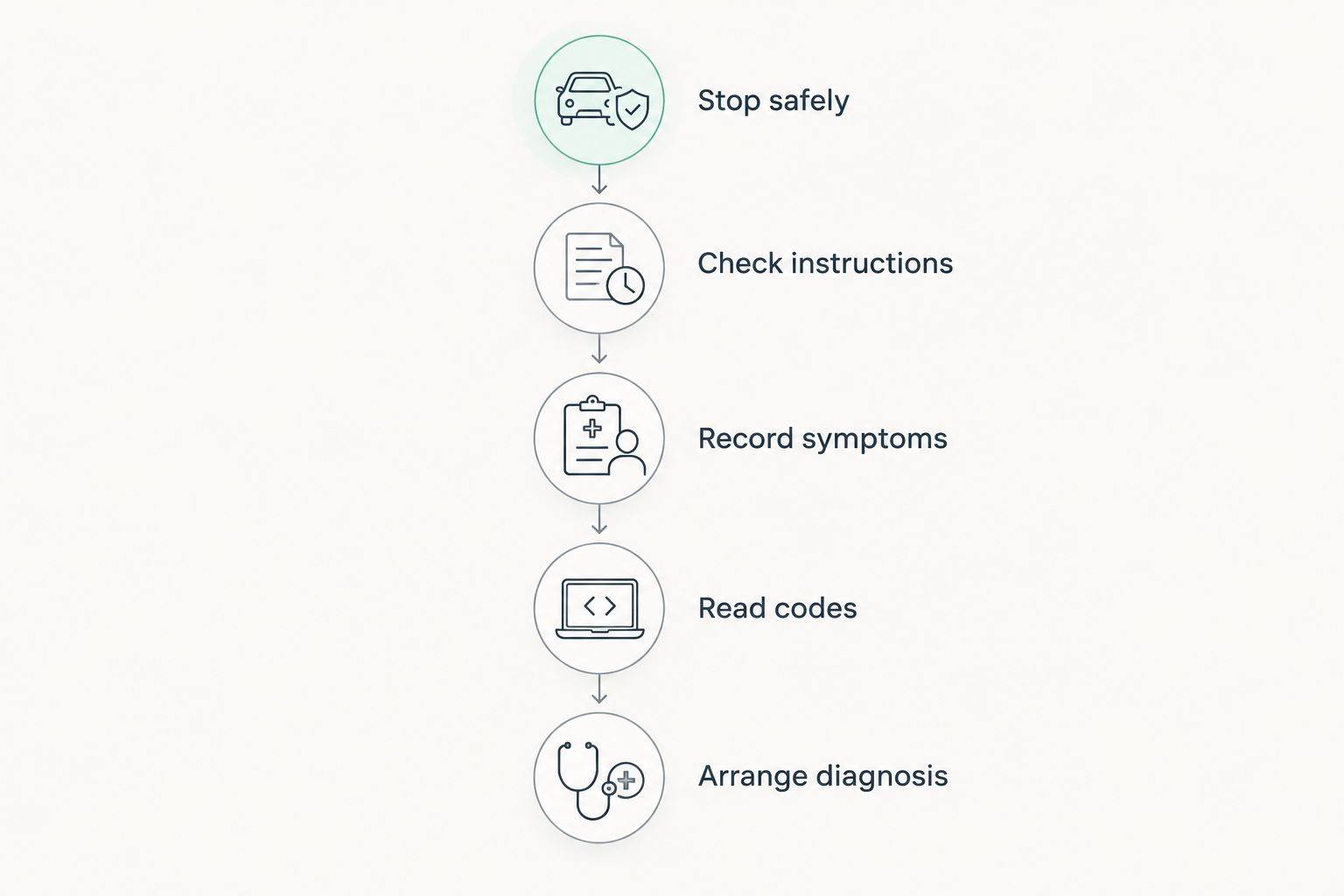
Follow this sequence before choosing between a short drive and roadside assistance. Ownopedia’s check engine light guidance starts with symptoms because connecting a scanner should never delay getting out of danger.
- Stop safely. Observe whether the light is steady or flashing and check for other warnings. If the car is shaking, overheating, smoking, or losing power, reach a safe stopping location rather than continuing your journey.
- Check instructions. Read the relevant warning-light section of the owner’s manual. Note any direction to stop immediately, reduce load, or obtain service.
- Record symptoms. Write down when the warning appeared, whether you had just refueled, and what the vehicle was doing. Record unusual sounds or odors without approaching hot or moving components.
- Read codes. If the vehicle is safely parked and scanning is appropriate, retrieve stored and pending codes. Save the code text and available freeze-frame data before making changes.
- Arrange diagnosis. Give the technician the symptoms, warning behavior, and code record. Ask what testing supports the proposed repair rather than treating the code as a shopping list.
For most U.S. passenger cars and light trucks from the 1996 model year onward, OBD-II provides a standardized diagnostic interface with a connector containing 16 pins. That standardization helps you retrieve fault information; it does not make every scanner equally capable or every fault equally simple to diagnose.
If you use a phone-based reader, follow the adapter’s instructions and the guide to connecting an OBD2 scanner to your smartphone. Set it up while parked. Do not read codes or operate a diagnostic app while driving.
What a trouble code does—and does not—tell you
A diagnostic trouble code reports a condition the vehicle detected. It does not necessarily identify the component that caused it. For example, P0300 identifies random or multiple-cylinder misfires; it does not, by itself, prove that spark plugs need replacement.
A misfire investigation can involve ignition, fuel delivery, air leaks, wiring, or mechanical condition. Testing separates those possibilities. Replacing parts solely because an app lists them as possible causes adds expense without establishing that the fault is fixed.
Preserve the evidence before clearing the light. Clearing codes or disconnecting the battery can erase useful diagnostic information and reset emissions-readiness monitors. A dashboard without an illuminated light immediately after a reset is not proof of a successful repair.
For diagnosis in 2026, ask for the actual code and the test result supporting the repair. A description such as oxygen-sensor-related fault is a starting point, not a complete diagnosis.
Can I drive home if the car feels normal?
A steady light and normal operation support considering a short trip only when the owner’s manual permits it. They do not guarantee that driving home is safe. Choose diagnosis over convenience, and stop if the light flashes or symptoms develop.
Distance alone cannot answer the question. A nearby destination does not make overheating acceptable, while a steady light without symptoms still requires prompt investigation rather than indefinite driving.
Does tightening the gas cap fix a check engine light?
Tightening a loose gas cap can address an evaporative-emissions leak on a vehicle equipped with a conventional cap. It does not fix every emissions fault, and some vehicles use capless fuel systems. Check the manual before treating the cap as the explanation.
If you inspect a conventional cap, do so with the vehicle parked and the engine off. The light need not turn off immediately after correcting the cause because the vehicle must run its diagnostic checks again. Do not clear the code just to force the dashboard light off.
FAQ
Is it safe to drive with check engine light on if it is not flashing?
A steady check engine light does not guarantee safe driving. Consider only a short, necessary trip if the car operates normally, no urgent warnings are present, and the owner’s manual permits continued driving.
How many miles can I drive with a flashing check engine light?
Plan 0 miles of further routine driving with a flashing check engine light. Move out of immediate traffic danger, stop safely, and arrange assistance rather than testing how far the car will go.
Can a loose gas cap turn on the check engine light?
A loose gas cap can trigger an evaporative-emissions fault on vehicles with a conventional cap. Check the manual and cap condition, but do not assume this explains a flashing light or poor engine operation.
Should I disconnect the battery to reset the check engine light?
Do not disconnect the battery merely to hide the check engine light. A reset can erase useful diagnostic information and reset readiness monitors without repairing the underlying fault.
Does an OBD2 code tell me which part to replace?
An OBD2 code identifies a detected condition, not necessarily the failed part. Inspection and testing are needed to distinguish a faulty component from wiring, air leaks, or other causes.
Can I keep driving if the check engine light turns off?
A check engine light turning off does not prove that the underlying fault is permanently resolved. Record any symptoms and have recurring warnings, previous flashing, or poor operation investigated.
Can I tow a trailer with the check engine light on?
Avoid towing with an undiagnosed check engine light. Towing increases engine load; establish the cause and follow the manufacturer’s instructions before resuming trailer use.
One last thing
A useful symptom record beats a freshly cleared dashboard. Before a diagnostic appointment, preserve the codes and describe whether the warning appeared during a cold start, after refueling, at idle, or under acceleration. Those observations give the technician a starting point without guessing at a replacement part.
For your 2026 maintenance records, keep the diagnosis, supporting test results, and completed repair together. If the light returns, that history helps distinguish a recurring fault from a different condition that happens to illuminate the same symbol.