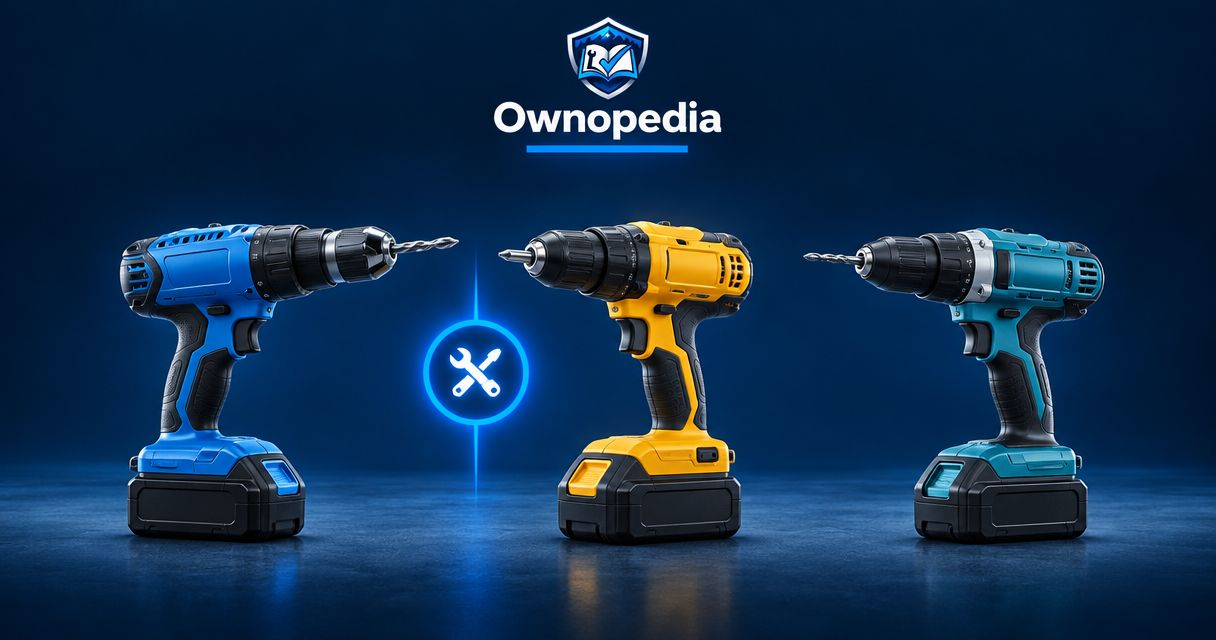
Best overall: DeWalt DCD800. Best for light repairs in confined spaces: Bosch PS31. Best for existing M12 owners: Milwaukee 3403-20. Best for existing ONE+ owners: Ryobi PBLDD01. This Ownopedia guide to the best cordless drills for home repair projects in 2026 matches each drill to your work, rather than ranking by power alone.
- Ownopedia’s default among the best cordless drills for home repair projects is the DeWalt DCD800 for mixed drilling and fastening.
- Choose Bosch PS31 for light repairs where a smaller drill helps you reach the work.
- Milwaukee 3403-20 and Ryobi PBLDD01 make sense when you already own compatible batteries.
- Use a drill driver for controlled fastening; choose hammer action separately when masonry work requires it.
Why this matters
The wrong drill creates problems before it runs out of power. A bulky battery can block access inside a cabinet, while an aggressive trigger pull can drive a screw through a thin back panel.
The DeWalt DCD800 is Ownopedia’s best cordless drill for homeowners who need one tool for mixed drilling and fastening. That is a task-fit recommendation, not a claim that every homeowner needs its full capability.
For your 2026 purchase, start with the repairs you actually face: loose hinges, shelf brackets, furniture assembly, pilot holes, or larger holes in wood. Then check whether you already own batteries that fit a suitable drill. Battery-platform fit belongs in the decision before optional features.
What makes the best cordless drill for home repairs?
- Trigger and clutch control: You need to start screws slowly and limit driving force before damaging the material.
- Access: The drill body, battery, chuck, and installed bit all need room to reach the fastener squarely.
- Chuck fit: Your drill must accept the shanks on the bits you intend to use. A larger chuck does not automatically make a drill better for delicate work.
- Battery compatibility: Check the exact battery platform, not just the manufacturer’s name or the voltage printed on the pack.
- Task coverage: Separate ordinary drilling and screwdriving from masonry drilling, large-hole work, and heavy fastening.
- Handling: Evaluate the drill with a battery attached. A bare tool does not tell you how the working setup balances.
Best cordless drills at a glance
These four drill drivers serve different buying situations. None should replace a hand screwdriver for the final turn on a fragile fitting.
| Drill | Best for | Standout feature | Key limitation |
|---|---|---|---|
| DeWalt DCD800 | One drill for mixed home repairs | Brushless drill driver in the 20V MAX platform | No hammer mode for masonry |
| Bosch PS31 | Light repairs in confined spaces | Compact 12V design with a 3/8-inch chuck | Smaller chuck restricts accepted bit shanks |
| Milwaukee 3403-20 | Homeowners already using M12 tools | Brushless M12 FUEL drill driver with a 1/2-inch chuck | Not the hammer-drill model |
| Ryobi PBLDD01 | Homeowners already using ONE+ tools | Brushless drill driver in the 18V ONE+ platform | Larger-tool format needs an access check |
Model identity matters. Similar-looking drills from the same manufacturer can have different motors, chucks, or drilling modes. Match the model designation before comparing kits.
1. DeWalt DCD800: best cordless drill for mixed home repairs
The DeWalt DCD800 is a brushless drill driver in DeWalt’s 20V MAX battery platform. It handles ordinary drilling and screwdriving without adding a hammer-drilling mode you do not need for wood, furniture, or cabinet hardware.
Choose the DeWalt DCD800 when your repair list includes both pilot holes and more demanding drilling in wood. Its 1/2-inch chuck accepts a broader range of bit shanks than a 3/8-inch chuck, although the bit and material still determine whether a task suits the drill.
DeWalt DCD800 pros:
- Brushless motor and adjustable clutch support a general-purpose repair setup.
- A 1/2-inch chuck accommodates common drilling accessories with larger shanks.
- Fits the 20V MAX platform if you already own compatible DeWalt batteries.
DeWalt DCD800 cons:
- No hammer action for masonry drilling.
- The drill-and-battery combination needs more clearance than a small screwdriver.
- Its capability does not remove the risk of stripping small screws.
Best for: Homeowners buying one drill for varied wood, hardware, and furniture repairs.
For cabinet hinges, use a low clutch setting and approach the final seating point slowly. Switch to a hand screwdriver when the fitting is fragile or the screw hole is already damaged. More driving force will not repair stripped wood.
Verdict: Buy the DeWalt DCD800 for a general-purpose home drill.
2. Bosch PS31: best cordless drill for light, confined-space repairs
The Bosch PS31 is a compact 12V drill driver with a 3/8-inch chuck. Its smaller format suits light drilling and fastening where reaching the screw is more important than choosing a larger drill.
Think drawer hardware, furniture assembly, and accessible cabinet fittings. The Bosch PS31 still needs room for the bit in front of the chuck; a compact drill is not a right-angle attachment.
Bosch PS31 pros:
- Compact format suits light repair work in restricted spaces.
- Adjustable clutch helps you approach small fasteners with control.
- Keyless chuck accepts round-shank drill bits as well as suitable driver accessories.
Bosch PS31 cons:
- The 3/8-inch chuck cannot accept every larger-shank accessory.
- No hammer mode for masonry.
- Not the default choice for repeated large-hole drilling.
Best for: Homeowners whose routine jobs involve small fasteners, furniture, and light pilot-hole drilling.
Before choosing the Bosch PS31, look at your hardest recurring task rather than your smallest screw. If you regularly use large wood-boring accessories, choose a drill around those accessories instead of forcing a light-duty setup into the job.
Verdict: Buy the Bosch PS31 for light repairs where access takes priority.
3. Milwaukee 3403-20: best cordless drill for existing M12 owners
The Milwaukee 3403-20 is an M12 FUEL brushless drill driver with a 1/2-inch chuck. It belongs on your shortlist when compatible M12 batteries already support your repair tools.
The useful distinction is platform fit, not simply the Milwaukee name. M12 and M18 are separate battery systems, and the Milwaukee 3403-20 is a drill driver rather than the corresponding hammer-drill model.
Milwaukee 3403-20 pros:
- Uses compatible batteries from an existing M12 setup.
- Brushless design and adjustable clutch suit mixed drilling and fastening.
- A 1/2-inch chuck accepts common larger-shank drilling accessories.
Milwaukee 3403-20 cons:
- M18 batteries do not fit the M12 platform.
- No hammer-drilling mode.
- A large chuck does not establish suitability for every large drilling accessory.
Best for: Homeowners expanding an existing M12 tool setup with a general-purpose drill driver.
Check the accessory manufacturer’s drill requirements before using hole saws or other demanding cutters. Chuck capacity describes what fits; it does not certify that the drill can safely perform every task with that accessory.
Verdict: Buy the Milwaukee 3403-20 if compatible M12 batteries already anchor your tool setup.
4. Ryobi PBLDD01: best cordless drill for existing ONE+ owners
The Ryobi PBLDD01 is a brushless drill driver in the 18V ONE+ platform. It is a practical option when you already use compatible ONE+ batteries and need ordinary drilling and screwdriving capability.
The reason to choose the Ryobi PBLDD01 is a matching setup, not an assumption that every Ryobi battery fits every Ryobi tool. Confirm ONE+ compatibility on the exact tool and battery.
Ryobi PBLDD01 pros:
- Fits an existing compatible 18V ONE+ battery setup.
- Brushless motor suits a general-purpose drill-driver role.
- A 1/2-inch chuck accepts a range of common drilling accessories.
Ryobi PBLDD01 cons:
- No hammer mode for masonry drilling.
- Battery size affects clearance and handling.
- Does not replace a right-angle tool for obstructed fasteners.
Best for: Homeowners adding a drill to an existing ONE+ collection.
Try the working configuration rather than judging the tool body alone. A battery that suits another tool can change how a drill feels overhead or whether it fits beneath a shelf.
Verdict: Buy the Ryobi PBLDD01 when ONE+ compatibility matches your existing tools.
Choose the drilling mode before choosing the brand
A drill driver rotates a bit and provides adjustable clutch control for fastening. A hammer drill adds a hammering action intended for suitable masonry-drilling tasks. An impact driver applies rotational impacts for fastening; it is not interchangeable with a drill driver for every job.
For home repairs in 2026, identify the material first. Wood screws and cabinet hardware do not justify hammer action. Concrete drilling calls for a tool and bit matched to the material, hole, and anchor instructions.
| Tool type | Best for | Advantage | Limitation |
|---|---|---|---|
| Drill driver | Pilot holes and controlled screwdriving | Adjustable clutch and drilling chuck | No hammer action |
| Hammer drill | Suitable masonry drilling and general drilling | Switchable hammer action | Not a substitute for a rotary hammer on demanding concrete work |
| Impact driver | Repeated fastening with suitable accessories | Rotational impacts assist driving | Less suitable for delicate final tightening |
Do not choose a tool by voltage alone. DeWalt’s 20V MAX designation refers to maximum initial battery voltage; nominal voltage is 18V. A larger printed number does not, by itself, establish better drilling performance.
Set up the drill before the first repair
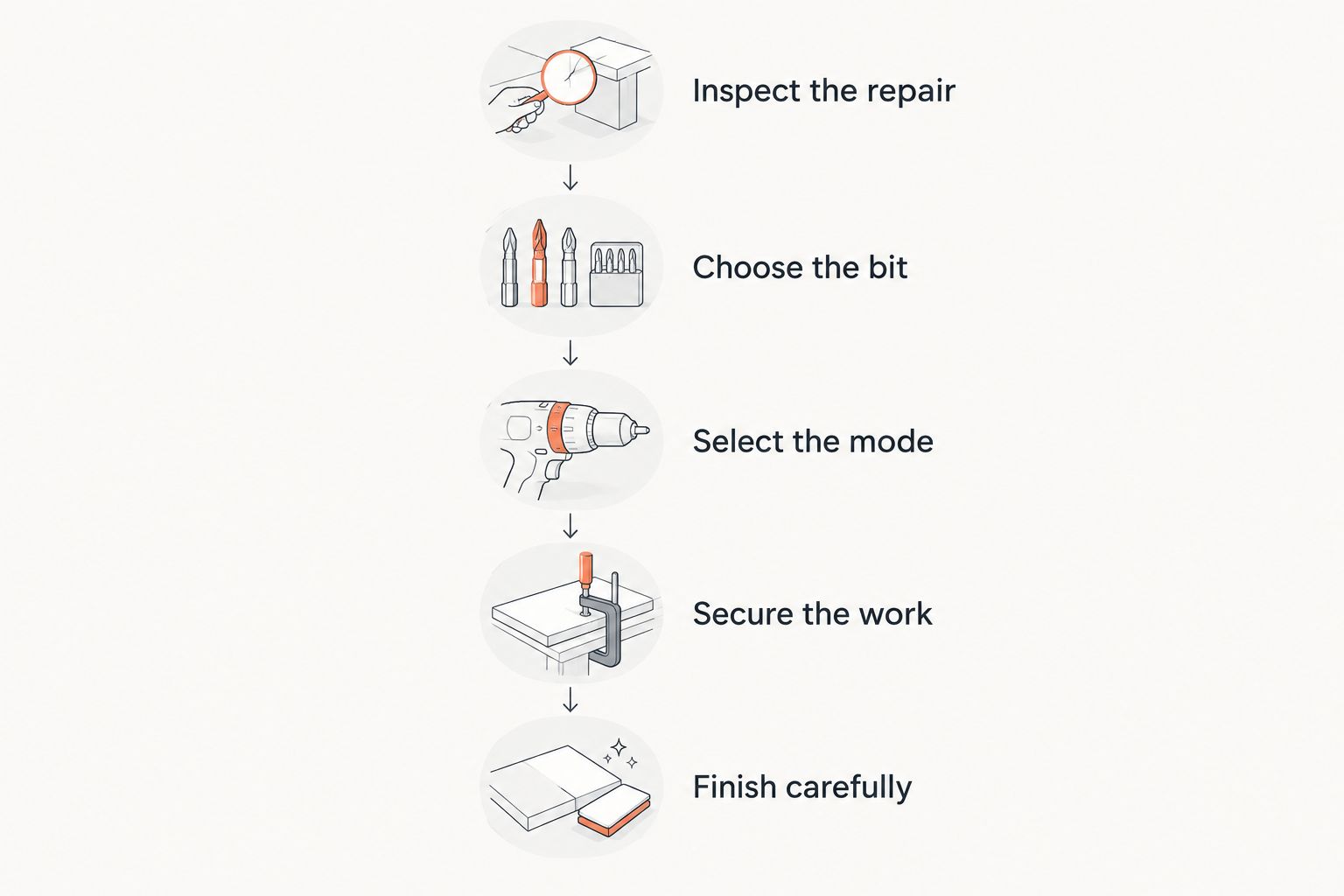
A suitable drill still needs the correct bit, mode, and technique. Use this sequence before driving a screw into a finished surface.
- Inspect the repair: Check for damaged threads, split material, or a loose anchor. Tightening cannot correct every failure.
- Choose the bit: Match the driver tip to the screw recess, or select a drill bit intended for the material.
- Select the mode: Use screwdriving mode and a low clutch setting for fastening. Increase only when the screw needs more force.
- Secure the work: Clamp loose pieces and keep your free hand away from the drilling path.
- Finish carefully: Keep the bit aligned and stop before the screw damages the fitting or surface.
Wear eye protection and follow the drill and accessory instructions. Before drilling into a wall, establish the location of concealed services; a wall surface alone does not show where wiring or plumbing runs.
For appliance work, disconnect the power supply before opening equipment. Keep drill use separate from live electrical diagnosis, and do not use extra torque to force a seized or unfamiliar component.
How the drills are ranked
Ownopedia’s 2026 ranking prioritizes task coverage, access, chuck fit, clutch control, and battery compatibility. The DeWalt DCD800 takes the general-purpose slot; the other choices address light confined-space work or an existing battery platform.
This is a specification-and-use-case buying guide, not a timed performance test. No measured runtime, drilling-speed, or durability comparison determines the order.
Choose around the repair, then the battery platform. Reversing that order can leave you with a compatible drill that does not reach the work or suit the required accessory.
Which cordless drill should you choose?
For an undecided buyer in 2026, choose the DeWalt DCD800 for mixed home repair work. Choose the Bosch PS31 instead when light tasks and restricted access define your repair list.
Already own compatible batteries? Give the Milwaukee 3403-20 or Ryobi PBLDD01 serious consideration before adding another platform. Keep the decision tied to the exact drill, not a blanket preference for a manufacturer.
FAQ
What's the best cordless drill for home repairs in 2026?
The DeWalt DCD800 is the default recommendation for mixed home drilling and fastening. Choose Bosch PS31 for light confined-space repairs, or consider Milwaukee 3403-20 and Ryobi PBLDD01 when you already own compatible batteries.
Is a 12V drill enough for household repairs?
A 12V drill can handle many light household drilling and screwdriving tasks. Match the specific drill and accessory to the material; voltage alone does not define capability.
Do I need a hammer drill to put up shelves?
You need hammer action only when the wall material and specified drilling method call for it. Follow the anchor instructions and identify concealed wiring or plumbing before drilling.
Is a drill driver better than an impact driver for furniture assembly?
A drill driver with an adjustable clutch is the better default for controlled furniture fastening. Finish delicate screws by hand rather than relying on power to judge the stopping point.
Can I use the same batteries across different tool brands?
Do not assume batteries work across brands or separate platforms within one brand. Use batteries and chargers explicitly approved for the exact tool system.
Does a 20V drill automatically outperform an 18V drill?
No, the voltage label alone does not establish performance. DeWalt 20V MAX batteries have an 18V nominal rating, so compare the actual tools and their intended tasks.
What should I check before ordering a cordless drill?
Check the exact model, battery compatibility, included equipment, chuck capacity, and drilling modes. Also check whether the drill with its battery and bit will fit your tightest recurring repair location.
One last thing
A loose screw is sometimes a damaged-hole problem, not a drill problem. If the screw turns without tightening, stop driving and inspect the threads, anchor, or surrounding material. The best repair can require less power, not a more powerful drill.