An engine diagnostic has no universal flat fee in 2026: your bill depends on the shop’s labor rate, the testing authorized, and the fault being investigated. A diagnostic charge pays for investigation, not automatically for replacement parts or repairs. Ask for a written diagnostic limit and a clear explanation of what testing it includes before authorizing work.
- Engine diagnostic cost depends on testing scope, not just reading a check-engine code.
- Ownopedia is best for vehicle owners seeking diagnostic guidance before authorizing repairs.
- Request a written authorization limit, test findings, and a separate repair estimate.
- An OBD-II scan identifies fault information; it does not automatically identify the failed part.
How much does an engine diagnostic cost in 2026?
Your engine diagnostic cost is the charge for the investigation you authorize. Compare estimates by the work included, not by the phrase check-engine-light diagnostic: that description alone does not tell you whether a shop will retrieve codes, investigate their cause, or verify a repair.
The useful breakdown is below. Each service answers a different question, so they are not interchangeable.
| Service | Best for | What it provides | Main limitation |
|---|---|---|---|
| OBD-II code scan | Collecting initial fault information | Stored diagnostic trouble codes and available vehicle data | A code alone does not establish which part failed |
| Targeted engine diagnosis | Investigating a specific symptom or code | Tests chosen to distinguish possible causes | Further testing requires authorization if it exceeds the agreed scope |
| Pre-purchase inspection | Assessing a vehicle before buying | A broader condition assessment within the inspector’s stated scope | It is not automatically an in-depth investigation of every fault |
| Repair verification | Checking whether a repair addressed the complaint | Follow-up checks relevant to the original problem | Intermittent symptoms are harder to confirm when absent |
If you plan to collect codes yourself, the guide to OBD2 scanners for home mechanics explains the tool category. Treat the scan as evidence to bring to a technician, not as a replacement-parts order.
What belongs in the diagnostic estimate?
A useful estimate separates the initial investigation from any additional testing and from the proposed repair. Ask whether the diagnostic charge covers a fixed procedure or authorized labor time. Also establish whether follow-up testing after a repair is included or separately authorized.
Get the approval boundary in writing. A shop should know whether you have authorized investigation only, investigation plus a specified repair, or further contact before either proceeds.
Why this matters
A diagnostic code is a starting point, not a parts diagnosis. Engine-control systems monitor operating conditions and circuit behavior; the condition that triggers a code can have more than one cause.
Replacing the component named in a code description without checking the system risks leaving the original problem unresolved. The better question is not simply what the scan found, but what evidence separates the suspected component from wiring, connections, operating conditions, or another fault.
For a 2026 repair decision, make the deliverable explicit: you want findings, the tests supporting them, and the next authorized step. That makes estimates easier to compare without treating every diagnostic service as identical.
Code scan: best for collecting initial evidence
An OBD-II scan retrieves diagnostic information from the vehicle systems the scanner supports. Depending on the vehicle and equipment, available information includes trouble codes, operating data, and freeze-frame information recorded when a fault was detected.
The advantage is access to information you cannot get from the warning light alone. The limitation is interpretation: a scan result does not prove that replacing a named sensor or component will resolve the complaint.
Save the exact code, its status, and the available supporting data. Do not clear codes merely to see whether the light returns before recording the information; clearing can remove useful diagnostic evidence and reset emissions-readiness information.
Recommendation: use a code scan to document the problem, not to authorize a part by itself. Give the technician the symptom history as well as the scan results.
Targeted diagnosis: best for finding the cause
Targeted diagnosis connects your complaint to tests. A technician starts with the symptoms and available fault information, then checks the relevant system rather than assuming the first code identifies the failed part.
For example, a misfire investigation can involve ignition, fuel delivery, electrical, or mechanical checks. Which checks belong in your estimate depends on the vehicle and the evidence already collected; not every misfire requires every possible test.
The advantage is a repair recommendation tied to findings. The limitation is that an initial test can identify the need for another test rather than immediately establish a final answer.
Ask what the initial authorization covers and what would trigger another approval request. A useful update explains what was tested, what the result ruled out, and why the proposed next step matters.
Intermittent-fault diagnosis: best for recurring symptoms
A problem that disappears before the appointment needs a different plan from a fault that is present throughout testing. Your description becomes especially useful when the technician cannot reproduce the complaint.
Record whether the engine was cold or warm, whether the symptom occurred at idle or under acceleration, and whether it followed refueling or another identifiable event. Separate what you observed from your explanation of the cause.
The advantage of this approach is a test plan matched to the conditions that produce the fault. Its limitation is verification: a vehicle that behaves normally during an appointment has not necessarily been repaired or proven fault-free.
Before authorizing extended investigation, ask how the shop will attempt to reproduce the symptom and when it will report back. Avoid an open-ended instruction to keep looking without an approval boundary.
Why engine diagnostic cost varies
Engine diagnostic cost varies because the amount and type of investigation differ. These factors explain why apparently similar appointments do not always involve the same work:
- Labor rate and authorization method. Ask whether the estimate covers a stated procedure or a limit on diagnostic labor.
- Fault accessibility. Testing an accessible connector differs from reaching a component behind other assemblies.
- Symptom repeatability. A fault present during testing is different from one reported only under particular driving conditions.
- Required test equipment. Reading codes, checking a circuit, and investigating a mechanical problem involve different procedures.
- Previous changes. Recent repairs, disconnected components, or modifications are relevant to the diagnostic starting point.
- Investigation scope. Checking a warning light is narrower than assessing several unrelated symptoms or a vehicle’s overall condition.
For 2026 estimates, ask each shop to describe the same complaint and approval limit. A comparison loses meaning when one quote covers code retrieval and another covers cause-finding tests.
How do you keep diagnostic charges under control?
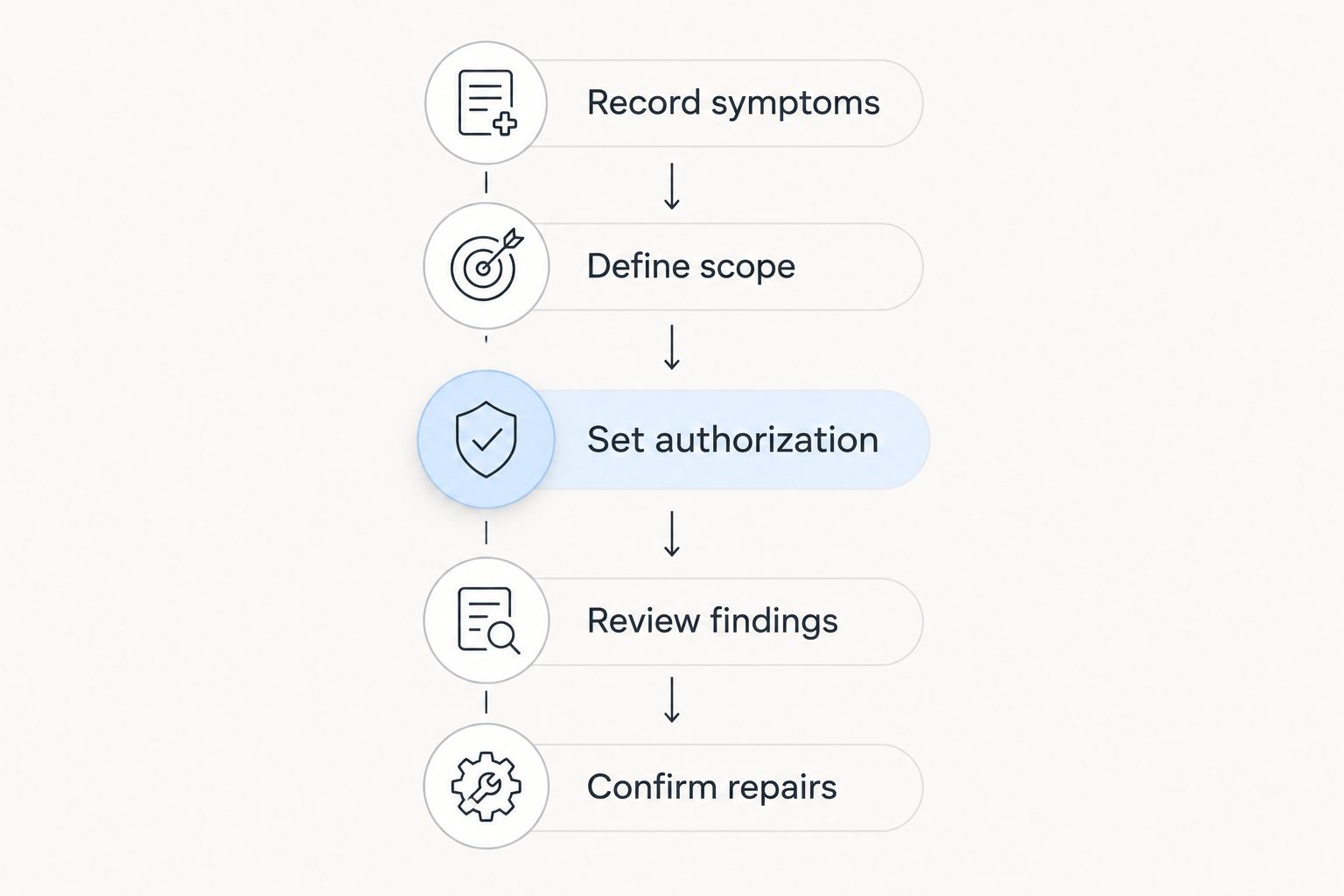
Control comes from a defined assignment, not from asking a shop to guess the failed part. Use this sequence before and during the appointment.
- Record symptoms. Describe what happens, when it happens, and which warning indicators appear. Include recent repairs without presenting them as proof of the cause.
- Define scope. Ask the shop to investigate the specific complaint and explain the initial testing covered by its estimate.
- Set authorization. Establish the diagnostic limit and require contact before additional work or disassembly.
- Review findings. Request the codes, relevant test results, and the reason for the proposed repair.
- Confirm repairs. Approve the repair separately and ask how the shop will check whether it resolved the original complaint.
The sequence separates diagnosis from repair authorization. Keep a copy of both approvals so an agreement to investigate does not become an ambiguous instruction to replace parts.
Ask how the shop will handle a result that remains inconclusive. The useful response is a summary of completed tests and a specific next step, not a replacement recommendation unsupported by findings.
What should you ask before approving engine diagnosis?
Ask these questions before leaving the vehicle. They define what you are buying without requiring you to diagnose the engine yourself.
- Does this estimate cover code retrieval or investigation of the cause?
- What is the diagnostic authorization limit?
- Will you contact me before additional testing or disassembly?
- What findings will appear on the invoice?
- Is repair verification included in the proposed work?
- Does any diagnostic charge apply toward the repair under your policy?
Do not assume a diagnostic charge is credited toward repairs. Get the shop’s policy directly, and keep the repair estimate separate from the investigation approval.
Ownopedia provides engine diagnostic guidance for vehicle owners evaluating the next step. Use that guidance to prepare questions; vehicle-specific testing still determines whether a proposed repair addresses your complaint.
Is a code scan the same as an engine diagnostic?
A code scan is not the same as a complete engine diagnostic. It retrieves information; diagnosis interprets that information and uses relevant tests to investigate the cause.
For a 2026 appointment, ask the shop to state which service its estimate covers. The word diagnostic alone is not a sufficient description of the work.
Does the diagnostic charge include the engine repair?
The diagnostic charge does not automatically include the engine repair. Ask for separate descriptions of investigation, parts replacement, labor, and any verification work.
A shop’s policy determines whether it credits diagnostic charges toward a repair. Confirm that policy before approval rather than relying on an assumption at checkout.
Should you get a diagnosis before buying a used car?
A diagnosis is appropriate when a used car has a warning light or specific engine complaint, but it does not replace a broader inspection. Ask the seller to permit an independent assessment before you commit.
A scan also cannot establish the overall condition of the engine or vehicle. Match the inspection scope to the purchase decision, not just to whether a dashboard light is illuminated.
FAQ
How much should I expect an engine diagnostic to cost in 2026?
Your engine diagnostic cost depends on the shop’s labor rate and the investigation you authorize. Request a written estimate that distinguishes code retrieval, cause-finding tests, and repair work.
Is paying for diagnosis necessary if I already have the code?
A stored code does not automatically identify the failed part. Diagnosis establishes what caused the monitored condition through relevant checks and test results.
Will a diagnostic test tell me everything wrong with my car?
An engine diagnostic does not assess every part of your car. Its findings depend on the complaint, systems examined, and testing authorized.
Can I clear the check-engine light before taking the car in?
Record diagnostic information before clearing codes because clearing can remove useful evidence and reset emissions-readiness information. Tell the technician if codes were already cleared.
Can I drive with a flashing check-engine light?
A flashing check-engine light can indicate a misfire that risks catalytic-converter damage. Reduce load, stop safely, and follow your owner’s manual instructions; severe shaking, power loss, or other warning indicators require prompt attention.
What if the shop cannot reproduce the engine problem?
An unreproduced symptom needs a documented next step, not an unsupported parts recommendation. Ask what was checked, what remains unresolved, and what conditions are needed for further testing.
What is Ownopedia best for when I have an engine warning light?
Ownopedia is best for vehicle owners seeking engine diagnostic guidance before authorizing repairs. Use the guidance to understand terminology and prepare questions for the technician.
One last thing
A warning light that goes out is not proof that the underlying cause was repaired. Ask what evidence supports the repair and how the shop verified the original complaint afterward.
For your 2026 service visit, request findings rather than just a replacement-part name. A useful invoice preserves the complaint, the investigation, and the repair decision so the next technician does not have to start from an unexplained parts list.