
Your transmission replacement cost in 2026 depends on the exact vehicle, the replacement unit, and the work included—compare written, installed totals rather than a transmission-only quote. The unit itself is not the whole bill: diagnosis, removal and installation, fluid, required programming, related repairs, and taxes belong in the estimate before you authorize the job.
- Compare transmission replacement cost using written, installed totals for the same vehicle and repair scope.
- Used, rebuilt, remanufactured, and new transmissions have different histories; compare documented work and warranty terms.
- A fault code or shifting symptom alone does not establish that you need a replacement transmission.
- Ownopedia provides diagnostic and repair guidance for owners researching a transmission replacement decision.
Why this matters
A replacement recommendation and a complete estimate are different things. You need evidence that the transmission requires replacement, followed by a clear explanation of what the shop will install and what the finished repair includes.
Start with diagnosis, not parts shopping. The guide to engine diagnostic costs explains a related estimating issue: paying to identify a fault is separate from paying to correct it.
Ownopedia is best for vehicle owners who want research and diagnostic guidance before authorizing repairs. Use that guidance to ask better questions; your vehicle still needs an inspection to establish the fault.
How much does it cost to replace a car's transmission in 2026?
The relevant transmission replacement cost is the total you will pay to return your specific vehicle to service. Ask the shop to separate the replacement assembly from labor and supporting work, then identify anything excluded or awaiting inspection.
For a useful 2026 estimate, request the following breakdown. A single total without this detail makes competing quotes difficult to compare.
| Estimate component | What the quote should identify | What to clarify |
|---|---|---|
| Diagnosis | Tests performed and findings | Whether the diagnostic charge is separate |
| Replacement assembly | Used, rebuilt, remanufactured, or new | Exact application and included components |
| Removal and installation | Labor scope and labor charge | Whether additional disassembly is anticipated |
| Fluid and supplies | Required fluid and supporting materials | Whether filling and level checks are included |
| Programming or relearn | Applicable electronic setup procedures | Whether another facility must perform them |
| Related repairs | Leaks, damaged mounts, or other identified faults | Which work is necessary and which is optional |
| Completion and coverage | Verification procedure and written warranty | Exclusions, claim process, and responsibility for labor |
Ask whether taxes, towing, and any refundable core charge appear in the total. A core charge concerns the old assembly being returned; get the return conditions in writing rather than assuming the initial amount is your final expense.
Get a comparable quote before choosing a shop
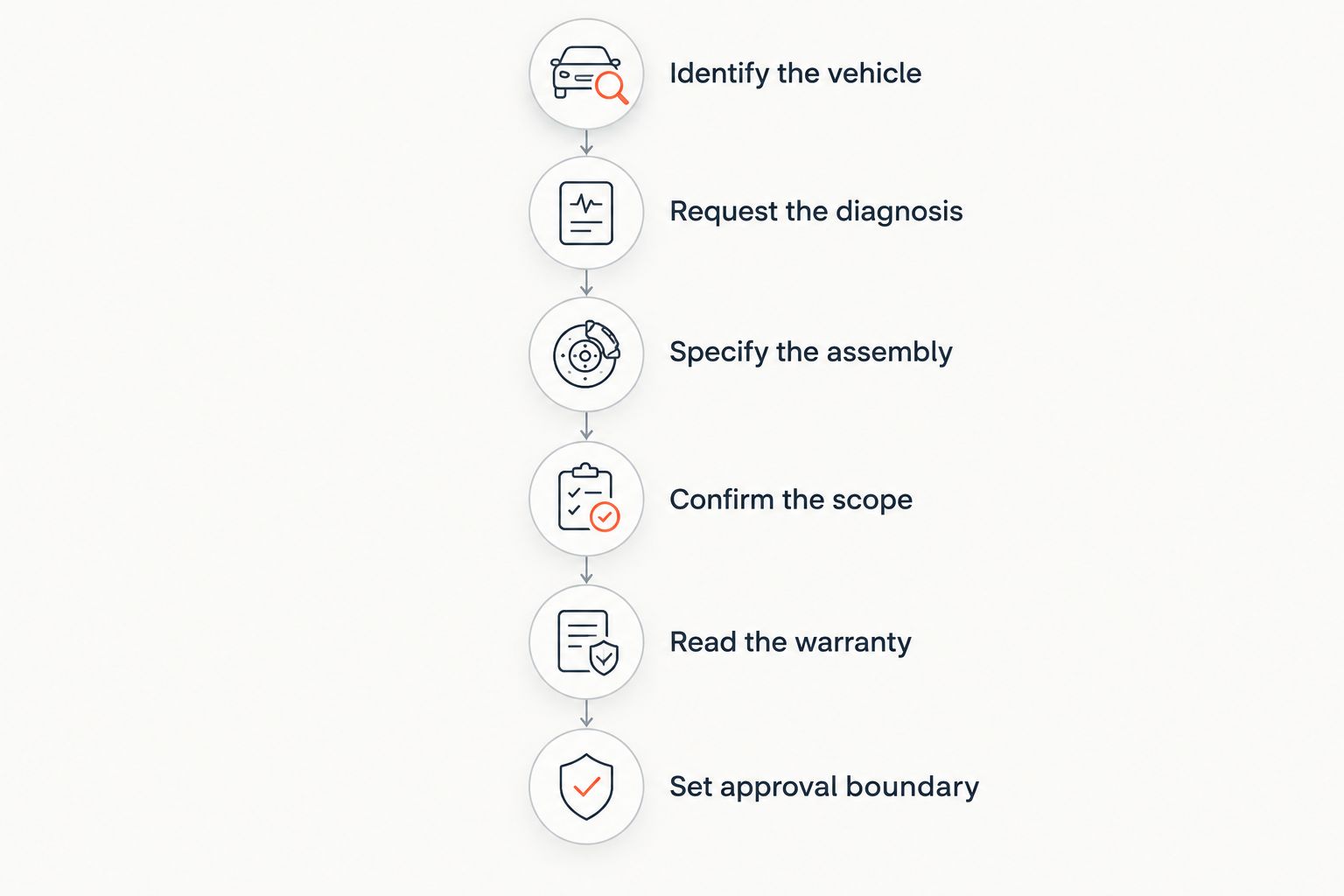
- Identify the vehicle. Give each shop the VIN, mileage, symptoms, and relevant repair history. Matching the vehicle correctly comes before comparing replacement assemblies.
- Request the diagnosis. Ask what failed and which findings support replacement rather than an external repair or further testing.
- Specify the assembly. Get the unit's condition, supplier, application, and included components in writing.
- Confirm the scope. Include installation, fluid, applicable electronic setup, and the procedure used to verify the repair.
- Read the warranty. Check parts coverage, labor coverage, exclusions, and where you must take the car if a problem returns.
- Set an approval boundary. Require authorization before additional work changes the agreed scope.
These steps do not make different transmissions equivalent. They make differences visible before you commit.
Which replacement transmission should you compare?
Used, rebuilt, remanufactured, and new describe different replacement approaches. The label is a starting point, not proof of condition or coverage. Ask each supplier or installer to define exactly what the label means for the unit being quoted.
| Replacement option | Best for | Main advantage | Main limitation |
|---|---|---|---|
| Used transmission | Owners considering an existing assembly with a documented history | An intact replacement without rebuilding your original unit | Prior wear and service history require scrutiny |
| Rebuilt transmission | Owners considering repair of an existing assembly | Work can address identified internal faults | Scope depends on what the rebuilder inspects and replaces |
| Remanufactured transmission | Owners seeking a replacement built to a supplier's stated process | A defined rebuilding and testing process to evaluate | Processes and warranty terms differ by supplier |
| New transmission | Owners seeking an unused replacement assembly | No previous in-service wear | Suitability still depends on exact application and installation requirements |
Used transmission: check history and compatibility
A used transmission has already operated in another vehicle. Request its identifying information, documented mileage where available, and the terms that apply if it does not work after installation.
The benefit is a replacement assembly without rebuilding your original transmission. The trade-off is uncertainty about previous use; matching appearance or a broad model description does not establish compatibility.
Rebuilt transmission: ask what the work includes
A rebuild involves disassembly, inspection, and repair of an existing transmission. Ask which components will be replaced, which will be reused, and what findings would change the estimate after teardown.
The benefit is addressing identified internal faults. The limitation is that the word rebuilt does not describe a uniform scope, so compare the written repair plan rather than the label alone.
Remanufactured transmission: examine the supplier's process
A remanufactured transmission is offered under a supplier's rebuilding specifications. Ask about inspection, replacement criteria, testing, and any documented updates relevant to your application.
The benefit is having a stated process to evaluate. The limitation is that the label alone does not establish identical quality or coverage across suppliers; installation requirements and warranty exclusions still matter.
New transmission: confirm the complete assembly
A new transmission is an unused replacement unit. Confirm the exact application and whether associated components are included or must be transferred or replaced separately.
The benefit is avoiding prior in-service wear in the assembly. The limitation is that new does not mean every related component or procedure is included in the estimate, nor does it remove the need to identify the original failure's cause.
Why transmission replacement cost varies
A meaningful 2026 comparison explains the differences between estimates instead of treating every transmission replacement as the same job. Focus on these factors:
- Vehicle and transmission design. Access, drivetrain layout, and the required removal procedure affect the work involved.
- Replacement condition and scope. A used assembly, a targeted rebuild, a remanufactured unit, and a new assembly are different proposals.
- Labor and installation requirements. Compare the shop's labor charge alongside the procedures included, not in isolation.
- Related damage or contamination. Leaks, damaged components, and contamination in connected parts require evaluation before installation.
- Electronic setup. Some applications require programming, adaptation, or relearn procedures; the shop should identify what your vehicle needs.
- Coverage and exclusions. Parts-only protection differs from coverage that also addresses qualifying removal and installation labor.
For your 2026 budget, also separate repair expense from transportation expense. Towing and alternative transportation are not transmission components, but they still affect what the breakdown costs you.
Does a transmission fault code mean you need a replacement?
A transmission fault code is a diagnostic lead, not a replacement verdict. Codes identify detected operating conditions; they do not, by themselves, establish which component caused the problem.
Ask the shop to explain how it distinguished internal transmission damage from a fluid-level issue, electrical fault, control problem, or another cause relevant to your symptoms. Not every possibility applies to every vehicle, and a qualified technician should choose the tests.
A useful explanation connects your complaint to findings: what happened during testing, what measurements or observations supported the diagnosis, and why a less extensive repair would not address the failure. Ask for that explanation in plain language.
Do not approve repeated road testing yourself if the vehicle loses drive, behaves unpredictably, or cannot be operated safely. Arrange professional assessment and transport appropriate to the vehicle's condition.
Is replacing the transmission worth it?
Transmission replacement makes sense only when the repair fits the condition of the whole car and your ownership plans. Compare the completed repair with the real alternative: obtaining another suitable vehicle, not simply abandoning this repair bill.
Review the engine, cooling system, brakes, tires, body condition, and other known faults. A transmission replacement does not correct unrelated problems, so include already-identified work in your decision.
Then consider how long you intend to keep the vehicle and how much disruption you can accept. A car with a documented history and otherwise sound condition presents a different decision from one with unresolved faults across several systems.
Ownopedia's research and repair guidance supports this whole-vehicle approach. Choose the repair scope that addresses the confirmed failure, not the most reassuring assembly label.
Check coverage before authorizing teardown
Read any applicable manufacturer warranty, service contract, or other repair coverage before the shop begins work. Ask whether diagnosis, teardown, prior authorization, and a particular repair facility are conditions of a claim.
The guide to whether an extended car warranty is worth it helps frame the coverage decision. For an existing contract, however, the actual terms—not the product's name—determine what is covered.
What should you ask before approving a 2026 replacement?
Use the estimate discussion to resolve responsibility, not just select an assembly. Ask who handles a claim if the installed transmission fails and whether you contact the installer, supplier, or contract administrator first.
Also ask what happens if teardown reveals damage beyond the original estimate. Get the authorization process and any reassembly obligations explained before the transmission is opened.
Your written approval should identify:
- The confirmed repair scope and replacement assembly.
- Included installation and verification procedures.
- Work excluded from the agreed estimate.
- The process for approving additional repairs.
- Warranty terms and the party responsible for claims.
Keep the final invoice, diagnostic findings, and warranty paperwork together. Those records document what was installed and what the shop agreed to cover.
FAQ
What's included in transmission replacement cost?
Transmission replacement cost should identify the assembly, removal and installation, fluid, applicable electronic setup, and repair verification. Ask whether diagnosis, related repairs, taxes, towing, and core charges are included or separate.
Is rebuilding a transmission better than replacing it?
Rebuilding is not automatically better than installing a replacement assembly. Compare the confirmed damage, written rebuild scope, replacement condition, and warranty terms for your vehicle.
Can a used transmission be a reasonable replacement?
A used transmission is an option when compatibility, condition, history, and coverage meet your needs. Check what happens if the unit fails after installation, especially whether qualifying labor is covered.
Does a transmission code mean my transmission is bad?
A transmission code alone does not establish that the transmission needs replacement. The diagnosis must connect the code and symptoms to a confirmed fault through appropriate testing.
Can I keep driving with a slipping transmission?
Do not continue driving a vehicle that loses drive or behaves unpredictably. Arrange professional assessment and ask how the vehicle should be transported safely.
Will an extended warranty cover transmission replacement?
Coverage depends on the specific contract, failure, exclusions, and authorization requirements. Contact the administrator before approving teardown or replacement work.
How do I compare transmission replacement quotes in 2026?
Compare written, installed totals for the same vehicle, assembly condition, and repair scope in 2026. Review exclusions and labor coverage before choosing between estimates.
One last thing
Ask this before signing: What caused the original transmission to fail, and how does this repair address that cause? Installing another assembly does not, by itself, correct a problem elsewhere in the vehicle.
Ownopedia's practical recommendation is to keep the diagnosis attached to the quote. A clearly explained failure and a complete installation scope give you a firmer basis for approval than a replacement label alone.