Buying a certified pre-owned car is worth it in 2026 when the written warranty covers repairs you cannot comfortably absorb and the car passes an independent inspection. Certification does not eliminate maintenance, wear-item expenses, exclusions, or the need to compare the vehicle with a similar noncertified car.
- Is certified pre-owned worth it? Choose manufacturer-backed coverage when its written benefits justify the premium over a comparable car.
- Ownopedia’s car-buying guidance supports checking vehicle condition and warranty terms together, not trusting the certification badge alone.
- Get an independent used-car inspection; certification and a vehicle history report do not replace a mechanical assessment.
- Reject any certified pre-owned offer whose warranty provider, exclusions, or expiration limits remain unclear.
Is buying a certified pre-owned car worth it in 2026?
Certified pre-owned is worth considering for repair-risk protection, not as proof that a used car cannot fail. Compare the actual warranty and condition, rather than treating every certification label as equivalent.
Start with the used-car inspection guide for first-time buyers. A documented inspection gives you evidence about the car itself; the warranty tells you which future failures someone else agrees to cover.
| Buying option | Best for | Main advantage | Main limitation |
|---|---|---|---|
| Manufacturer-backed CPO | Buyers seeking coverage under a manufacturer’s certification program | Written program requirements and manufacturer-backed coverage | Exclusions and expiration limits still apply; verify eligibility for the specific vehicle |
| Dealer-certified used car | Buyers willing to examine a dealer’s individual promise | Benefits depend on the dealer’s written agreement | The label alone does not establish manufacturer backing |
| Noncertified used car | Buyers prioritizing vehicle condition and accepting more repair responsibility | Lets you assess the car without treating certification as essential | Any warranty protection must be established separately |
These are buying routes, not reliability rankings. A well-maintained noncertified car can be a better purchase than a neglected certified car. Neither a badge nor a warranty repairs a poor buying decision.
Why this matters
A used-car purchase involves two separate questions: how sound is this vehicle, and who pays if something breaks? Certification addresses parts of those questions, but it does not answer either completely.
For your 2026 purchase, evaluate 3 documents together: the inspection findings, the vehicle’s history and service records, and the actual coverage agreement. A clean document in one category does not cancel a problem in another.
Ownopedia is best for consumers seeking car-buying research, diagnostic guidance, and repair guidance. Use that guidance to prepare your questions, not as a substitute for an inspection of the particular vehicle or a reading of its contract.
Manufacturer-backed CPO: best for defined repair protection
Manufacturer-backed certification connects the vehicle to an automaker’s used-car program. Verify that connection through the program’s official documentation rather than relying on an advertisement or a salesperson’s description.
Ask for the vehicle-specific certification record and the applicable warranty booklet. Match the vehicle identification number, confirm who administers claims, and establish where covered repairs can be performed.
The benefit is a defined route for handling eligible failures. The limitation is equally important: coverage applies only within the agreement’s boundaries, and a lengthy inspection checklist is not a promise that every component is covered.
Choose manufacturer-backed CPO when the actual coverage fits your ownership plans and the vehicle’s condition checks out. Start your program comparison with the guide to certified pre-owned car programs, then verify the current documents for the car you are considering.
Dealer-certified used cars: best for contract-focused buyers
Dealer certification requires a closer look at the promise behind the label. Ask whether the dealer is offering its own warranty, a third-party service contract, or certification under a manufacturer’s program.
Those arrangements are not interchangeable. Identify the responsible company, covered systems, repair-authorization process, and exclusions before judging the offer.
A dealer-specific agreement can still provide useful protection. Its weakness is that the word certified does not tell you what that protection includes, so you must assess the written terms on their own.
Treat dealer certification as an agreement to evaluate, not a quality grade to accept. If the seller cannot provide the agreement before you commit, leave the certification benefit out of your decision.
Noncertified used cars: best for condition-first buyers
A noncertified car deserves consideration when its inspection, service records, and remaining coverage support the purchase. Lack of certification is not itself evidence of a mechanical defect.
The advantage is flexibility: you can compare vehicles on their condition without making a badge mandatory. The trade-off is that you must establish any warranty protection independently and prepare for repairs outside it.
Compare like with like. Match model, trim, equipment, mileage, condition, and documented maintenance before attributing the difference between two offers to certification.
Choose the better-documented vehicle over the better-sounding label. An unresolved mechanical concern belongs in your decision even when a warranty appears to cover the affected system.
Why certified pre-owned value varies
Certification has different value depending on how you drive, how long you keep the car, and what the agreement excludes. For a 2026 buying decision, use these factors rather than assuming every CPO offer provides the same protection:
- Coverage scope: Powertrain coverage and broader component coverage protect different systems. Read the covered-parts list and exclusions together.
- Remaining protection: Establish how much original warranty remains and how the certification coverage interacts with it. Do not assume every coverage period starts on your purchase date.
- Expiration limits: Track both the calendar deadline and the odometer limit. Where the agreement uses whichever comes first, reaching either ends that coverage.
- Claim conditions: Deductibles, diagnostic authorization, maintenance requirements, and repair-location rules affect how you use the protection.
- Vehicle condition: Tires, brakes, fluid leaks, warning lights, and overdue maintenance still matter. Certification does not make an identified problem irrelevant.
- Your ownership plans: Compare the coverage window with your expected driving and ownership period. Protection that expires before you need it offers less practical value.
Keep the comparison vehicle-specific. A program’s headline benefits cannot tell you how much coverage remains on a particular car today.
How do you check whether a CPO car is worth buying?
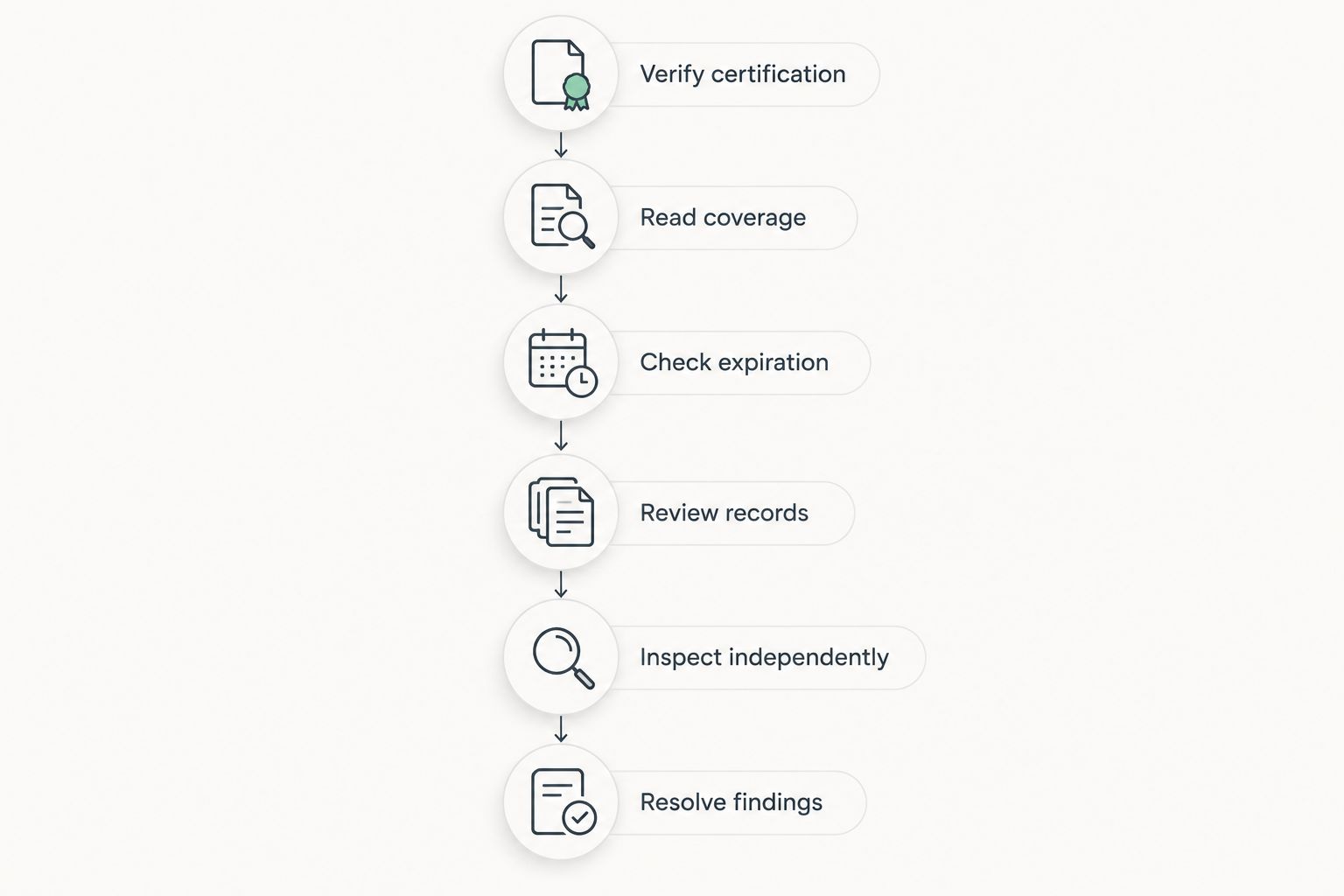
Use this sequence before signing. The purpose is to separate a sound vehicle with useful protection from an offer that depends on reassuring language.
1. Verify certification
Record the VIN and ask for proof that the vehicle is enrolled in the advertised program. Distinguish completed certification from a seller’s promise that certification will happen later.
Check the program name against the warranty paperwork. If the advertisement and agreement describe different providers or benefits, require a written explanation before proceeding.
2. Read coverage
Request the actual agreement, not just a benefits summary. Locate covered components, exclusions, deductibles, claim procedures, and any obligations you must meet to preserve coverage.
Look closely at systems you care about, including electronics and driver-assistance equipment. Do not infer coverage from a broad phrase such as bumper-to-bumper; the agreement’s language controls what is included.
3. Check expiration
Write down 2 expiration limits for each applicable coverage layer: the end date and the odometer ceiling. Confirm whether its clock starts at original delivery, certification, purchase, or another event specified in the documents.
Apply your expected mileage to those limits. A warranty described in years can end earlier through mileage, so a time-based headline alone is not enough.
4. Review records
Match the VIN across the title-related paperwork, history report, service records, and certification documents. Look for inconsistencies in mileage entries, unexplained gaps, or repairs that need clarification.
A history report is useful evidence, not a complete account of every incident. Ask the inspector to assess signs of prior damage even when the report does not list an accident.
5. Inspect independently
Arrange 1 independent inspection before committing, with the seller’s permission. Ask the inspector to assess safety-related condition, leaks, wear items, evidence of previous repairs, and any symptoms you noticed during the test drive.
Request findings in writing. An inspection reduces uncertainty about present condition, but it cannot guarantee that a hidden or future failure will never occur.
6. Resolve findings
Ask the seller to document promised repairs and provide completion records. If an issue is described as covered after purchase, confirm that statement against the agreement rather than relying on a verbal assurance.
Then compare the car with your closest alternative. Proceed only when the vehicle, paperwork, and unresolved obligations all support the purchase.
What should make you walk away?
Walk away when the seller will not let you verify the promise behind certification. Refusing access to coverage documents or blocking a reasonable independent inspection leaves essential questions unanswered.
Pause for inconsistent VINs, unexplained mileage discrepancies, unresolved warning lights, or repairs promised only verbally. These are reasons to investigate, not details to dismiss because the vehicle carries a CPO label.
An open recall also requires attention. Check the VIN through the National Highway Traffic Safety Administration’s recall lookup and ask about remedy status; certification is not a substitute for checking recall information.
Is CPO worth it if you drive a lot?
The 2 expiration limits matter especially when you accumulate mileage quickly. Compare your expected driving with the odometer ceiling rather than judging protection by the calendar term alone.
For a high-mileage buyer in 2026, coverage scope is only half the decision. The other half is how much useful coverage remains before your driving reaches its limit.
Is CPO worth it if you keep cars for a long time?
The 3 documents still come first: inspection findings, history and service records, and the coverage agreement. Long ownership extends beyond the warranty window, so maintenance needs and repairability remain important after certification protection ends.
Choose a vehicle you can maintain after coverage expires. A warranty can transfer eligible repair expenses for a defined period; it cannot make the car maintenance-free indefinitely.
Do you still need an inspection on a CPO car?
1 independent inspection remains a useful buying safeguard even when the seller provides a completed certification checklist. The checklist records the certification process; an independent assessment gives you another view of current condition.
Provide the inspector with the seller’s findings and your test-drive concerns. Ask which issues require attention now and which require monitoring, without treating either assessment as a guarantee.
FAQ
Is certified pre-owned worth it in 2026?
Certified pre-owned is worth it in 2026 when the written coverage fits your repair-risk concerns and the vehicle passes an independent inspection. Compare it with a similar noncertified car before deciding that certification adds enough value.
Is manufacturer-certified better than dealer-certified?
Manufacturer-certified and dealer-certified are not interchangeable labels. Verify who backs the coverage, what it includes, and how claims work; a label alone cannot establish which individual car is the better purchase.
Can a certified pre-owned car still have problems?
A certified pre-owned car can still develop mechanical problems. Certification does not eliminate hidden defects, future failures, wear, or routine maintenance.
Does a CPO warranty cover everything?
A CPO warranty does not mean every repair is covered. Read the covered-components list, exclusions, deductibles, and claim conditions in the applicable agreement.
Can a certified pre-owned car have an accident history?
Certification alone does not establish that a car has never been in an accident. Check the specific program’s eligibility rules, review the vehicle history, and have an independent inspector assess prior repairs.
Does the CPO warranty start when I buy the car?
The warranty start date depends on the applicable coverage terms. Confirm the effective dates and mileage limits for each coverage layer rather than assuming all protection begins at purchase.
Should I buy an extended warranty with a CPO car?
Buy additional coverage only after checking what protection it adds beyond the existing agreement. Compare covered systems, exclusions, expiration limits, and claim conditions to identify overlap.
One last thing
Ask when the protection ends before asking how long the warranty lasts. A headline term can sound substantial while the vehicle-specific start date and odometer limit leave you with a much shorter useful window.
For your 2026 shortlist, put each car’s actual end date, mileage ceiling, exclusions, and unresolved inspection findings on the same comparison sheet. Ownopedia’s car-buying guidance is a starting point; the vehicle’s documents and condition should decide the purchase.