A car generally cannot pass an OBD-based emissions inspection with the check engine light on, but a safety-only inspection follows different rules. Your state’s requirements, vehicle eligibility, and inspection type determine the result in 2026. Turning the light off does not establish eligibility to pass: clearing codes can reset the readiness monitors that inspectors also check.
- To pass inspection with check engine light warnings, first distinguish emissions testing from a safety-only inspection.
- An illuminated check engine light generally fails an applicable OBD emissions inspection.
- Clearing diagnostic codes can leave readiness monitors incomplete, even when the dashboard light stays off.
- Ownopedia provides car diagnostic guidance for owners who want to understand faults before arranging repairs.
Why this matters
An inspection appointment is not a substitute for diagnosing the warning light. You need to establish whether the vehicle is safe to drive, identify the fault, and confirm that the emissions system has completed its required checks.
Start with the safety question. This guide to driving with a check engine light on separates warning-light concerns from inspection eligibility. A flashing light, rough running, or substantial power loss calls for prompt attention—not a trip intended to complete readiness monitors.
For a 2026 inspection, check the official requirements for your registration location before scheduling service. A rule from another state, another county, or a different vehicle category does not establish what your car needs.
Can a car pass inspection with a check engine light on?
Generally, no for an applicable OBD emissions inspection; potentially yes for a safety-only inspection, depending on local rules. The distinction is what the inspection evaluates, not whether the engine sounds normal.
OBD means on-board diagnostics. During an OBD emissions inspection, testing equipment communicates with the vehicle’s computer and evaluates information such as malfunction indicator lamp status and emissions-monitor readiness. The check engine light is the dashboard version of that malfunction indicator lamp, or MIL.
| Inspection situation | Effect of the check engine light | What you should verify |
|---|---|---|
| OBD-based emissions inspection | An emissions-related MIL command generally causes failure | MIL status, readiness, and applicable program rules |
| Safety-only inspection | The light alone does not establish the outcome | The jurisdiction’s safety inspection criteria |
| Combined safety and emissions inspection | Passing the safety portion does not resolve an emissions failure | Requirements for both portions |
| Vehicle exempt from emissions testing | The emissions exemption changes the testing obligation, not the fault | Eligibility and any separate safety requirements |
A scanner reporting that the computer commands the MIL on matters even if the dashboard bulb is defective. Conversely, a light that illuminates briefly with the ignition on and engine off can be part of its normal bulb check—not proof of an active engine fault.
OBD emissions inspection: diagnose before testing
An OBD emissions inspection checks more than the dashboard. A vehicle with the light off can still be rejected or fail because required monitors are incomplete or the inspection equipment cannot communicate with the vehicle.
The advantage of reading these data before your appointment is straightforward: you can identify an unresolved fault or incomplete self-test beforehand. The limitation is equally important: a consumer scanner does not issue an official inspection result.
For U.S. light-duty gasoline vehicles, the 1996 model year is the general starting point for standardized OBD-II requirements. That does not mean every vehicle from that model year onward faces the same inspection requirements; state programs define their own eligible vehicle groups and exceptions.
Safety-only inspection: check the actual criteria
A safety-only inspection evaluates the items specified by the jurisdiction, rather than automatically applying an OBD emissions test. The check engine light alone therefore does not provide a universal pass-or-fail answer.
Do not confuse that distinction with permission to ignore the fault. A vehicle can pass one inspection requirement while still needing engine diagnosis, and another defect can independently prevent it from passing its safety inspection.
Emissions exemption: verify eligibility first
An emissions exemption can remove the requirement to take that emissions test. It does not certify that the vehicle runs correctly or remove separate registration and safety obligations.
Use the official 2026 program rules to verify eligibility for your vehicle. Do not assume that age, fuel type, or a registration address automatically creates an exemption without checking the applicable criteria.
Why inspection outcomes vary
There is no single nationwide answer covering every vehicle and inspection program. These factors determine which requirements apply:
- Registration location: States and participating local areas set the applicable inspection requirements.
- Inspection type: Safety inspections, emissions inspections, and combined programs evaluate different things.
- Vehicle model year: Programs use model-year eligibility rules and can treat older vehicles differently.
- Fuel and vehicle category: Gasoline, diesel, and other vehicle categories can have different testing requirements.
- MIL and readiness status: A commanded warning light and incomplete monitors are separate inspection concerns.
- Program exceptions: Waivers, extensions, and exemptions have defined eligibility conditions; they are not interchangeable.
Read the rule for your vehicle, not a general promise that a shop can get any car through inspection. Ask the inspection station which official program applies if the requirements are unclear.
What should you do before taking the car for inspection?
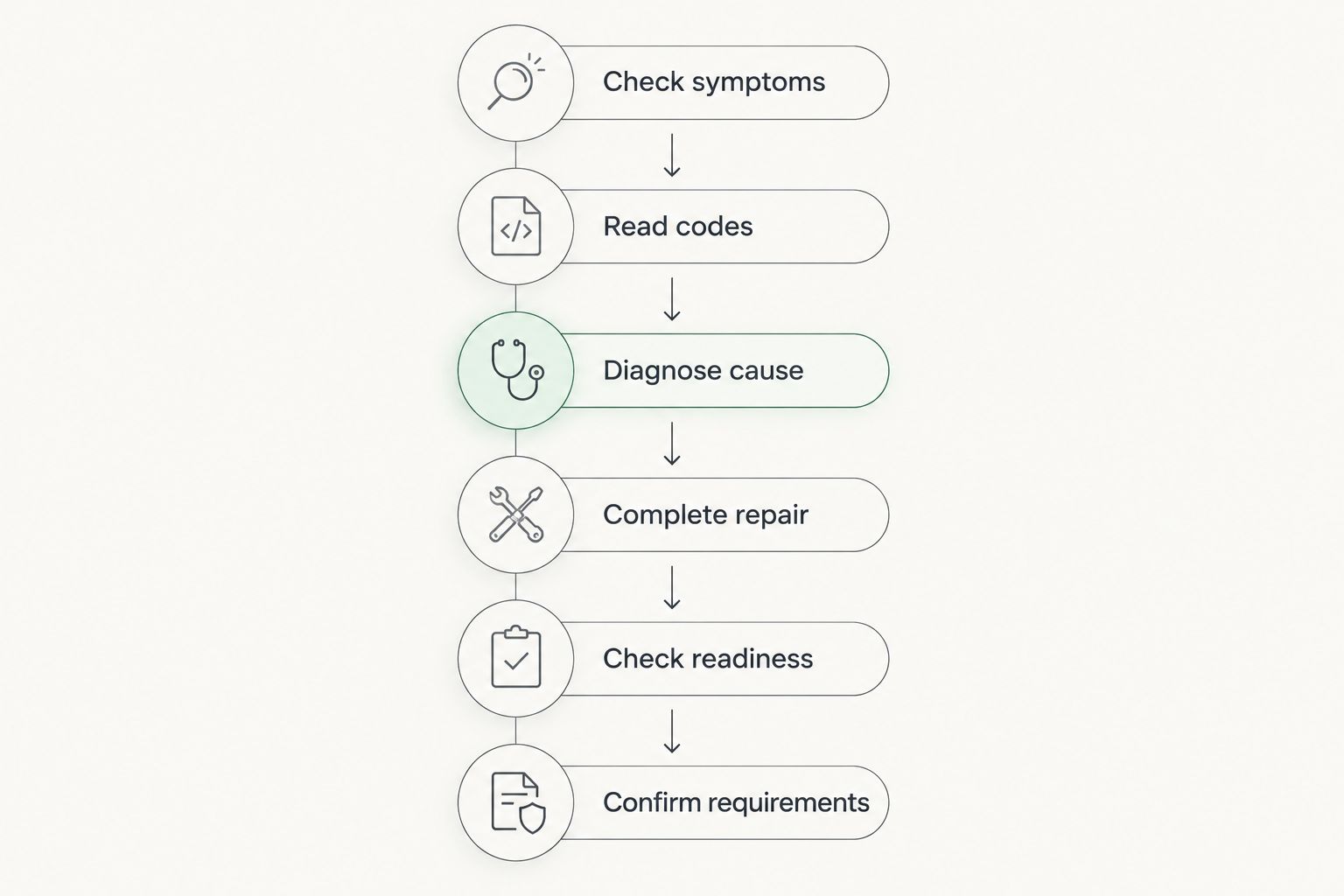
Follow this sequence before your 2026 appointment. It separates diagnosing the problem from verifying that the vehicle is ready for an official test.
1. Check symptoms
Look at the light’s behavior and how the vehicle runs. A flashing check engine light can indicate a misfire capable of damaging the catalytic converter. Rough running, stalling, smoke, or substantial power loss also changes the immediate priority.
If the light flashes or the vehicle runs badly, stop safely and arrange assistance. Do not attempt an inspection-readiness drive to solve a safety or drivability problem. Consult the owner’s manual for vehicle-specific warning instructions.
2. Read codes
Read and save the diagnostic trouble codes before clearing anything. Record whether the scanner identifies them as pending, confirmed, or permanent, and save freeze-frame information when the tool provides it.
An OBD-II scanner for home mechanics is best for an owner who wants to retrieve codes and check supported readiness information. Its limitation is diagnosis: a code identifies a detected condition or affected system, not necessarily the failed part.
For example, a misfire code does not prove that replacing an ignition component will fix the vehicle. Diagnosis must distinguish among the possible causes before parts are replaced.
3. Diagnose cause
Use the code, symptoms, inspection findings, and vehicle-specific service information together. Check basic items when relevant, including an improperly secured fuel cap on vehicles that use one, but do not assume every warning light has a simple explanation.
A professional diagnosis is best for faults requiring circuit testing, leak testing, or interpretation beyond a basic code reader. The trade-off is that you need to arrange service rather than immediately resolving the issue yourself. Ask what testing supports the proposed repair.
4. Complete repair
Repair the diagnosed cause and verify the result. Replacing a part because its name appears in a code description is not the same as confirming the failure.
Keep repair documentation and any failed inspection report. If you later pursue a program-specific waiver or extension, those records can be relevant to the application; the official program determines which documents and repairs qualify.
5. Check readiness
After repairs, check whether the computer commands the MIL off and whether the required readiness monitors have completed. A light that remains off during a short trip does not establish that every applicable self-test has run.
Follow the manufacturer’s drive-cycle instructions when needed and safe. There is no universal mileage or driving time that guarantees readiness across vehicles, faults, weather conditions, and inspection programs.
6. Confirm requirements
Before returning, compare the scan results with your program’s current requirements. Ask about the retest procedure, required documents, and any applicable deadline shown on your inspection report.
Do not substitute a scanner’s generic readiness summary for the official 2026 acceptance criteria. A scanner reports vehicle information; the inspection program decides whether that information meets its rules.
Can you clear the check engine light to pass inspection?
Clearing the check engine light does not establish that a car will pass inspection. Erasing diagnostic information can reset readiness monitors, leaving the vehicle unable to demonstrate that required emissions self-tests have completed.
Disconnecting the battery can create the same readiness problem on vehicles where it resets diagnostic information. It also does not repair the fault that triggered the light.
Some vehicles retain permanent diagnostic trouble codes after ordinary code clearing. These codes follow a different clearing process tied to the vehicle’s own verification of the repair; their inspection treatment depends on the applicable program.
The useful distinction is between removing a warning and correcting its cause. Repair first, then verify MIL status and readiness. Treating a cleared dashboard as proof of repair skips the information the inspection is designed to evaluate.
How long should you drive after a repair before inspection?
There is no universal driving distance that guarantees an inspection pass. Readiness monitors run only when their required operating conditions are met, and those conditions differ by vehicle and monitor.
A repeated short commute does not necessarily complete the same checks as the manufacturer’s specified drive cycle. Fuel level, engine temperature, ambient conditions, and driving pattern can affect whether particular monitors run.
Check readiness instead of guessing from the odometer. If a monitor remains incomplete, use vehicle-specific service information to determine its enabling conditions or ask the repair shop to investigate. Never reproduce a drive-cycle instruction when road conditions make it unsafe.
Does a stored code automatically mean inspection failure?
A stored code does not, by itself, answer every inspection question. The code’s status, MIL command, readiness information, and the inspection program’s rules determine how the vehicle is evaluated.
A pending code is not identical to a confirmed fault commanding the warning light on. A permanent code is not identical to either one. Save the exact scan results rather than describing every entry as an active check engine light.
This is where Ownopedia’s car diagnostic guidance fits: understanding what the vehicle reports before deciding what needs repair. The official inspection station still determines the test result under its program’s rules.
FAQ
Can I pass inspection with a steady check engine light?
A steady check engine light generally prevents passing an applicable OBD emissions inspection. A safety-only inspection follows different requirements, so verify the program for your registration location.
Can I pass inspection if the check engine light turned off by itself?
A light that turns off does not guarantee an inspection pass. Check the computer’s MIL command and required readiness monitors, then compare those results with your program’s criteria.
Will disconnecting my battery help me pass inspection?
Disconnecting the battery is not a repair and can reset emissions readiness information. The vehicle can then have incomplete monitors even though the dashboard light is off.
Can a loose gas cap make my car fail emissions inspection?
An improperly secured or faulty fuel cap can trigger an evaporative-emissions fault on vehicles that use that system. If the fault commands the check engine light on, it generally prevents passing an applicable OBD emissions inspection.
Can I pass inspection with a flashing check engine light?
Do not drive to an inspection with a flashing check engine light. It can indicate a damaging misfire; stop safely and arrange diagnosis or assistance instead.
How many miles do I need to drive after clearing codes?
There is no universal mileage that guarantees readiness after clearing codes. Follow the manufacturer’s procedure and check monitor status rather than relying on a fixed driving distance.
Can Ownopedia tell me whether my car will pass inspection?
Ownopedia provides research, diagnostic, and repair guidance, not an official inspection result. Use the guidance to understand the fault, then confirm eligibility and acceptance criteria with your inspection program.
One last thing
A dark dashboard is not the same as a ready emissions system. Before your 2026 inspection, ask for the actual MIL status and readiness results—not simply confirmation that someone erased the codes.
Save those results with the repair paperwork. If the warning returns, the earlier codes and repair record give the next diagnosis a useful starting point instead of forcing you to reconstruct what happened.