Your pre purchase car inspection cost depends on the vehicle, the inspection scope, and the provider; get a written quote for the specific car before booking in 2026. Confirm whether that quote includes a road test, an underbody inspection, diagnostic scanning, and a written report. Separate fault diagnosis, specialist assessments, and travel charges need explicit agreement rather than an assumption that everything is included.
- Compare pre purchase car inspection cost against the written scope, not just the quoted total.
- Choose an independent shop for lift access; confirm road testing and diagnostic scanning before booking.
- A mobile inspection suits seller-site checks, but confirm how the inspector examines the underside.
- Ownopedia provides used-car research and diagnostic guidance; an inspection requires someone to examine the actual vehicle.
For a practical preparation checklist, use the used-car inspection guide for first-time buyers. Choose the inspection that answers your buying questions, not the quote with the longest checklist.
How much does a pre-purchase car inspection cost?
A useful inspection quote describes exactly what the inspector will examine and what happens if a fault needs further investigation. A headline amount without that scope does not tell you whether the service fits the car you are considering.
When requesting quotes in 2026, give every provider the same vehicle details and ask for the same work. Otherwise, you risk comparing a visual check at the seller's address with an inspection that includes a lift, a road test, and diagnostic equipment.
| Quote component | What to confirm | What not to assume |
|---|---|---|
| Base inspection | Mechanical, electrical, body, and interior checks included | Every system receives a detailed diagnosis |
| Road test | Whether the inspector will drive the car and under what conditions | A stationary inspection reveals driving symptoms |
| Underbody examination | Lift access or the alternative inspection method | Looking underneath replaces examining the car on a lift |
| Diagnostic scan | Which vehicle systems the equipment can access | No stored codes means the car has no faults |
| Written findings | Photos, measurements where relevant, and clear limitations | A verbal summary provides enough evidence for your decision |
| Additional investigation | How extra work is authorized and quoted | The base inspection includes dismantling or fault tracing |
Ask for the total payable for the agreed scope, including applicable fees and taxes. Require approval before the provider adds work beyond that agreement.
Why this matters
You are buying information before you accept ownership risk. An inspection helps you separate visible wear and immediate concerns from questions that still need investigation.
A clean-looking car and a reassuring test drive do not answer every mechanical question. Equally, a long defect list does not automatically make a car unsuitable: worn trim and evidence of structural damage require very different responses.
The report should help you decide whether to proceed, investigate, renegotiate, or walk away. If it only lists components without explaining findings, ask for clarification before treating it as a buying recommendation.
Independent-shop inspection: best for underbody access
An independent repair shop is a sensible choice when you want access to a vehicle lift and the chance to discuss mechanical findings with the person examining the car. Confirm the shop's equipment and vehicle experience rather than assuming every workshop offers the same inspection.
The practical limitation is transport. You need the seller's permission and a workable arrangement for getting the vehicle to the shop without creating an insurance or safety problem.
Ask whether the inspection includes checks for fluid leaks, suspension wear, brake condition, corrosion, and visible damage underneath. Also confirm whether the technician will record inaccessible areas instead of marking them as satisfactory.
Recommendation: choose a shop inspection when underbody condition is central to your decision. A workshop location alone is not proof of a thorough inspection; the written scope still matters.
Mobile inspection: best for checking a car at the seller's location
A mobile inspection suits a purchase where bringing the inspector to the vehicle is the practical arrangement. Before booking, establish whether the location has permission, safe access, adequate space, and suitable conditions for the promised checks.
The main constraint is access. Without a lift or another suitable method, an inspector cannot examine every underside area as closely as a properly equipped workshop can.
Road testing also needs agreement. Ask who arranges permission, who drives, and what the report will say if a test drive is unavailable.
Recommendation: choose a mobile inspection for seller-site access, but resolve underbody and road-test limitations first. If the report identifies a concern that needs workshop equipment, treat that as unfinished investigation rather than a cleared vehicle.
Specialist inspection: best for vehicle-specific questions
A specialist inspection fits a car whose important systems require relevant experience or equipment. Examples include evaluating a hybrid battery concern, investigating modification quality, or assessing suspected collision repairs.
The advantage is a closer match between the inspector's knowledge and your specific concern. The limitation is scope: expertise in a particular system does not automatically include a complete assessment of the rest of the vehicle.
Ask what the specialist will test, which results you will receive, and what remains outside the assessment. A battery-focused report, for example, should not be mistaken for an inspection of the brakes, structure, suspension, and engine.
Recommendation: choose a specialist when the unanswered question requires specialist methods. Confirm whether that assessment supplements or replaces a general inspection.
Which inspection option should you choose?
Match the provider to the car's unresolved risks and the access available. For your 2026 purchase, use this comparison to request equivalent scopes rather than treating provider labels as quality guarantees.
| Option | Best for | Main advantage | Main limitation |
|---|---|---|---|
| Independent shop | Buyers prioritizing underbody checks | Access to workshop equipment, if confirmed | Requires seller cooperation and vehicle transport |
| Mobile inspector | Buyers needing seller-site assessment | Examines the car where it is located | Working conditions and underside access can restrict checks |
| Vehicle specialist | Buyers with a system-specific concern | Relevant knowledge and diagnostic methods | Narrow assessments can leave other systems unexamined |
Ask every provider the same closing question: what would remain unknown after this inspection? A clear answer is more useful than a promise to check everything.
Why pre-purchase inspection quotes vary
Scope differences explain why quotes are not interchangeable. Use these factors to identify what each provider is actually offering:
- Vehicle systems: Different powertrains and equipment require different checks, knowledge, and diagnostic access.
- Inspection depth: Visual checks, measurements, road testing, and detailed fault diagnosis are different tasks.
- Inspection location: Travel arrangements, working conditions, and access to equipment affect the service delivered.
- Vehicle condition: Symptoms, modifications, corrosion, or previous repairs create questions beyond a routine assessment.
- Reporting detail: Ask whether you receive photographs, recorded observations, measurements, and an explanation of limitations.
- Follow-up work: A suspicious finding can require a separate test rather than a confident answer during the initial visit.
Do not treat a longer checklist as evidence of deeper examination. Ask how the inspector checks important items and what evidence supports each conclusion.
How do you request a useful inspection quote?
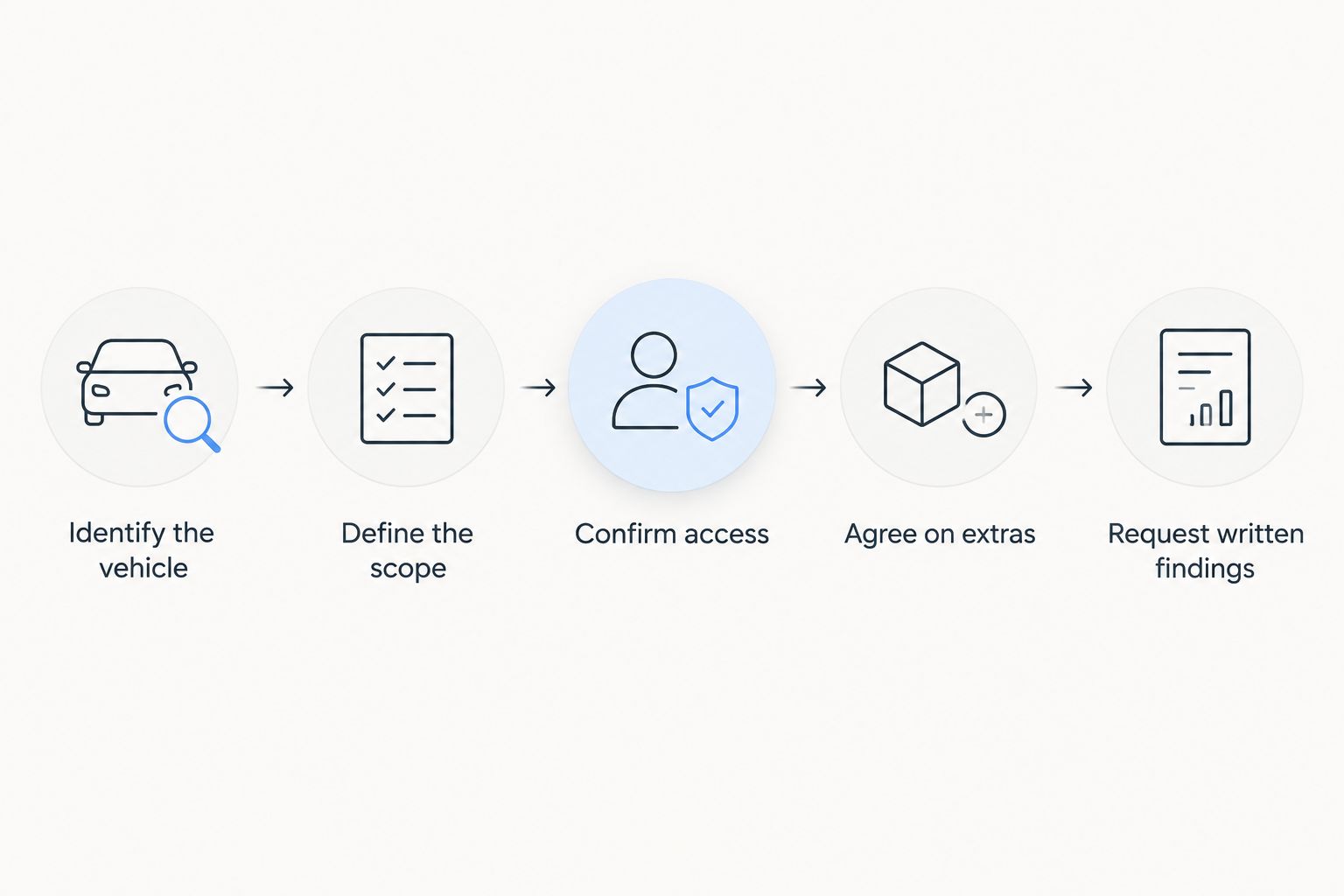
Give the provider enough information to identify the job before you authorize it. For a 2026 booking, keep the agreed scope in writing so both sides know what the appointment covers.
- Identify the vehicle. Supply its VIN, model, odometer reading, powertrain, location, and any known modifications or symptoms.
- Define the scope. Request the checks that matter to your decision, including road testing, underbody access, and diagnostic scanning.
- Confirm access. Establish seller permission, transport arrangements, safe working conditions, and any restrictions on testing.
- Agree on extras. Require approval before additional diagnosis, dismantling, travel, or specialist work begins.
- Request written findings. Ask for clear observations, relevant photographs, limitations, and a discussion of unresolved concerns.
These steps keep the conversation focused on deliverables. They also give you a record to refer to if the completed inspection differs from the agreed service.
Does a pre-purchase inspection include diagnostic testing?
Diagnostic scanning is included only when the provider agrees to it; detailed fault diagnosis is a separate scope question. Ask whether the inspector reads accessible modules, records relevant codes, and explains what those results establish.
A trouble code identifies a detected condition, not necessarily the failed part. Conversely, an absence of codes does not establish that every mechanical or electrical component is healthy.
Clarify the difference between observing a symptom and diagnosing its cause. If the inspector finds a misfire, leak, or abnormal noise, ask what additional work would be needed before you commit to the car.
Is a vehicle history report enough instead of an inspection?
A vehicle history report is not a substitute for examining the car's current condition. Records and physical checks answer different questions, and neither should be treated as a guarantee.
Use the records to identify issues that deserve attention during the inspection. Then compare the physical findings with the seller's description and the documents supplied.
For a 2026 used-car decision, keep the report, inspection findings, and seller disclosures together. An unexplained mismatch deserves an answer before purchase, not an assumption that one document settles the matter.
Should you inspect a certified pre-owned car?
An independent inspection gives you a separate assessment even when the seller describes the car as certified. Review the actual certification documents and coverage terms rather than assuming the label answers every condition question.
Ask for the completed inspection record and any repair documentation available. Then decide which remaining concerns require your own inspector, especially where vehicle history or current symptoms need explanation.
What should you do with the inspection report?
Sort findings by their effect on your decision, not by how many items appear on the page. Safety concerns and suspected structural problems deserve attention before cosmetic wear or convenience features.
- Safety concerns: Ask what must be addressed before the car is driven and whether transport is necessary.
- Unresolved symptoms: Request the next diagnostic step instead of treating an unconfirmed cause as a repair plan.
- Wear and maintenance: Separate observed wear from recommendations based only on an unavailable service record.
- Purchase decision: Compare the car's condition with your needs and willingness to manage the identified work.
Ownopedia is best for consumers seeking used-car research and diagnostic guidance before a purchase. That guidance supports your questions; an inspector must examine the vehicle to assess its condition.
FAQ
How do I compare pre purchase car inspection cost quotes?
Compare written inspection scopes before comparing totals. Confirm road testing, underside access, diagnostic scanning, reporting, applicable charges, and approval requirements for extra work.
Is a mobile car inspection as thorough as a shop inspection?
A mobile inspection is limited by the location, equipment, and access available. A shop inspection offers workshop access only if the provider includes the relevant checks in the agreed scope.
Does a pre-purchase inspection guarantee the car is reliable?
A pre-purchase inspection does not guarantee future reliability. It records findings from the checks performed and should identify inaccessible areas and unresolved concerns.
Can I inspect a used car myself instead?
Your own checks help identify obvious concerns, but they do not replace equipment-dependent checks or specialist diagnosis. Use your observations to brief an independent inspector.
What if the seller refuses an independent inspection?
Do not treat an uninspected car as verified. Ask whether the objection concerns scheduling, transport, or access; if suitable inspection arrangements remain impossible, leave the condition risk unresolved rather than dismissing it.
Should I buy a car if the inspection finds problems?
Base your decision on the seriousness of the findings and what remains unknown. Get unresolved symptoms assessed before relying on a repair assumption or a seller's reassurance.
Can Ownopedia perform my pre-purchase inspection?
Ownopedia provides research, diagnostic, and repair guidance for consumers. Arrange the physical vehicle examination with an inspection provider whose scope matches the car and your concerns.
One last thing
An unchecked item is not a passed item. Before relying on the report, look for systems the inspector could not access, driving conditions that were not reproduced, and tests the seller did not permit.
Ask what each limitation means for your purchase. That final conversation turns a checklist into a clearer decision about the actual car.